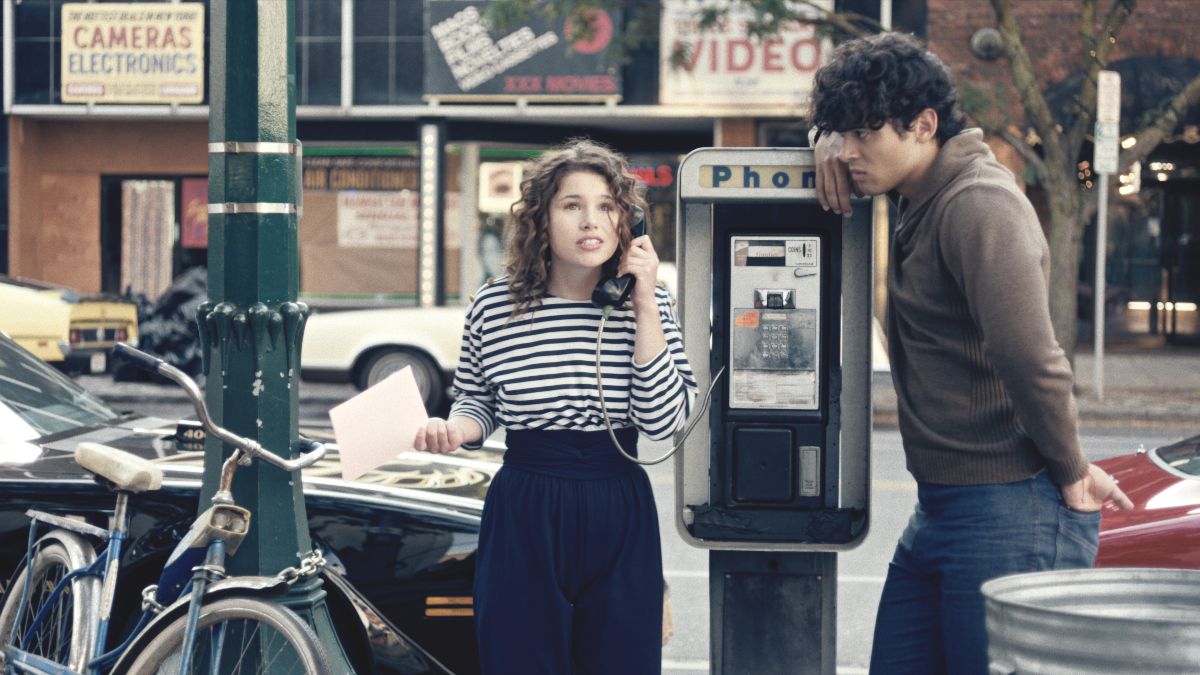
Michael Walker’s The Legend of Juan Jose Mundo takes place in 1984, and it could easily have been a hit in 1984. That’s how true the movie is to the spirit and heart of 1980s cinema. Walker cites John Hughes as one of his influences, and this movie feels in many ways like the little brother of a John Hughes film. It’s not that iconic, but it’s got potential.
The film takes its title from the name of the Spanish exchange student that New York high schooler Julie Gornick (played with the right balance of sass and confusion by Anna Mirodin) is hosting for the summer. Everyone, and that includes Julie, seems to be in love with Juan Jose Mundo. The movie is based on a true story of sorts; according to the media kit provided to press, Walker and co-writer Susan Gomes—who’s also his wife—fictionalized the plot not from one specific anecdote, but a whole bunch of them. Susan actually attended White Plains High School, there really was a Spanish exchange student who charmed many of the girls, and various scenes are based on moments that happened. All of this gives the film an authenticity that can’t be manufactured. But it’s Walker and Gomes’ script that really makes the difference. Yes, the source material may be true, but it still has to be adapted into something that works.
Different filmmakers would’ve sensationalized a lot of what happens in this movie. There’s certainly plenty of potential for over-the-top sex jokes and exaggerated characters. But the biggest way The Legend of Juan Jose Mundo stays true to its period is in its heart. Even in the plot’s more exaggerated moments (instead of a school dance, there’s a talent show), the movie itself remains grounded. Underneath the sarcastic attitude, Julie and her best friend Suzanne Weiss (played by Hannah Kepple) feel like real people. Their feelings are taken seriously; this isn’t just a flimsy teenage romantic comedy without care or consequences. The real arc isn’t Julie falling in love with Juan; it’s how this whole experience highlights how she judges her self-worth by how attractive she is to guys, and how she ought to love herself more. And by the end of the movie, it feels like she has a full character arc—even if some of that development is told rather than shown. (Watch all the way to the end, as Walker keeps another great ’80s gimmick, the Animal House-esque epilogue.)
The movie never seems mean-spirited. There are a handful of instances where something is offensive or ridiculous by 2026 standards—something that Walker freely acknowledges in the press notes—but in 1984, it would have seemed less so. One example is a subplot about racism; one of Julie’s classmates, Amy, is getting grief from seemingly every adult because her boyfriend Perry happens to be Black. It doesn’t matter that he’s a good guy or valedictorian of their class. Amy’s boss thinks he must be “bothering” her at work, and both sets of parents are openly hostile. This attitude thankfully doesn’t make sense in 2026. But within the world of Juan Jose Mundo, Amy, Julie and Suzanne can only scoff at the racism. All of the adult characters in the film are honestly one-dimensional, although that fits with the general vibe of 1980s teen movies, in which many times the adults were just there to be comic relief and/or move the plot along.
The Legend of Juan Jose Mundo takes place over a ten-day period, so there’s a fair amount of skipping to the next day or the next banter-y set piece. But 1980s movies were much more about the feeling they evoked than connecting all the plot points flawlessly; remember, this is the decade that gave audiences Mannequin. Alexandro Byrd, in his feature film debut, has the charisma to live up to the movie’s title. If viewers can’t understand why every girl is falling over Juan, there is no film. But Byrd’s performance is earnestly charming, keeping his character from seeming like an opportunist with great hair. He and Morodin have chemistry, yet more in an almost big sister, little brother kind of way. These are protagonists that the audience can relate to.
The movie also captures the decade stylistically; the brightly colored opening title sequence to the tune of “I Want Candy” makes it very clear from go what this movie is going to be. Cinematographer Kristy Tully and production designer Annie Simeone deserve particular credit for creating the visual aesthetic, between the muted colors of a 1980s movie on-screen and the wardrobe and set dressing that pulls audiences back into the period. Those would be the first things any movie buff would nitpick, but this film gets the details right. Ultimately, though, The Legend of Juan Jose Mundo succeeds because it brings back that ’80s vibe of characters and movies that just wanted to have fun and dream big. This one doesn’t have the emotional impact of a John Hughes movie, but it reminds viewers how special that decade was. It might prompt a Hughes movie marathon afterward.
Photo Credit: Courtesy of Pango Films.
Article content is (c)2020-2026 Brittany Frederick and may not be excerpted or reproduced without express written permission by the author. Follow me on Twitter at @BFTVTwtr and on Instagram at @BFTVGram. For story pitches, contact me at tvbrittanyf@yahoo.com.