Beast is one of the most exciting indie films in a while, and the reason why it compels that visceral reaction is Daniel MacPherson. MacPherson’s work as Patton James is not only incredibly entertaining to watch, but it’s impressive as a reminder of how much an actor brings to a role. MacPherson delivers a knockout, emotionally and technically, and that’s what gives Beast its heart.
The movie works because it’s fundamentally sound—it knows exactly what its purpose is and doesn’t try to be anything else. Viewers can predict the basic plot points and character types of Beast just by reading the synopsis. It would be a massive letdown to ask moviegoers to invest in a comeback story only to pull the rug out from under them at the end. They want to see the hero reclaim his throne. But the creative team understands something that’s been overlooked for a while: not every project has to be novel; it just has to be done well. And Beast is a cinematic comeback story done very well. It satisfies every expectation that the audience has going into the theater.
What elevates the film from good to great, though, is the casting of MacPherson at its core. Every memorable sports underdog story requires a hero that the audience can embrace. From Rudy to Remember the Titans, the success of the film rides on the fans getting behind the hero’s journey. MacPherson checks all the necessary boxes to make Patton James a winning character: he’s tough, he’s charismatic, he can be funny. But what he does that many actors in his position don’t is that he gives Beast genuine emotional depth. So often movies in this subgenre focus on the journey, with the great character moments ultimately coming second to getting to the finish line. Beast provides more character moments, and those moments exist because of the layers inherent in MacPherson’s performance. It’s obvious that he’s sinking his teeth into the role, and that commitment propels the film.
FIGHT OF A CHAMPION

The first few minutes of Beast establish a baseline: this is Patton James at his best. That’s where the movie has to start; the audience has to see Patton as a contender in order to believe he can reach the top of the proverbial mountain again. The character gets a near-complete hero’s introduction, with a rousing pep talk from his longtime trainer Sammy and the roar of the crowd as he enters the arena. All that’s missing is seeing the pinnacle of his fighting career (but we’ll get back to that creative omission later).
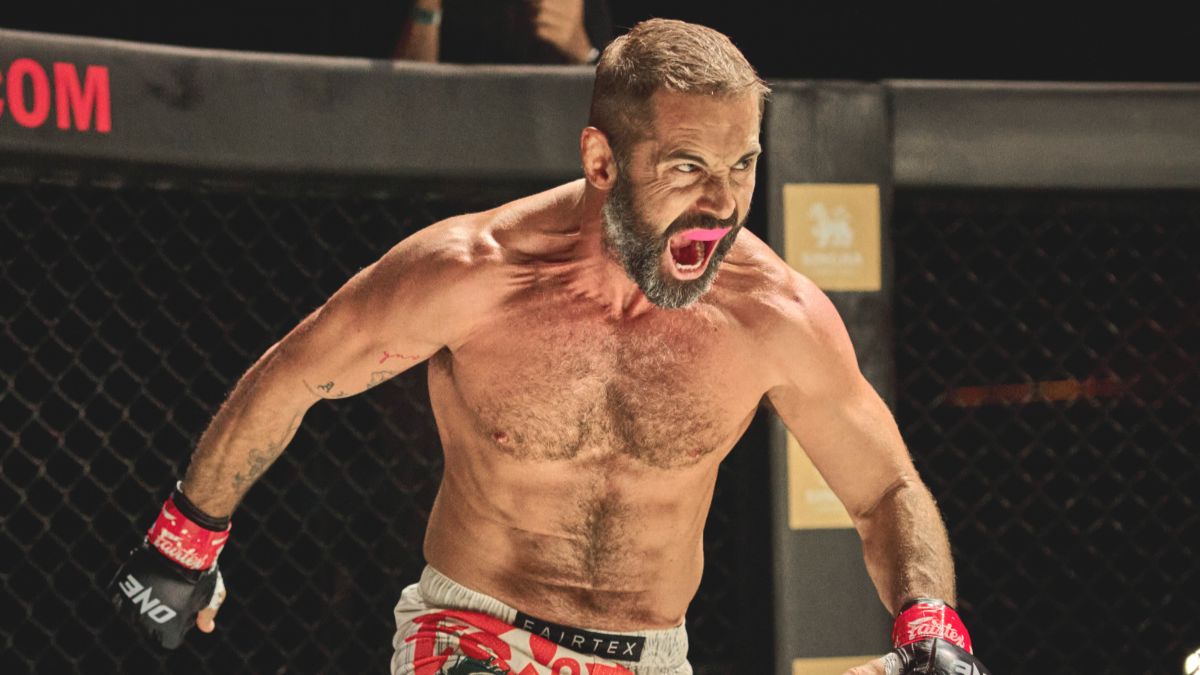
Beast serves up all the fight action that movie fans are looking for. Any film about combat sports had better deliver when it comes to those scenes, and this one gets them mostly right. When MacPherson is asked to step onto the training mat or into the cage, he’s physically believable as someone who’s supposed to have been one of the best. He fulfills the hyperbole that those opening moments put forward. He’s a very smart choice for the part, given those three seasons of Strike Back where he and his colleagues were pushed to their physical limits on a regular basis. Anyone who can lead that show is a certified badass for life. And Beast is the first time since then that it feels like MacPherson has been pushed that hard again.
When it comes to the physicality of the role, that creates a certain irony that makes Patton a more effective character than most in this genre. His grit is never in doubt, but Beast never makes anything look too easy just because he’s supposed to be a great fighter. Instead, it seems to dwell on how much effort MacPherson is putting in. Even the training sequences, which could be just the means to an inevitable end, are a little bit painful to watch because it’s clear how hard he’s working. The actor’s journey informs the character as both of them are rising to the challenge. And because of that, Patton is more real and relatable.
But make no mistake about it: it’s easy to find someone who can play tough, it’s much harder to find someone who actually embodies tough. MacPherson has the same quality that made Daniel Craig so great as James Bond: he can portray toughness and confidence, but he makes it feel like it isn’t an act. He doesn’t have to prove to the audience that Patton James is a warrior, because he has that innate strength in his screen presence. Because of his credibility as a performer, the viewer buys quickly into Patton’s journey—and that’s when Beast really takes off.
THE EMOTIONAL BATTLE

MacPherson’s performance provides Beast the emotional throughline that it needs to differentiate itself from other films in the genre. There are plenty of great sports movies with underdog stories, both true and fictional, such as the undervalued Glory Road with fantastic work from Josh Lucas and Derek Luke. But because audiences come for the sports—the big game, the last match, the climactic play—the character development doesn’t always hit the mark. It sometimes has to bend around the plot. But MacPherson is so emotionally present in Beast that he keeps the emotion at the forefront for the audience as well.
It’s a very interesting choice by co-writers David Frigerio and Russell Crowe to keep some of Patton’s most obvious moments off the screen. There are a few expected scenes, like Patton mourning the death of his brother Malon at the hands of his nemesis, or Patton’s marriage to Luciana being strained when he decides to return to fighting. Again, Beast isn’t trying to pretend it doesn’t know what it’s doing. But Frigerio and Crowe skip over several other instances where they could’ve played up the drama. The movie doesn’t show Patton’s infamous six-second knockout of Xavier Grau that serves as Grau’s main motivation, or the bar fight that torpedoed Patton’s career and landed him in prison—even through flashbacks. Those are two huge moments that would’ve been easy sells for different filmmakers. But instead of handing viewers that emotion on a silver platter, Crowe and Frigerio rely on MacPherson to carry it. Maybe that’s because they know he can.
Moviegoers don’t need to see Patton’s initial knockout of Xavier because MacPherson’s already established Patton’s persona in those opening minutes. A very quick victory isn’t going to tell them anything character-wise that they don’t already know. And as for his fall from grace, that comes out in MacPherson’s performance when Patton tries to bury the hatchet with Sammy ten years later. As he attempts to explain himself, the audience can hear the emotion in his voice and see it all over his face. The mutual respect between MacPherson and Crowe—who’ve worked together previously—also gives this pivotal moment more credibility that it wouldn’t have in anyone else’s hands. Because the actors are on the same page, that makes it even more believable that Patton is so determined to repair his relationship with Sammy.
Beast thrives in the moments of Daniel MacPherson’s vulnerability. In a sport that’s about physical strength, and even in the world in general, emotional vulnerability is often taken as weakness. Athletes are still often ridiculed for being publicly vulnerable. It’s refreshing to see Beast go against that grain and spend more time on Patton’s emotional arc than just what’s necessary to complete the hero’s journey. Of course he’s going to be torn between his fight and his family; of course he’s going to doubt himself; of course there will be a moment when he hits rock bottom. Those things are par for the narrative course. But Beast lingers in some of those moments, which it can do because MacPherson can bring those emotions even in scenes that don’t explicitly ask him to do so.
One of the best examples comes early on, when Luci tells Patton that she’s expecting their second child. This is good news—but when Patton hugs his wife, the camera holds on the true worry in MacPherson’s eyes. He doesn’t have to say anything to convey that anxiety and self-doubt. At any given moment, the audience can look at him and know exactly what Patton is feeling; there’s an emotional rawness to his performance. It gives Beast an energy that makes the movie seem alive even in its quiet moments. The fight scenes, in turn, feel like payoffs for that emotion—instead of everything else feeling like filler between the fight scenes. The film seems to be taking its cue from MacPherson, following him as his heart keeps Patton moving forward, no matter what.
Patton James isn’t the hero of Beast because he overcomes his vulnerability; he’s a hero because he’s vulnerable. Frigerio, Crowe, director Tyler Atkins and MacPherson come into a space that’s all about toughness and pushing through pain—and show that toughness can also come from embracing that pain and emotion. It’s clear from the jump that Patton is going to win that second fight against Xavier; what the audience questions is how he’s going to complete the personal journey to get there. It’s satisfying to see him win, but it’s equally satisfying to know what that means for him on an emotional level, which makes up for the movie’s freeze-frame ending. It’s important that Patton is now champion for the sake of avenging Malon, but the audience doesn’t have to know if he’s going to defend his title or retire again on the spot. What Beast is actually about is Patton James getting back to being Patton James, and that’s what creates the emotional release the audience feels at the end.
Beast is a win for indie filmmaking, because it’s great to see a movie that is just a well-done picture without any pretentions, gimmicks or unneeded plot twists. It’s easy as movie fans to get caught up in the next big thing, especially when we see so many films. But as in sports, the fundamentals are underappreciated. This movie does everything it ought to do and avoids anything it doesn’t need. Yet its biggest pleasure comes from watching Daniel MacPherson and the confluence between actor and character. He’s a remarkably talented star, but this goes beyond talent to just being a human experience. There’s something special about seeing a performer giving everything they have to any role, and it’s because of that commitment that Patton James comes alive. If Beast is about heart, MacPherson exemplifies it.
Beast is now available digitally and on demand. Photo Credit: Courtesy of Lionsgate.
Article content is (c)2020-2026 Brittany Frederick and may not be excerpted or reproduced without express written permission by the author. Follow me on Twitter at @BFTVTwtr and on Instagram at @BFTVGram. For story pitches, contact me at tvbrittanyf@yahoo.com.