SPOILER ALERT: The following contains spoilers for American Hostage Season 1, Episode 1 and Episode 2.
From the jump, American Hostage throws MGM+ viewers for a loop. The tongue-in-cheek on-screen text makes clear this isn’t going to be another “based on a true story” crime drama, and thank heaven for that. Instead, Shawn Ryan and Eileen Myers deftly navigate multiple tones with the help of an experienced cast led by the peerless Jon Hamm.
TV shows based on podcasts have become a recent trend, especially in true crime, where there’s no shortage of podcasts. But Ryan, who is also the showrunner behind The Night Agent and one of TV’s great writers, comes together with Myers and actor-director Adam Arkin to make American Hostage feel as if it’s completely original. That happens in a lot of ways: it’s the sense of humor that runs through the first two episodes, it’s knowing when to pull back the humor, it’s the creative visual style that pays tribute to the 1970s setting, and it’s dialogue that is immediately quotable. What could have been melodramatic and rote is sparkling and live.
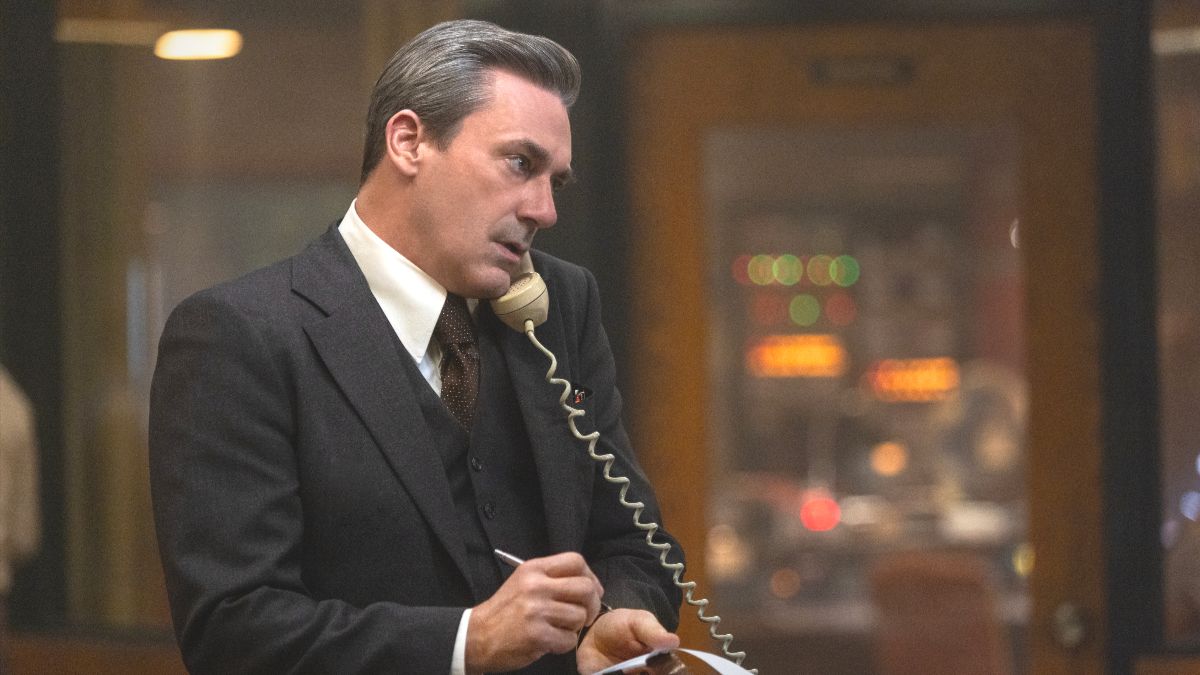
Hamm fits the role of Indianapolis news director Fred Heckman like a glove. Aside from having the perfect voice for radio, he can do the deadpan kind of comedy that happens early and often in American Hostage, but he can also bring home the seriousness that still needs to exist. This is a wonderful contrast to his other current role in Your Friends and Neighbors; both are fun characters, but Fred is the anchor of this hostage situation, rather than an instigator like Andrew Cooper. At times, he feels like the only voice of reason, including the local police chief (played by an absolutely rollicking Mark McKinney, with lines like threatening to throw one of his officers down a well) and a quartet of squabbling lawyers.

On the flip side, there’s something of an acting masterclass going on between The Offer alum Giovanni Ribisi and Kristoffer Polaha. It’s fun to see the latter do something completely different from the Hallmark movies he’s well known for, and impressive how much he can convey while physically limited as the titular hostage. Polaha has fairly limited dialogue in the first episode, and yet viewers can still feel how confused and scared Dick Hall is. Conversely, Ribisi keeps himself up at eleven for most of Episode 1 and Episode 2; it’s a wonder he’s not exhausted with how manic Tony Kiritsis is and how much dialogue he’s asked to deliver. Ribisi immediately makes Tony feel different from the usual “unhinged hostage-taker” archetype, because while he may be scattered, there’s a sincerity to his performance.
Ryan and Myers make sure every character, no matter how minor, has something to do. There’s a depth to their scripts that just isn’t found in most TV shows, and their writing is incredibly smart—both in the sense of being witty and in the economy of plot. They don’t hit the audience over the head with the show being set in the 1970s or make any winks to the audience about how dated something now is. They don’t forget that while certain things are hilarious, this is still a story about a man’s life being on the line. The best example of this is the extended outdoor sequence, when Tony forces Dick to walk through the streets of Indianapolis. It’s funny to see the cops try to follow, and the shots are positively beautiful. But then there is a genuinely heartbreaking moment when a local pastor tries to intervene, and a genuinely terrifying one when the duo slip on ice with the shotgun between them. For all the verve in American Hostage, Myers and Ryan still land punches, often when the audience least expects it.
On a purely entertainment level, it’s also rewarding to watch actors whom the audience knows doing things that they don’t expect. The series also includes Mirelle Enos (The Killing), William Jackson Harper (The Good Place), and Adam Arkin (The West Wing) pulling double duty as both director and one of the aforementioned lawyers. This is a cast of veterans, and all that experience is obvious in their performances. They can find the subtleties in the scripts; they can shift tone effortlessly, sometimes in the same scene. And it’s not just the actors who are aces; Arkin shoots scenes from some wonderful angles, and the score from longtime Ryan collaborator Robert Duncan (The Unit, The Chicago Code) is beautiful because unlike almost every other TV series, the music never intrudes into the plot and doesn’t become a giant spoiler.
American Hostage is the latest show to premiere with two back-to-back episodes, a growing trend that deserves to be encouraged. So much of premieres, particularly series premiere, is backstory. By serving up the first two episodes of this show simultaneously, the creative team is able to give that first-look audience a more substantive taste of the story. Episode 1 has plenty of drama and laughter, but it’s by Episode 2 that viewers understand the full picture and truly get to know both Dick and Tony. The American Hostage premiere is a buffet of the things that make television great—the writing, the acting, the directing, and the composing. It makes the podcast seem pedestrian, and proves that true crime doesn’t have to follow the same overdone formula.
American Hostage airs Sundays at 9:00 p.m. ET/PT on MGM+. Photo Credit: Courtesy of MGM+.
Article content is (c)2020-2026 Brittany Frederick and may not be excerpted or reproduced without express written permission by the author. Follow me on Twitter at @BFTVTwtr and on Instagram at @BFTVGram. For story pitches, contact me at tvbrittanyf@yahoo.com.