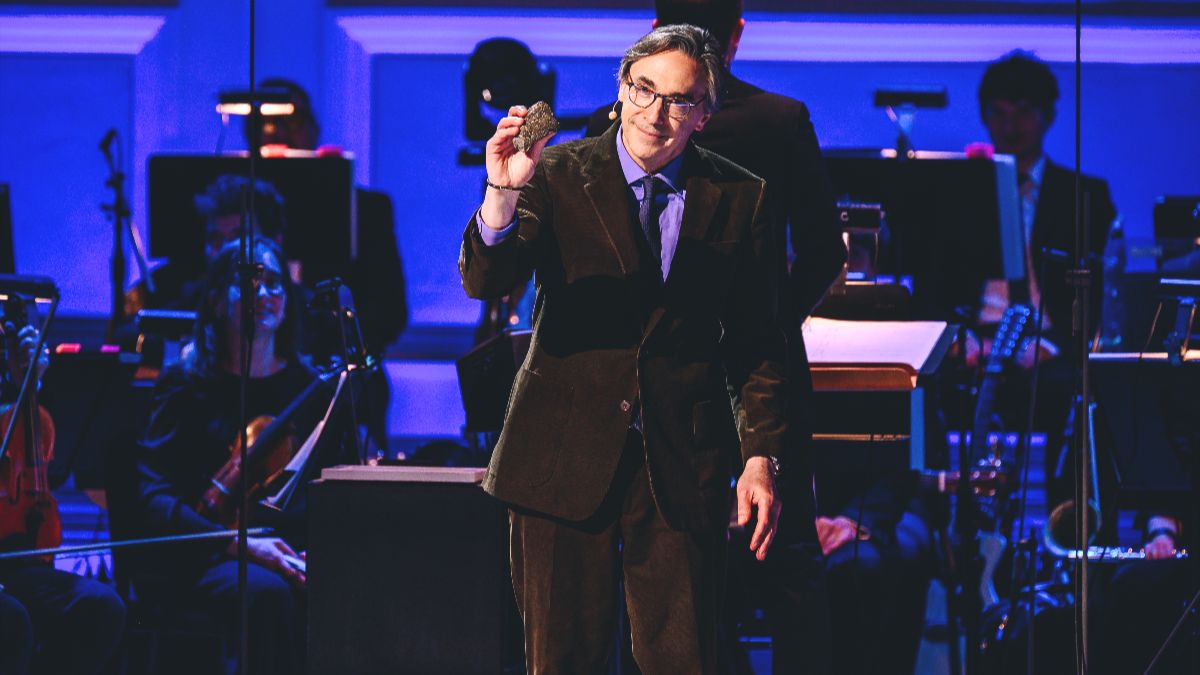
The Space Race was America’s most epic adventure, and historian John Monsky captures that excitement in We Chose to Go to the Moon, a live theatrical experience showcased on PBS. Monsky, Tony Award-winning Broadway director Michael Mayer (Spring Awakening), a cast of stars and a live orchestra don’t just retell this important period in history; they make it feel like it’s happening in the room.
Yet how exactly were they able to assemble this unique experience? And what was it like to go through the creative process? TVBrittanyF.com spoke to Monsky to get his insights on the production, and understand what makes it so magical. Viewers can watch (or rewatch!) the special again on demand through PBS.org and the PBS app.
Brittany Frederick: We Chose to Go to the Moon is the most unique way of telling the story of the Space Race. But what makes it stand out to you from previous documentaries and scripted projects? What did you want to add to the discussion?
John Monsky: We tried to pick up—almost like tying your shoelaces together—the key veins [of the story], and one of them is the ’60s and the change that’s going on in the ’60s. People ignore and miss the fact that deeply impacted the astronauts. They were not immune to it. We pick that up not only through the music, but also through their stories. Some of them had deep connections to Vietnam that we miss. So we’re picking up the whole period—not just the music from the period, but their stories from the period.
The other thing is the families. A lot of times people tell this from a technical point of view, or they tell it from science point of view. Mark Armstrong worked with me on this quite intensely. [He’s] the son of Neil [and Neil’s] granddaughter Kali you’ll also see on stage in this production. They blow it away with a song they do that Mark wrote about his dad, and you see this through the eyes of Neil and [his first wife] Janet as a couple. So there are a number of angles that came together as we were developing this.
I saw Apollo 17 take off as a kid, so that was a kind of emotional moment for me, and I wanted to dig into that. How did that Saturn V rocket get there? Who made it get there? And the stories of the families, because for me it was an experience with my family.
We Chose to the Moon is referred to as a “living documentary,” because of the theatrical experience. What are some of the moments where you felt that you were particularly able to take advantage of that?
There are two pivotal moments in the show. One is the landing, which the six Broadway performers do like I’ve never seen done before. You can listen to the tape of [the astronauts] coming down, and Armstrong said at the beginning, we don’t have enough fuel. He was worried about fuel. In the show, you see the drama of Mission Control, and each of the performers is taking a different part of that dramatic landing. You see the fuel gage and the altimeter, and it’s riveting every time. Every time I was on stage, I was nervous that they were going to crash—and they did land with, at least from Mission Control’s perspective, just 17 seconds of fuel. Capturing some of that edge of the knife that we don’t remember anymore is, I think, important to understand the sacrifices and the risks that were taken to pull this off.
I was really excited as we I was writing the script to see how this would be done by Broadway performers. Not just cutting the film from Mission Control… They get it on stage in a way that makes you feel like you are not listening to it, but you’re sitting in the control room. It’s a big difference. And when you watch the film, I think people see that.
There’s an incredible amount of Broadway talent involved in the project. What was it like working with this group of actors?
They had connectivity to it in one way or another. Liz Gillies, who plays Janet Armstrong, just knocks it out of the park so much so that Mark said, “I thought you were my mother.”She really captures Janet Armstrong, and you cannot capture Neil without capturing Janet. They were a team. And then you pick up Brett Comer, who plays Dave Scott, unbelievable.
Taylor Louderman plays Poppy Northcutt, and people don’t know enough about Poppy Northcutt. She was the first woman in Mission Control. She’s 25 years old. They don’t know what to do with her, and she’s not sure what she’s doing there, because it’s so shocking to all these men that she’s there. And you hear her story, and she says you know, it was awkward. They were training the camera on me, but you get over it, and you do your part, and then more women will follow. It’s amazing, the whole story she tells. And you’re watching this, and then at the very end of the production, Poppy Northcutt stands up in the audience.
The whole audience, there’s tears in their eyes, and then the camera comes up close to Taylor, and you can see the tears of this professional Broadway actor rolling down her cheeks. It was infectious, telling the story of Poppy and having Poppy there in the audience. I like to say when we do these productions, we’re telling history but also making history, and we were making history with Poppy and that moment.
The other piece of making history is when we get to the end of the first act. It’s the story of the Apollo 1 fire, and we lost three astronauts on the launch pad with that fire: [Gus] Grissom, [Ed] White, and [Roger] Chaffee. Most people tell that story from the launch pad. What happened at that launch pad? Why did that fire go on? What was the spark that happened? The terrible moment where the astronauts are trying to get the hatch open and beating on the door and trying to get out. But then we take you to another scene, entirely different. [It’s] five, six o’clock in Houston, and you hear the story—which is from their memoirs—of each of the astronauts’ wives. The actors are playing them and telling what it was like when they got that knock on the door.
The first knock on the door was wives of astronauts in the neighborhood who were just sent over there and didn’t know why they were going over there, but they knew it was bad. These were all veteran families; they knew it couldn’t be good. And then the knock on the door comes from the NASA astronaut or official, and they tell that whole story—going back to tell the kids that their father is dead. The last of the three is Martha Chaffee, and she says after the funeral, she slept next to his burial flag, his coffin flag, because it was the last thing closest to him.
That gave me the thought that I should get all three flags there for Carnegie Hall to honor these astronauts. It was really important from my perspective because the crew was not buried together. Two were buried at Arlington, one at West Point. We dropped all three flags from the balcony. You hear “Sound of Silence” being sung as those flags are dropped, and it’s history telling history, but [also] history happening, because that crew had not been together since the fire.

There’s also off-stage talent, with Michael Mayer directing after having made so much Broadway history of his own. How would you describe his contributions to We Chose to Go to the Moon?
Brilliant is the first word. I spend a year writing these scripts, and then he interacts and does really unique things with them, and he pulls it all together. The respect of the actors, the dramatists, the writers, the creators, all flows to him. Just one example of how he can, in a flash of a moment, come up with amazing work, is the landing. I worked very hard on [it], and the actors were doing really great.
There was a speech prepared for [President Richard] Nixon in the event they crashed, because Frank Borman, who was working on the Apollo 11 mission [and] who was liaison with the White House, said you guys should get ready. There’s a chance they’re just going to crash, and then they’ll be stuck on the moon… We had that speech, and the way I put the script out was to read that speech after or before the landing. What Michael did is he cut the speech up, and it’s interspersed in the landing sequence. It’s riveting the way it worked out. Things like that happened in rehearsal the whole way through. He’s an incredible person to work with.
What’s really heartwarming to me is all of the talent on this show… how bonded they are to telling the story. They really cared about what we were telling, because we need to renew our history. We have these wonderful events and these wonderful role models, but it doesn’t do us any good if we don’t go back to the well and remember them.
Are there any other particular aspects of the production or moments in We Chose to Go to the Moon that you want to draw audiences’ attention to?
The other thing about the show is the music itself. “Space Oddity,” the way that’s done with the footage of Ed White’s spacewalk in the background, and the way they syncopate. When you hear Bowie say, “I’m sitting in a tin can” and you look at the Ed White spacewalk, he’s virtually coming out of a tin can. There’s a Supremes song from 1970 called “Up the Ladder to the Roof” that Joy Woods does like nobody does. And then you get an incredible performance of “Life on Mars.”
But probably the moment that’s going to stir people the most is when Mark Armstrong and Kali get up and do a song that he wrote called “Flight of Fancy,” and you really won’t see that anywhere else. If you watch it just for that moment, then that’s fine because it’ll steal your heart.
It’s important to note that this is just one of a series. American History Unbound has several productions commissioned under the Carnegie Hall Presents banner. For people who watch We Chose to Go to the Moon and want to learn more, where would you point them next?
There is streaming on the PBS app the production I did about F. Scott Fitzgerald in World War I [American Heart in WWI: A Carnegie Hall Tribute], and we’ll soon be streaming the one about World War II [The Eyes of the World: From D-Day to VE Day], which focuses on J.D. Salinger, who landed on Utah Beach, and Ernest Hemingway, who landed on Omaha Beach. J.D. Salinger chases down Ernest Hemingway, and they have this whole experience in the middle of some of the toughest battles of the war.
We Chose to Go to the Moon is now streaming on PBS.org and the PBS app. Fans can also get more information and updates on future shows at the American History Unbound website. Photo Credit: Courtesy of PBS.
Article content is (c)2020-2026 Brittany Frederick and may not be excerpted or reproduced without express written permission by the author. Follow me on Twitter at @BFTVTwtr and on Instagram at @BFTVGram. For story pitches, contact me at tvbrittanyf@yahoo.com.