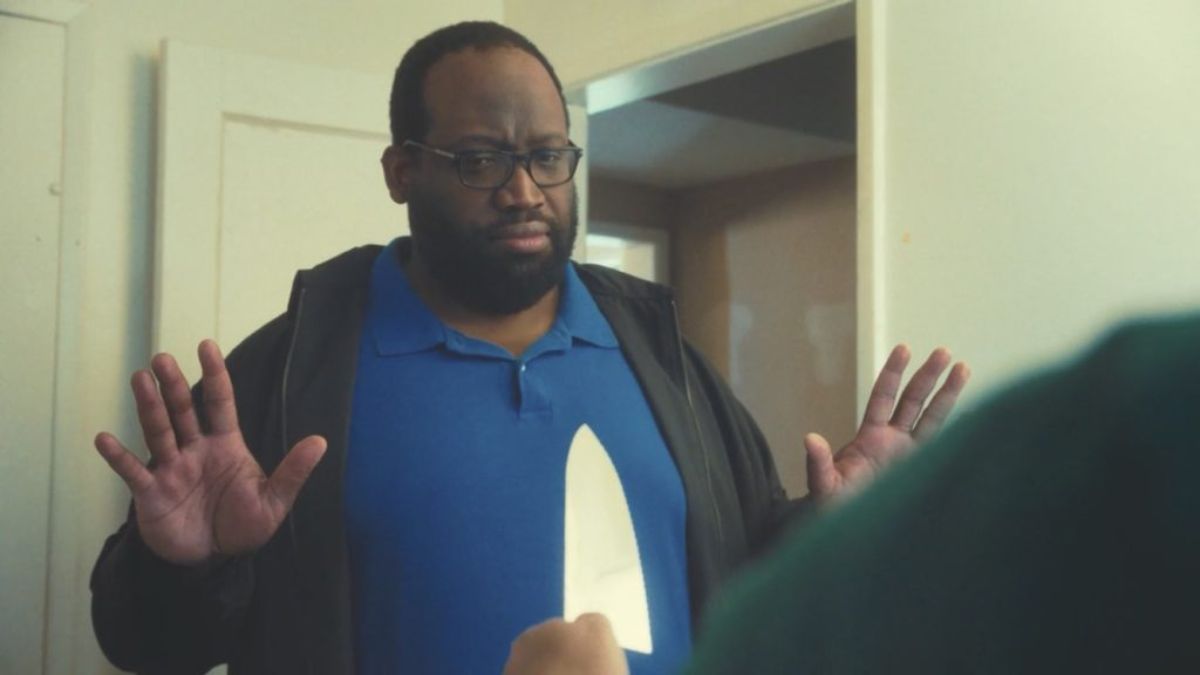
Marcellus Cox has established himself as a filmmaker to watch with his debut movies, Jamarcus Rose & Da 5 Bullet Holes and Liquor Bank. The former was good enough to transcend the short film format, while the latter is gaining Oscar nomination buzz in the Best Live-Action Short category. So how exactly does Marcellus create short films that feel like full-length features?
In an interview with TVBrittanyF.com, he explained the creative process that made Jamarcus Rose and Liquor Bank so successful. Marcellus also reflected on why he’s drawn to making movies that are based on true stories. Plus, what does he see for himself creatively in the future—such as a possible feature-length project?
Brittany Frederick: You’ve proven to be exceptional in the short film space. Was that a space that intrigued you creatively, or was this something that just felt like the right place to start making movies?
Marcellus Cox: It’s more of [I didn’t] have the budget to make a feature. A lot of filmmakers out here working, we’re all trying to be as creative as possible to put work out there. You tell a story [with] what you do have—the amount of funding that you can accumulate and put together, the resources. It’s just the circumstance of trying to get a feature made. But the number one thing I was always taught from school is just to keep creating.
Any chance that you get, if you can get a camera crew together, you can get actors together, you have a story that you can tell. You can limit it to 10, 15, 20 minutes… Tell that story, figure out how to get it done. I’m always trying to be as creative as possible and be on my game because I figure at some point that this is going to [progress] into a feature and I believe I’m getting closer than ever to it. So for me, it’s just always be creatively working, creatively thriving at this craft and getting better at it. And I feel like I’m doing that.
There’s a depth of character in both Liquor Bank and Jamarcus Rose & Da 5 Bullet Holes that isn’t common within short films. How would you describe your writing process, that you’re able to accomplish that?
I always prepare myself in terms of feature format, because that’s where I want to be. If I’m going to tell a story and only have a limited amount of time, I need to be able to make sure that with that 10, 15, 20 minutes, I have a complete layered film as much as possible. I need the audience to know these characters. I need the audience to know this story.
When you see a lot of these films, the stories—as beautiful as they may look, they can be all over the place… and I don’t want to work like that. I have a beginning, the middle, and the end to everything that I have to say, and I want to go about it that way because that’s where I see myself as the artist. But at the same time, I interject my own style into it.
And most importantly, because a lot of them have been true stories, I really like to be able to deal with the people behind those stories as much as possible. [I’m doing] as much research as I can, meeting with them and their families and being able to meet the people in those fields. I’ll take extensive time—days, even months—to be able to follow people and actually be able to break my story down from there and get into the creative development from there.
So I’m going about it [with] the traditional beginning, middle and end, because that’s the formula I like, as opposed to a lot of stories that can be avant-garde, which is fine. Or they can just be the filmmaker playing with an idea, and sometimes it can be great… And short films give those artists freedom to play with it, because you don’t have anybody behind it to interfere with your creative process. That’s great.
But I feel like for me, this is a calling card. And if I’m going to have a calling card, then I need to be able to make sure that I give you something for 15, 20 minutes that you can say, hey, I like this. This is good. I know what this guy’s doing. I know his style. I can see his aesthetic. So that’s the way I go about telling stories.
What interested you on basing your films on true stories, rather than going forward with entirely fictional ideas?
I have plenty of ideas; the problem is that it just costs too much. [Laughs.] If it was me, the short films I would have done would have been all samurai films. That’s what I’m hoping would be either a second or third feature, would be a samurai film.
But for me, I want to make sure that everything that I’m doing is preparing myself for that that next level of being a director who actually has a full-on 90, 120-minute formula. And true stories help me with that because it helps me be able to decipher things that take place, but still be able to have a creative process—in terms of character development, in terms of writing, in terms of how a story will be able to obtain an audience…. If you take a real story and you can play with it, then when you get into that original format again, now I know how to go about building these characters. Now I know how to go about obtaining a story.
Plus, you get to tell these people’s stories, that I think a lot of time would never get to see the light of day. So that helps me too—to be able to make sure that these people have justice in their lives, that even if you never got a chance to meet them, you know them through these characters.
Both Liquor Bank and Jamarcus Rose & Da 5 Bullet Holes are about people in challenging circumstances, whether it’s alcoholism or gang violence. Did you want to shed a light specifically on people working to overcome adversity, or how did you settle on these two stories?
Those were the stories that appealed to me, and it came from people within the business. With Liquor Bank, I got the story from Brian Sherwood; he was working at PBS. Brian Sherwood is now an executive over at A24, and he [introduced me] to Eddie. And it was just one of those things where me and Eddie connected and [I said], I love this story. I would really love to bring this together. The fact that these people allow you to be a part of their lives—to be able to follow them, to be able to study them, and to be able to know more about them—those type of stories just became so compelling to the point where it was like anything that I have artistically right now [didn’t] match who these people are in person. And these were the kind of stories I wanted to tell anyway, these kind of truths artistically. I actually have the people who would allow me to tell their truths.
Everything that I was hoping to do artistically, these people came into my life and they made that possible—through their own pain, through their own heartache, through their own suffering. And they allowed me to be able to tell those [stories] and tell [them] in a truthful way, but in a real way. Because these stories matter and because stories in general like this need to be told… It’s one of those things that it just happened, but I’m happy it happened. So now as I’m going back, sitting at my desk and I’m going over original scripts I had written before or outlines I had written before, now I have a clear understanding of what it is that I really want to do artistically, creatively. And I’m just grateful that I have the opportunity to do it with these short films.
How much do you see your creative process changing as you continue to evolve as a filmmaker? Are there things from Liquor Bank and from Jamarcus Rose that you’re going to carry with you on these longer and bigger projects?
When you have 90 minutes, now I can let the story settle at certain moments. I always want something in the first 10 minutes to hold the audience. You hold the audience and then you can pace yourself from that point on to the middle of the story, where I can tell it in the way that I want to tell it—whether it’s slow, or whether it’s fast, or whether it’s in any manner that I want. With these short films, you know how to break the beginning, middle and end in such a short amount of time that now I can apply this in a longer format.
It really helps in terms of fine-tuning and breaking down the story and breaking down these characters. Now I know I can tell more of a layered story. Even the smallest character—I don’t have to worry about just giving them one line. I want that character to mean something, from the biggest to the smallest [part]. And you can do that if you time [the movie] perfectly and you put it together wisely.
Now I know I have better command of my storytelling, and I’m so grateful for that. Especially with these two shorts in particular, it has really helped me prepare myself. So when that time comes—and I feel like it’s coming soon—I know that I’m ready. I don’t have to worry about anything that comes my way, because now I know how to adjust. I’ll still be able to maintain my story and be [sure] that it stays true to the fabric of what it is that I want visually, creatively, artistically.
As you make the move toward a full-length feature, what do you want movie fans to know about Marcellus Cox? How do you describe yourself as a filmmaker?
I’m more of an arthouse filmmaker. I’m more of an auteur, cinephile style. My work will always be more purely indie than anything commercial. But even with that style, I try to focus on subjects that will be universal, while talking about it in that perspective. That way, I know everybody will have a pure, grounded understanding of what it is that I wish to convey in terms of art and in terms of cinema.
But I’m just as much of a fan of a superhero film or a martial arts film or a horror film when it comes to cinema. I just love cinema in general. I know my style artistically, but I love everything about cinema—except for musicals. [Laughs.] I am not a fan of musicals. That’s the one genre… But almost every other genre, every other creative aspect of cinema, in terms of storytelling, I love [and] I’ll watch. Even if I’m not the biggest fan.
Liquor Bank is streaming on Prime Video via ShortsTV. Photo Credit: Courtesy of Films With a Purpose.
Article content is (c)2020-2026 Brittany Frederick and may not be excerpted or reproduced without express written permission by the author. Follow me on Twitter at @BFTVTwtr and on Instagram at @BFTVGram. For story pitches, contact me at tvbrittanyf@yahoo.com.