Travis Hodgkins’ Line of Control is a movie adaptation of Mirza Waheed’s 2011 novel The Collaborator. The story has lost none of its emotional edge in 15 years, with writer-director Hodgkins preserving everything that made it so tragic. That’s both a strength and a weakness for the film.
One does not need to have read the novel, which follows a nameless teenage boy whose status as a local dignitary’s son singles him out as war rages in Kashmir in 1993. Hodgkins’ new title is a reference to the “line of control” that divides the area, and some on-screen text provides basic details about the conflict. However, it doesn’t quite feel like enough for a broader audience. A lot of the dynamics in Line of Control require some understanding of culture and history, and it takes a good half-hour for the audience to grasp who’s who and why certain characters behave the way they do. That’s an important hurdle for the film, because the entire point is to shed that greater light on this terrible conflict and the people it affected so deeply.
But once viewers are attuned to the cultural and class dynamics, Line of Control builds the tragic dread that every war film cultivates. The audience knows that events will not go well for the boy (played by Nikhil Singh Rai) and his three childhood friends. Naturally, they dream of things far greater than they’ll ever actually get to achieve. The synopsis for the film acts as somewhat of a plot spoiler, and anyone who’s familiar with the genre will be able to get a general idea of the ending. The strength of Line of Control isn’t in its novelty, but in Hodgkins’ execution of the terrible journey Waheed sent his protagonist on. Despite knowing a fair amount of what’s coming, viewers are still upset by watching it unfold.
Rudi Dharmalingam (Wakefield) gets top billing as the most recognizable name to international audiences, and his performance as ruthless Captain Kadian is as smarmy and anger-inducing as viewers expect. He has the “shameless evil hiding under a veneer of false charm” act down pat; it’s impossible to watch the movie and not hate him. But the film belongs to Rai as his character is gradually broken down—and not just from the violence he sees. What The Boy learns is also how the other people in his life see him, and it’s not flattering. There’s really no hope for him in any direction, and Rai pulls every ounce of emotion out of that.
Which creates another hurdle for Line of Control: this is a hard movie to watch, even compared to other war films. No movie in this genre is easy, but this is particularly bleak. On top of that, it’s also particularly long; it’s just shy of two hours. It’s a big ask for the audience emotionally and at the end, they’re likely to be just as drained as The Boy is. Viewers should be aware that this is a more difficult viewing experience than they might expect, and that they’ll be in that dark space for a while.
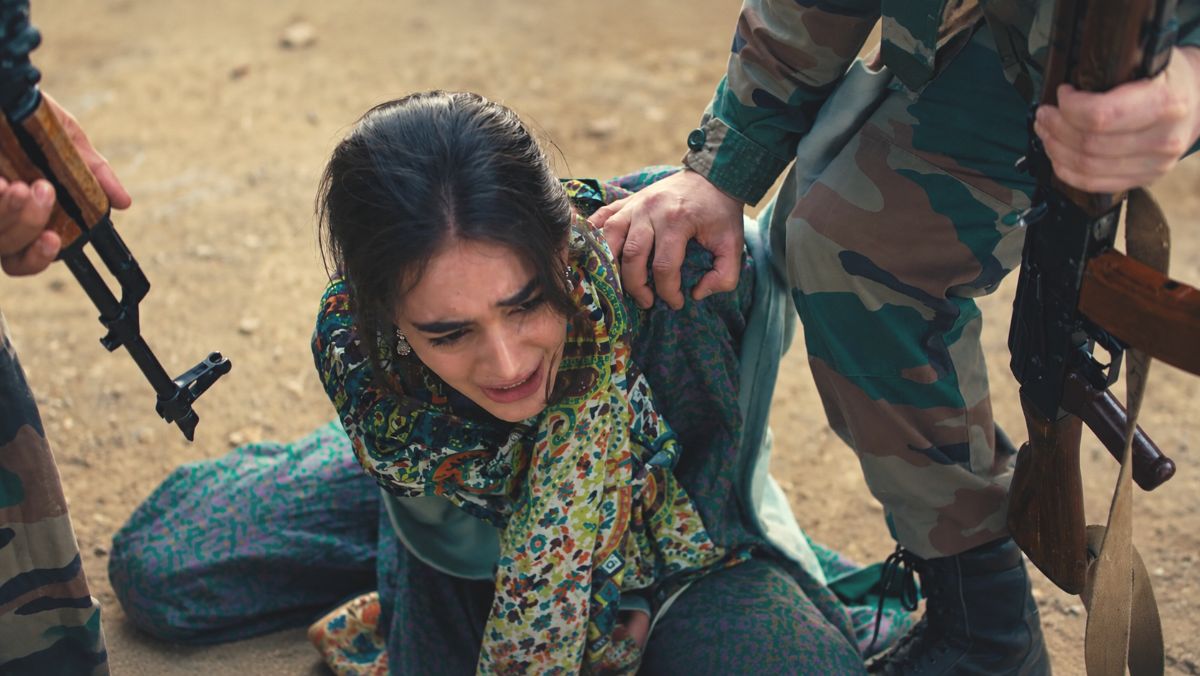
Yet for audiences willing to make that investment, Line of Control is an artistic achievement. It’s a tough movie, but a very well-crafted one. Its slow pacing contributes to that constant feeling of dread and visually, Hodgkins lingers only on the violence as long as he needs to. The movie doesn’t take advantage of the trauma of war for dramatic effect. The opening scene, in which The Boy is seen among dozens of dead bodies, is a good example of this. Hodgkins provides a wide shot allowing viewers to be horrified by the sheer number of corpses, but there are only close-ups insomuch as it takes for the audience to understand what The Boy is doing. Likewise, later beats of further violence last only long enough for viewers to understand what’s happened.
The actors are solid across the board, but some of them are limited in the impressions they can make, because their characters serve very specific functions in the plot. Line of Control mostly belongs to Dharmalingam, Rai, Vikram Kapadia (as Khadim Hussein, the father of The Boy’s best friend) and Nitin Ganatra (as The Boy’s father). The latter three all have scenes of heartwrenching vulnerability. By the time the credits roll, the audience will feel the characters’ pain, and that’s universal. They may not feel any wiser about Kashmir or its circumstances, but hopefully they’ll be motivated to learn more. Because as with Waheed’s novel, Line of Control succeeds at using fiction to prove why the true story of Kashmir needs to be told.
Line of Control is now streaming on Apple TV and Prime Video. Photo Credit: Courtesy of the filmmakers.
Article content is (c)2020-2026 Brittany Frederick and may not be excerpted or reproduced without express written permission by the author. Follow me on Twitter at @BFTVTwtr and on Instagram at @BFTVGram. For story pitches, contact me at tvbrittanyf@yahoo.com.