In watching Something Pointless, one can almost feel what writer Neil Graham was thinking when he penned the movie. There’s a sense of wanting the audience to smile, not just his nameless young protagonist. And thanks to another winning performance by actor Owen Teale and some fine direction by Asa Bailey, the film accomplishes that.
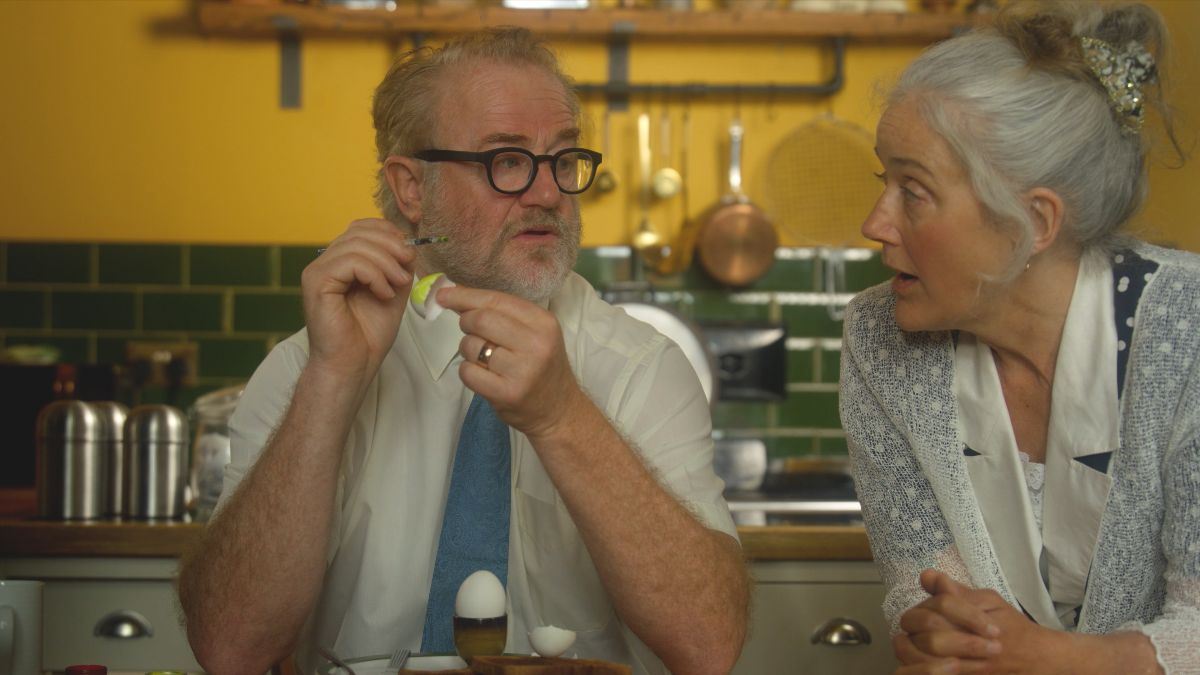
Teale portrays Aldous Evans, who serves not only as the main character but the movie’s narrator—it’s essentially built around him. That makes it all the more valuable that Graham and Bailey have such a talented actor in the role. Teale is always dependable no matter what character he’s playing (and for Line of Duty fans, it’s extra entertaining to see him as someone far different than the villainous Commander Osborne). He gives Aldous the quiet grace that Something Pointless requires.
“Quiet” is the key word here, because there are long stretches of the movie without dialogue, and there’s limited dialogue in general. Like many short films, Something Pointless relies on time jumps (through montage) to tell a complete story within a compressed amount of time. The usual problem with this is that it means the filmmaker wants to tell a bigger story and is just trying to squash it into the proverbial short film box, resulting in a movie that feels awkwardly paced or overstuffed. But that doesn’t happen here, as Graham’s choice to limit his dialogue works in two ways: he’s not forcing too much information into every scene, and the resulting increased emphasis on visuals is perfect for a movie that’s about an unexpected piece of artwork.
The production takes its title from Aldous’ belief that people should do something pointless every day, so that they appreciate the other parts of their life that much more. Aldous has started using eggshells to create art on the alley wall outside his home, which happens to be shared with a school attended by a young man (played by Leo Harris) credited only as “The Boy Who Never Smiles.” The Boy’s arc is as expected: he’s bullied by classmates and his parents are clueless about him, but seeing Aldous’ art every day finally gives him happiness. Something Pointless would be even better if it didn’t reveal its plot twist up front: Aldous learns that he’s dying, and one of the final scenes is The Boy meeting his widow Eleri (a wonderful Sophie Thompson) at the wall, where she encourages him to continue the art project.
That premise makes Bradley’s direction more valuable. Quick exterior shots that would’ve felt like filler in another movie now seem almost like canvases of landscape art. Close-ups of the eggs carry incredible meaning. The final image, of the art project seemingly coming to life, is the perfect way to end the movie, because it embodies Aldous’ message. If it’s an ending; Graham’s script leaves the door open for a sequel, as Aldous says he’s developed another theory in the afterlife. And Something Pointless is so good that the audience wants to hear that theory. They want to know his story, even as they’ve only seen this small sliver of his and Eleri’s life. Teale has created a character who is both relatable and magical at the same time.
It’s also appreciated that Graham doesn’t belabor the bullying that The Boy goes through. He implies it through a montage of The Boy having to change his shirt after each bullying incident, and that’s enough. Other movies would see the dramatic potential in the confrontations, but Graham eschews the cruelty to spend more of his limited screen time on Aldous’ progress. It’s a small distinction, and perhaps said running time is part of it, but it’s still nice to see any movie that would rather dwell on the positive. Which is what the viewer is left with as the credits roll here: something genuinely positive and perhaps even inspiring.
Something Pointless has successfully toured the festival circuit in both the United States and United Kingdom, and it’s no surprise that the movie has already won several awards along the way. It’s a genuinely heartwarming idea, carried by a remarkable actor, and shaped by a beautiful visual language. If there’s a flaw to the film, it’s that the audience wants more—more dialogue, more of Aldous’ story, more about how that wall gets fully finished—and that’s a very good problem to have.
Photo Credit: Courtesy of the filmmakers.
Article content is (c)2020-2026 Brittany Frederick and may not be excerpted or reproduced without express written permission by the author. Follow me on Twitter at @BFTVTwtr and on Instagram at @BFTVGram. For story pitches, contact me at tvbrittanyf@yahoo.com.