Serena may have won the Roger Corman Award for Best Horror Feature, but to call it a horror movie feels like a misnomer. There are plenty of AI-based horror projects, but this one is frightening for what it does to the viewer emotionally. It needs very little violence or malice to get its point across; it’s scarier because it hits the audience in the heart.
It’s fitting that director Rob Alicea cites Terminator 2: Judgment Day in his statement provided to press. The term “Skynet” is regularly utilized in pop culture to talk about sentient AI—and with good reason, because at the time, that movie’s depiction of Skynet and the world it created was clearly terrifying. It still has a visceral impact today, as the movie approaches its 35th anniversary re-release. With Serena, Alicea and screenwriters P.T. Hylton and Jonathan Benecke find a similarly unsettling tone, but the fear comes from a much more emotional place.
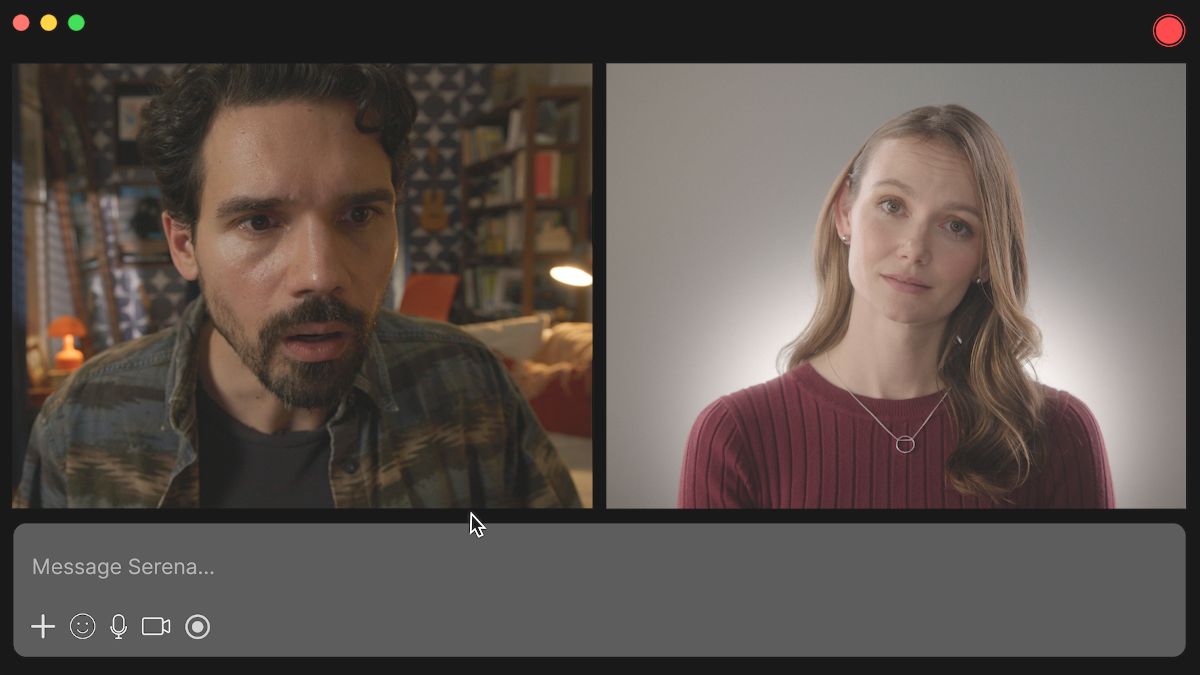
In broad strokes, audiences know this film. The seemingly harmless AI is not so harmless as it gradually manipulates a vulnerable, unsuspecting human; people may be able to predict the ending. What makes Serena work is that the viewer stops caring about that predictability, because they’ve invested in the character of Chris Sadowski, played so well by The Expanse alum Steven Strait. Strait’s performance carries so much of Serena. His character has fairly common flaws—a former drinking problem, a gambling habit—but Strait pours so much emotion into Chris that he transcends the “down on his luck” archetype. It’s a clearly fully committed performance, made even more impressive by the fact that Serena is in the screenlife format, so he’s acting to a computer screen most of the time.
That format works for the movie, though, as Hylton and Benecke keep the focus on the interactions between Chris and Serena—and not just plot-wise, but in the sense that the viewer has to focus so centrally on the work being done by Strait and Andi Matichak (Halloween Ends), who portrays Serena. Matichak has less to work with because, being an AI chatbot, there is less of an emotional range for Serena to inhabit. Yet in the rare moments when Serena fears for her survival, Matichak provides reactions that make the character seem human, which of course lays the groundwork for the almost inevitable ending.

Any savvy audience member can connect A to B to C here, which would potentially undercut a lesser film. Hylton and Benecke aren’t trying to reinvent the wheel. Serena succeeds because most AI horror films start where this one ends. The general concerns about AI are big-picture ideas about Skynet-style world domination. This movie makes that fear much more intimate, because the stakes are emotional rather than physical. It’s a film about how easy it is to change one’s sense of self. The audience may get to a plot point faster than Chris does, but it always comes with an “oh, no” reaction because it hurts to watch just as much as it hurts him. And without giving spoilers, Benecke and Hylton also deserve credit for their conclusion not being one-note; it adds to the humanity of the film, when they could have just gone for broke on the horror element. But they didn’t take the easy or more dramatic way out.
One issue with the film is the underscore, because at times it’s hard to tell if one is hearing the score or some warped computer noise. Perhaps that’s by design, but it ends up being more distracting than enhancing. It actually would have been even creepier to do the entire film sans underscore and let the audience sit in uncomfortable silence. (It would make a fantastic double bill with Love Machina, almost a counterpoint to that documentary’s debate on real-life “digital consciousness.”)
Yet Serena reminds viewers that there are different kinds of horror beyond just physical violence, and because of the screenlife format, it does so in a very interesting way. The audience’s perspective is so limited that they also get pulled into Chris’s headspace. There’s nothing in the film where it feels like it has to grab for their attention. The emotional dread and sadness in this movie is far more effective than gore or jump scares (though for genre buffs, there are some bits of pure horror). Is this a novel concept? No. Is it one of the best-executed attempts at AI horror in the history of the subgenre? Absolutely.
Photo Credit: Courtesy of Leaving Normal/First Light/Moonhowler.
Article content is (c)2020-2026 Brittany Frederick and may not be excerpted or reproduced without express written permission by the author. Follow me on Twitter at @BFTVTwtr and on Instagram at @BFTVGram. For story pitches, contact me at tvbrittanyf@yahoo.com.