WARNING: This review contains a mention of suicide.
The documentary American Troll has a very good argument at its core: is there a balance between free speech in comedy, and human decency? It’s an argument very much worth having. But the viewer has to push through some frustrating parts of the movie to get to that valuable discussion.
Director Saturnin revisits the controversial legal battle that erupted when comedian Mike Ward devoted part of his stand-up act to mocking disabled singer Jeremy Gabriel. Gabriel’s family filed a human rights complaint and in 2016, Ward was ordered to pay monetary damages to Gabriel. However, Ward took the case to the Supreme Court of Canada, which sided with the comedian and voided the award in 2021. Ward has continued a successful career, including winning the Canadian Comedy Award for Comedic Artist of the Year in 2016. Gabriel subsequently filed a libel suit against Ward.
Particularly in the early going, it seems like American Troll is attempting to advocate for Ward as a victim of society and/or the government. There are significant portions of the documentary that are cringe-worthy, such as one comedian claiming that being bullied “makes us a better person,” and the tired refrains that “it’s just a joke” and someone who gets offended by a joke is “weak.” That rhetoric is obnoxiously myopic, and it takes more than a few minutes to see that Saturnin isn’t just making a spirited defense of Ward.
But it’s worth waiting out that first twenty or so minutes to get into the bigger picture of what the Ward-Gabriel conundrum represents. The film rightly asks where the lines in comedy are and who is the arbiter of those limits. To use another example from American Troll, is a white comedian who has his hair in dreadlocks really committing cultural appropriation, or is that just his personal style? How much does intent matter? How much does context matter? What happens if the comedian is the one being attacked? It’s not so simple as “it’s just a joke” or “it’s free speech,” and Saturnin gets into that arena from a variety of different angles.
Not all of them are successful—there’s one particular commentator who does more harm to the film than good, and the movie would be even more effective if Jeremy wasn’t the only person arguing the counterpoint. The majority of the contributors in the film are on Ward’s side. As a critic with a disability who has experienced some of the same things that Jeremy speaks to, I found it disappointing that there wasn’t more room made for the other side of the argument. Not to say that there’s a right or a wrong, but that there was a little more empathy on both sides.
Because here’s the bottom line: there’s a fair chance that watching American Troll, someone will be offended. Whether it’s because of a specific opinion they disagree with, or one of the movie’s many over-the-top visual gags, this film is clearly designed to push the audience’s buttons. But that is in turn the entire point of the movie. Are we allowed to be offended? What happens when we’re offended? Does it even matter if we’re offended or not? It’s Ward who actually makes a solid point, when he speaks about how he reacts to things that upset him, and says “I don’t want to live my life being angry about something I heard or saw.”
One could argue it’s easier for him to say that, since he didn’t experience the harsh effects that Jeremy did, But Ward didn’t get through unscathed either; aside from the court case, he speaks about getting threats of his own, most notably one person who told him that his mother would commit suicide if she saw what he’d become. What American Troll makes clear is that none of this is okay. If you’re going to criticize Ward for what he said about Gabriel and the effects that it caused, you can’t then turn around and behave just as badly toward him.
The best assessment I can make of this film comes from my personal experience. There are numerous things in American Troll that I personally did not agree with, and I felt that there was a fair amount of hyperbole. But I also felt like it was a documentary worth watching. It’s worth having the discussion, and asking those questions of ourselves as viewers. Anyone who is interested in comedy should give this one a look.
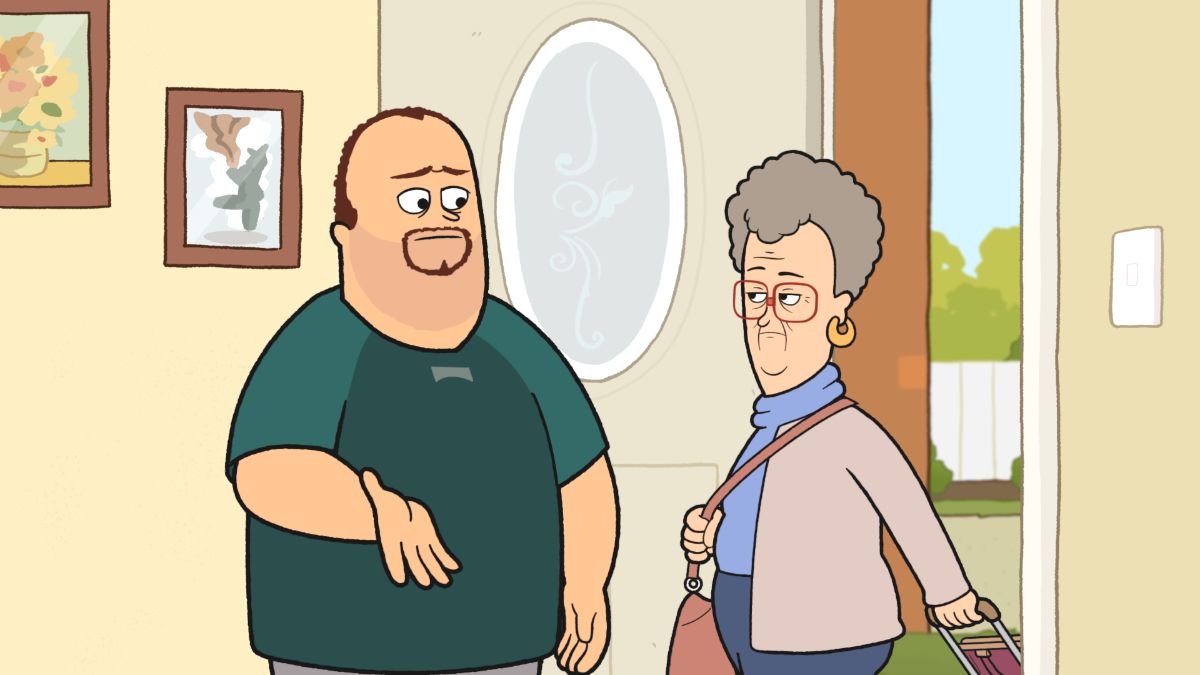
American Troll is now streaming on Tubi. Photo Credit: Courtesy of the filmmakers.
Article content is (c)2020-2026 Brittany Frederick and may not be excerpted or reproduced without express written permission by the author. Follow me on Twitter at @BFTVTwtr and on Instagram at @BFTVGram. For story pitches, contact me at tvbrittanyf@yahoo.com.