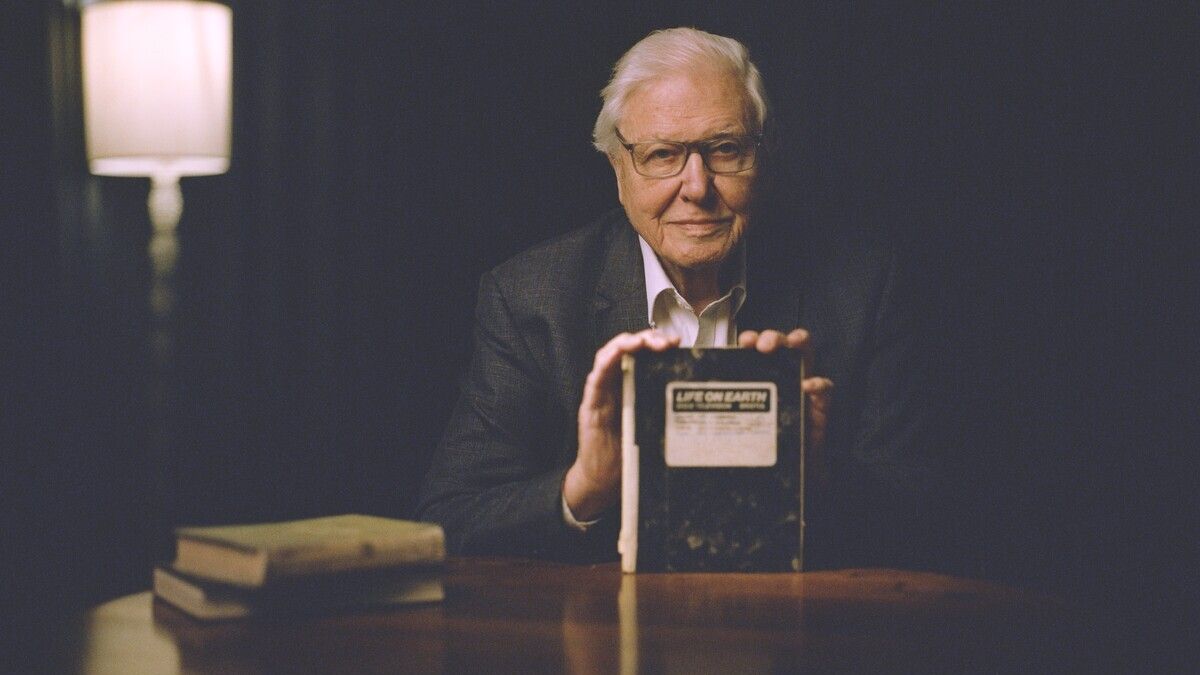
When Sir David Attenborough made Life on Earth, he had no idea that it would change his life and the lives of viewers. PBS is now looking back on that TV milestone with Life on Earth: Attenborough’s Greatest Adventure. Executive producer Mike Davis spoke about how the project came together, and how much it means as Attenborough celebrates his 100th birthday.
Brittany Frederick: What was the most poignant part of making Life on Earth: Attenborough’s Greatest Adventure?
Mike Davis: All of the contributors got very emotional. David actually keeps his cards quite close to his chest. He wasn’t looking at himself and going, “Oh, those were wonderful times.” But there was definitely emotion and reflection. He definitely talks about the gorilla experience as being almost like a dream, saying how it changed his life and was a huge privilege. Looking back 50 years on the adventures you had, being your younger self, I’m sure was emotional.
But certainly for the other crew members who are now in their 70s and 80s, probably the most emotional moment was when we took them back to the original offices. The Natural History Unit is still in Bristol, which is kind of an outlier of London in the Southwest of the UK. It’s where natural history has found its home in terms of filmmaking in the UK. But when we took them back to the old offices—that are now deserted—where all of this took place, all of this started 50 years ago, they all got really upset and emotional in a very positive way because it helped trigger memories and it helped to almost transport them back 50 years, took them back in time.
When you saw their reaction, it’s like, “Oh, I remember. And I used to sit over there and David used to come through that door and we looked at the rushes there. And I remember when this happened and I was just standing but looking out the window…” [We were] creating that space for them to kind of travel back in time to the 20-somethings that they were on this amazing journey to making this series. All of them were quite choked up to be there. I think it was very transportive for them.
That was a vital part of making this film more than just a retrospective documentary. We wanted it to be immersive and wanted to use them and their firsthand stories, but also the original source materials, David’s diaries and their old schedules and maps and so on. We really wanted to make it feel like you were seeing this series through their eyes rather than necessarily looking back. But there was definitely emotion when they were telling their stories. And I think it certainly helped to place them in the original environment where it all started.
Speaking of the passage of time, you now have the chance to reach an audience that may not have seen the original series. Did you craft your project any differently as a result of that?
I actually think that people remember the gorilla encounter. It’s so iconic, and there are key scenes or moments that they remember, or they remember a sense of what Life on Earth is about. But when you go back and watch it, it’s a beautiful, brilliant series, but it’s very high concept. It’s obviously chronologically traveling through the whole history of life on earth and every animal or every element of evolution and every kind of development of the animal kingdom through there.
So it was really interesting for me going back and actually seeing David as a young person, presenting this as somebody in their fifties. Very interesting to understand the camera technology of the time. [It was] particularly fascinating, as someone that writes scripts and tries to make series and films that are engaging, to rewatch the series. I really hope people go back to it. I would hate for people not to go back and enjoy the original series, but it’s 13 hours and I think probably you would tell that story differently today.
For me, it was quite surprising going back and seeing that it was quite different than I had remembered. And the way the natural history genre has evolved…. in quite a different direction. I think there’s a lot more focus on animal behavior now, rather than that kind of more teacherly, kind of academic lecture-like approach. And again, it’s brilliantly engaging. The things that really surprised me when I went back and I realized it was so much more than just the mountain gorilla moment or some of the key sequences you remember… There’s a bit at the end of Episode 1 where he has been diving like James Bond in his red scuba suit on the coral reef, but he talks about how 500 million years ago, life had started to get going in the oceans.
Right at the end, as he’s then throwing to the next episode, he says, “If intelligent alien life was looking down on the shallow oceans and they saw the colors of life, they would know that life had gotten going in the oceans of earth and that kind of that story had begun.” I just thought that was so cool and profound and cinematic, that idea. And it made me realize again how brilliant a storyteller is. That could be so dry and academic, that idea of coral reefs and life in the ocean being visible from space. But looking at that through the lens of that slightly science fiction, quite Carl Sagan-like idea of looking down on Earth and realizing in the chemistry of the oceans that life had gotten a hold here, it was brilliant and so clever and so absolutely made you want to watch the next episode.
And it is the kind of DNA of David. It’s that kind of secret sauce; he just has brilliant ways of expressing big ideas. S it was delightful to go back for that reason. And I really do implore audiences to go back and watch the original series. But you need to go back and remember it was made in the 1970s and storytelling was slower. It might be a harder watch for my teenagers today.
Is there anything in particular you’re hoping that the audience will take away from watching Life on Earth: Attenborough’s Greatest Adventure? What do you want to leave them with?
I think what you might get from this is a wonderful portal to a slightly more innocent and different world only a few decades ago, where traveling the world and telling these stories was just a hugely different and kind of exotic endeavor.
I’ve always kind of thought, I wonder how a younger audience will see this. And I wonder whether it will get them excited about the natural world, but [if they will] also be kind of fascinated by the kind of social history and the adventure story of how you make a series 50 years ago, and how you travel the world, and how you have to innovate to capture animal behavior and so on.
My feeling is that there’s so much more to this film than just a portrait of David Attenborough and/or an amazing series that was made 50 years ago. I think it also is a lovely window to a vanished world as well, a kind of analog world. It was a very challenging and scary world to navigate through without the ability to be pulled out of those situations, but it feels like almost a different time which is interesting and fascinating and exotic for audiences who probably didn’t who didn’t live through it.
I was five when [Life on Earth] came out. I just about remember flares and smoking on planes and I was able to remember filming on film stock at the beginning of my career. But [today], all film crews can be medevac’ed out of rainforests and you’ve got satellite phones and you can email and do Zooms from the middle of the Amazon. It’s still difficult to make a natural history series, but it was infinitely more difficult then. And I think this is a lovely way of reliving that, hopefully.
Life on Earth: Attenborough’s Greatest Adventure is now airing on PBS stations; check your local listings for time and channel. You can also view the documentary above. Photo Credit: Robert Hollingworth/Courtesy of PBS.
Article content is (c)2020-2026 Brittany Frederick and may not be excerpted or reproduced without express written permission by the author. Follow me on Twitter at @BFTVTwtr and on Instagram at @BFTVGram. For story pitches, contact me at tvbrittanyf@yahoo.com.