
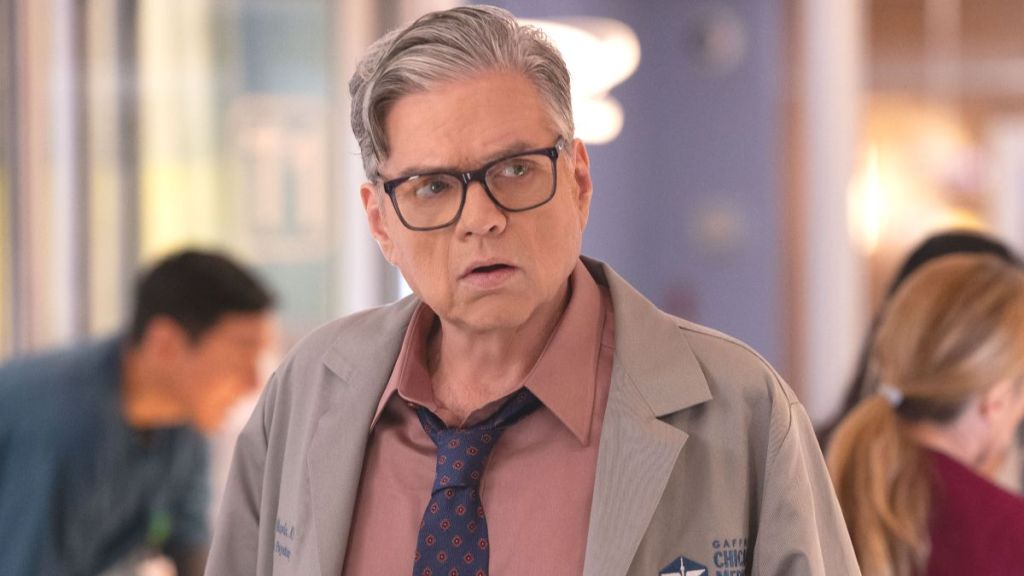
Chicago Med showrunner Allen MacDonald is taking a big leap with “The Book of Charles,” an episode that digs further into Dr. Daniel Charles than ever before. Oliver Platt’s character is a fan-favorite on the NBC series, but this installment will challenge him and what One Chicago viewers think of him.
Ahead of the episode’s airing, Allen connected with TVBrittanyF.com to talk about the joy of writing a Charles-focused episode. He also spoke about why he wanted to head in this direction with the character, and what it was like to collaborate with Oliver in making it happen. Be sure to circle back after “The Book of Charles” airs for the second part of our interview!
Brittany Frederick: You were a fan of Chicago Med before you started working on the show, and Dr. Charles is foundational to the series. So how fun is it simply to write a Charles-centric episode?
Allen MacDonald: It’s very exciting. I love all the characters on the show, obviously, but if you’re watching Dr. Charles over the years, he’s always such a comforting, encouraging presence. He is so observant about his patients [with] his intuition as a psychiatrist… When somebody is that good at something, and is that driven to become that good at something, and has a natural ability to read people, I always think that must come from some kind of trauma of some sort. That there’s something that the character is trying to make up for or change or work out.
And in this case, I felt that this episode—”The Book of Charles” and the one that follows, “Altered States,” because in a lot of ways they should be considered a two-part episode—that would finally allow me to kind of get into Dr. Charles’ background a little more, and reveal why he is the way he is. Something that has been phenomenal this season and last season is just Oliver Platt, who’s phenomenally gifted as an actor, that he has this huge willingness to go to darker places with the character than perhaps he’d gone to in the past.
Exploring Dr. Charles means exploring how he interacts with his colleagues, and “The Book of Charles” plays him off a lot of different characters rather than just one or two. Was there anyone that you were particularly excited to pair him up with?
I always enjoy watching Charles bounce off of Dr. Lenox. There’s not a lot of that in the episode, but I think that’s an interesting dynamic.
One of the things that I loved—that had already been created and set up before I got there—was Dr. Ripley’s background as a wayward teenager, meeting Dr Charles in the juvenile facility. That is something that I didn’t come up with. It was created at the beginning of Season 9 by the previous showrunners [Diane Frolov and Andrew Schneider] when Dr. Ripley was introduced, but I thought it was a great backstory, and I have tried to highlight that whenever I can. And so I always love playing that little bit of an ease between Charles and Ripley about that backstory.

Yet this Chicago Med episode also deals with not just one, but several very heavy subjects, from the opening scene. How would you describe what Charles (and the audience) are about to go through?
The north star for me and Oliver, who is always a huge collaborator in telling Dr. Charles stories—if he were here, I’m sure he would point out the fact that Charles has started to volunteer for the suicide hotline. The opening scene shows that, and it doesn’t go the way he would like it to. And because Charles is destabilized by that, over the course of the day, he starts to not follow a lot of the rules that he has for himself in terms of interacting with patients.
He kind of gets ahead of himself in a way that he usually wouldn’t, because he’s off his game a little bit. And so in almost every story, he gets ahead of himself in a way that he usually wouldn’t, and that just makes his day worse, because those rules Charles has are guard rails to protect him from those sorts of outcomes. But he is a bit out of control.
What were those conversations you had with Oliver, when you’re giving him such great material to work with, but that comes from dismantling his character and putting him in, as you said, a darker place?
I think dismantling is a good word, but it still is all consistent with his character. If he’s motivated by things that happened in his youth, then there’s the good side of that, which is all the good work we’ve seen him do over 11 seasons. And there is the dark side of that, that he’s always successfully held down, that is now kind of bubbling up.
It’s two sides of the same coin. So we both felt that it was consistent with the character to go on this journey, and that it would do nothing but make the audience feel more empathy for him, and sort of understand why he is who he is.
Chicago Med airs Wednesdays at 8:00 p.m. ET/PT on NBC. Photo Credit: Courtesy of NBC.
Article content is (c)2020-2026 Brittany Frederick and may not be excerpted or reproduced without express written permission by the author. Follow me on Twitter at @BFTVTwtr and on Instagram at @BFTVGram. For story pitches, contact me at tvbrittanyf@yahoo.com.

 TVBrittanyF.com