
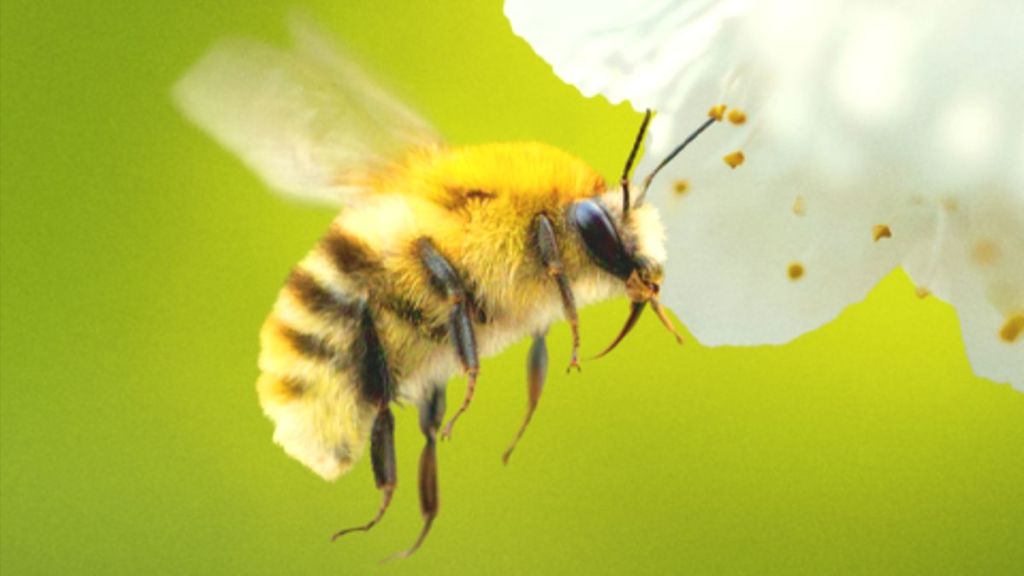
Bertie Gregory is about to surprise and delight NatGeo audiences with Secrets of the Bees. The latest installment in the Emmy Award-winning Secrets series is a window into a world most people never think of—and don’t realize that they need. But that’s where Bertie comes in, using his own Emmy-winning expertise as a wildlife filmmaker to get people to look at bees differently.
In an interview with TVBrittanyF.com, Bertie spoke about the journey he went on to make Secrets of the Bees alongside fellow National Geographic Explorer Dr. Samuel Ramsey. He dove into the technical challenges of a TV show on an incredibly small scale, and how important that story is in a big picture sense. Plus, find out how viewers watching on Disney+ and Hulu can help the bee community in a very simple (and equally delightful) way this Earth Month.
Brittany Frederick: Your last NatGeo project was Cheetahs Up Close, so what interested you in following that up with a very different animal in Secrets of the Bees?
Bertie Gregory: I’m pretty honest with the fact that I have spent the vast majority of my career going to film big, charismatic animals in faraway places. Bees are not big, and many of the species don’t live far away. And I was initially worried, do they ooze with the same charisma as a lion or a pole bear? Well, it turns out as soon as you get on their level and see them at their scale, suddenly you realize they have just as much character and charisma as any other animal that you might think of as being more charismatic.
The other thing is, it’s called Secrets of the Bees. So that means we’re making a promise to the viewer that they’re going to see something they haven’t seen before. And the good news is, bees have so many secrets. So I thought they’re actually the perfect subject.
To your point, they’re not an animal that has been documented extensively, so does it help or hurt when you’re showcasing a subject that is not as widely known?
People are somewhat familiar with bees, as in, it’s not like you’re making a documentary about an animal that no one’s ever heard of. And so I think they’re kind of that perfect balance of familiar, yet not familiar at all.
We filmed some of the incredible 20,000 species of bees around the world. We featured the honey bee, which I’m sure people will be most familiar with. But we also featured bees that ride broomsticks, like characters out of Harry Potter. We featured bees that turn rotting flesh into honey. We featured bees that hold another insect captive and tickle them until they release a sugary substance that they then use to make honey. Bees have all these weird and wonderful ways of making a living.
Secrets of the Bees also comes with some obvious technical challenges because of their size. What are some of the tools or techniques you used on this series?
There’s two things. First thing is, a lot of the amazing behavior that we wanted to film, certainly with the honey bee, happens inside the hive—a place that you can’t see from the outside. So the first thing we had to do was build an extension onto the hive, big enough for our cameras and the camera person. Basically you get those accepted into the hive, so when the bee enters the hive they think everything is normal and they behave naturally, but we have our cameras inside the hive to be able to film them.
The other key piece of technology we relied on was called the probe lens. If you’re trying to film something very small, you use a macro lens. It’s a zoom lens that can focus very close. It allows you to make small things look big. The problem with those lenses is that as you zoom in, the background gets more and more blurry, and you lose all context.
The probe lens, it gets you in really close, but then it also keeps the background in focus. It’s a wide-angle macro lens, and so suddenly you can see the little tiny bee massive and up close and full of character—but within their landscape, within their world. Little flowers that you know in real life are two or three inches tall, suddenly behind the bee, they look like skyscrapers, and that’s really key to take people on the adventure with the bees.
Aside from different equipment, do you have to adapt your filmmaking approach based on the animal that you’re documenting?
Every single shoot, we have extensive meetings about what is the specific technology we’re going to use to best tell the story… A lot of what I do is with drones. Well, drones don’t work quite as well with bees, because they blow away. [Laughs.]
So we don’t use those to actually film the bees, although one thing that we did use a lot of is first-person drones—FPV drones—to shoot the POV of the bee. Because you see a bee buzzing around a field, but how do you actually help the viewer get into their mind? Well, we used FPV drones so that you buzz through under the branches and into the field and looking for different sources of flowers. It really helped add the energy, and again, [to] get the viewer into the head of the bee.
What parts of Secrets of the Bees clicked most for you? Anything that you’re particularly excited for viewers to discover?
There are some amazing stories. The bees that turn rotting flesh into honey and little, tiny bees defending themselves against enormous murder hornets—some amazing behavior.
But the thing that I love most about this series is we’re going to show you the bees are in trouble, but there’s enough doom and gloom in the news cycle, so we’re going to spin it around and say that if you want to help bees—which I really hope you do because one, they’re amazing and two, they’re responsible for a third of the food we eat. So if bees are in trouble, we’re in trouble. We should help bees, because we’re helping ourselves too.
The great thing is that it’s so easy to help bees; all you have to do is plant wildflowers. That can be in a smaller container on your windowsill outside your apartment, or if you’re lucky enough to have a garden, in your garden, or a park down the road. Plant wildflowers. And the amazing thing is, not only will you be helping bees and helping people—because bees help people—but you will also be able to see the positive change that you’re making. And that is a really awesome and inspiring thing. Plant flowers, you help the bees, get to enjoy the bees and the flowers. What’s not to like?
What are you hoping that the audience takes away from Secrets of the Bees that they didn’t know before? Since that’s the whole concept of this project.
Well, we want to entertain people. That’s important. I hope you have a bunch of facts that the next time you’re in a bar, you can impress all your friends. Also important. [Laughs.] And I hope you come away just being really inspired to help protect the bees, and you realize how straightforward that is. So many animals, to help protect them is really tricky, and you might never see the effects of your actions. Bees, just plant the wildflowers and they will come and you will see all the good that you did.
What did you learn from making the series? Was there anything that was new to you?
I learned that there is just as much drama in a little patch of flowers as there is on any African savanna with lions chasing zebra. You just need to stop and spend some time looking, because we are all walking past incredible animal dramas all the time. And I guess I’m partly responsible for this—we often think that we live in one place and nature lives in another, and you need to travel halfway around the world to a really exotic place to see an amazing animal. But actually, it turns out that just in a little patch of flowers, even in a city, there’s all these amazing bee dramas going on. And I hope this series opens people’s eyes to that.
This idea that you live in one place and nature lives in another, and how wrong that is on so many levels… Our modern-day society, we’re disconnected from nature, and that’s a problem. Not just because nature’s amazing and it’s really good for us to hang out in, but it also means it’s much easier to do damage to the natural world, if you’re never really thinking about it.
And taking that one step further, I feel like in the media and just in general, in popular culture, there’s kind of this idea that if you want to look after nature, that stands in the way of enterprise. [It] stands in the way of progress. You’re this tree-hugging hippie. But the reality is that nature provides us with so many things we take for granted… The food we eat, fresh air, clean water, productive soil—all these things that without nature, we’d be stuffed. So give nature a bit of bit of attention, bit of love, because it’s amazing what we get from her.
Secrets of the Bees is now streaming on Disney+ and Hulu. Photo Credit: Courtesy of National Geographic.
Article content is (c)2020-2026 Brittany Frederick and may not be excerpted or reproduced without express written permission by the author. Follow me on Twitter at @BFTVTwtr and on Instagram at @BFTVGram. For story pitches, contact me at tvbrittanyf@yahoo.com.
 TVBrittanyF.com