
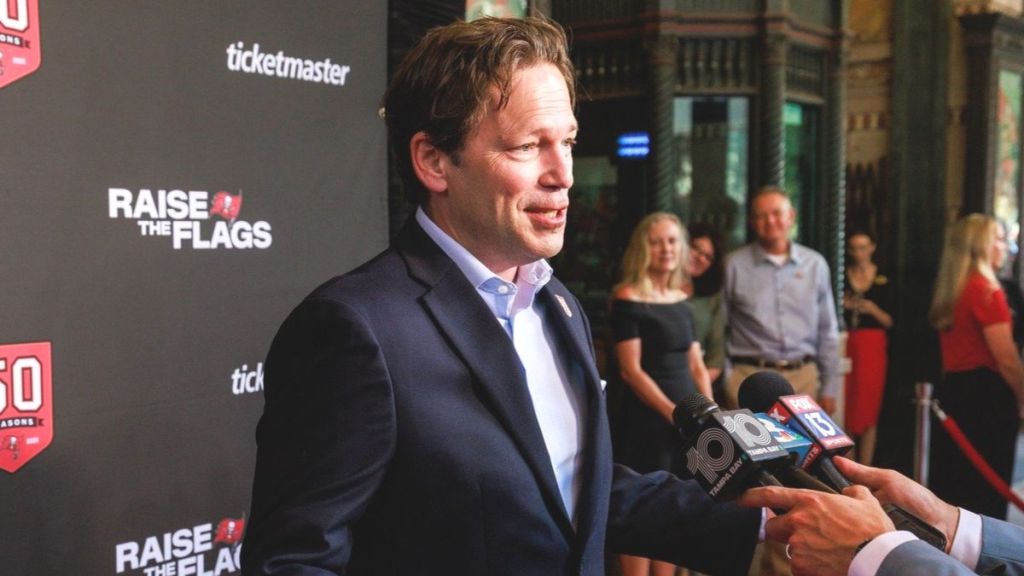
Raise the Flags: 50 Years of Buccaneers Football set a new standard for sports docuseries. The Prime Video project paid tribute to the history of the Tampa Bay Buccaneers, but it also told the NFL team’s story in a way that felt dynamic and insightful. In a sea of talking-head documentaries, Raise the Flags stood out.
Director Trent Cooper joined TVBrittanyF.com to talk about why the project was a “dream gig” for him. He also walked through the process of bringing Raise the Flags together, from the more obscure stories to the reigns of Tom Brady and Baker Mayfield. Learn how this outstanding series came together before streaming it on Prime Video.
Brittany Frederick: You’ve spent years chronicling the stories of the NFL. Where did your interest in football begin, and was it with the Buccaneers?
Trent Cooper: Biggest Tampa Bay Buccaneer fan in the world. I grew up about 30 minutes outside of Tampa, and I like to tell people, my first-ever NFL game in person was their first-ever home win. I think I was six years old or something, and all I remember is seeing the fans storm the field and tear down the goalposts. And I was hooked.
So I’ve been following that team forever. But I played football near Buffalo, at a place called Alfred University. I played small Division III football. When I was growing up, I loved two things, football and movies—so we get to do a little of both of those now, which is super-fun.
How did you get involved with Raise the Flags? Did your fandom lead to you coming aboard the project?
The genesis of it is the Tampa Bay Buccaneers organization were about to celebrate their 50th year in existence, and the owners of the team wanted to do something really special for the fans—to go back and tell the whole story of how did we get where we are? This team that so famously started out 0-26 and the laughing stock of all of sports, how did that team become this team that went on to win not one but two Super Bowls in two different eras? t’s such an awesome underdog story, with so many incredible characters that have come through that organization.
The owners wanted to celebrate that for the fans, and the reason they asked me to help them with it is that I had done multiple projects for them early in my career. We had formed a trust and a relationship around the time that the Glaser family bought the team. I had done a really cool project with them 20 or 30 years prior, and they knew I loved the team. They had seen some of my stuff with NFL 360, and they thought this is a very unique opportunity to get someone who loves story and understands film, but also knows our organization inside and out, and someone that they had worked with and trusted a lot. They called me and said, would you like to do this? And I said, heck yeah. It’s like a dream gig for me. And I poured everything I had into it for a year and a half.
Obviously, you have five decades of information to sort through, some of it more well-known than others. How did you decide what to prioritize in Raise the Flags, and what didn’t need as much screen time?
It’s very simple for us. We want you to feel things. We want this to be an emotional journey, driven by story and characters… We always say if you want stats, go to the stat page. If you want a history lesson, go to Wikipedia. But if you want to feel emotions, you want goosebumps, you want tears, you’ve got to tell stories. And if you use that as your filter, it gets real easy.
You’re sitting in editing—yeah, that’s a Wikipedia [part], get rid of that. Oh, I feel something here. I really care about this person, and what they’re going through, and the obstacles in front of them, and how badly they need to win here because of X, Y and Z… If you let that be your guiding light, those decisions get a little easier than you’d think.
Was there anything you learned that you didn’t know? Or that you were excited to bring to a wider audience in this series?
A lot of it, I didn’t know. Just because I’m a fan doesn’t mean I know the story behind a certain moment. Fans only know what they saw on television or what they read in the paper. My research gets me in a position where I see the broader strokes, and I kind of know the beats, but, but when I get to sit with somebody for a couple hours, we get to talk and share. I get to hear their point of view, and I get to follow up and ask, and suddenly the real story, the story underneath the story, reveals itself in that moment. So the discovery part of this is really important.
I only know what all of us knew, until we get in that chair and start going into what almost feels like therapy for some of our subjects. These moments were so were so big when they were younger, and they haven’t necessarily explored them in 20 years, and suddenly they’re sitting with somebody who’s asking them questions. Suddenly, all the emotions and details are pouring out that no one knew.
There are some things that I was embarrassed that I didn’t know. My first hero was Doug Williams. My first-ever jersey was a #12 creamsicle Bucs jersey, and I wanted to be Doug Williams. I didn’t know what he was going through with the tragic death of his wife [from a] brain aneurysm shortly after they had their first child. I was just a kid. I had no idea the racism and things that he was exposed to as a young man, being the first Black quarterback to be drafted that high in the first round, and be a face of an NFL franchise. I had no idea what he was going through, and so learning that, I kind of felt like, I wish I did know.
Then later in life, I was a huge fan of Jon Gruden and Tony Dungy, and I knew how different they were, but I didn’t know why. I knew what they were able to get out of players, but I didn’t know why. And after spending so much time with them, you get it. You get why they were both so great in completely different ways. I was a big fan of [Warren] Sapp, [Derrick] Brooks, [John] Lynch, [Tiki] Barber, the Tampa Two defense. These guys all became Hall of Famers, but I was a young fan watching that happen before my eyes. So understanding who they were as young men, and the turning points in their lives and careers, [was] super-cool for me.
Me discovering it with the people that worked with me, the editors and shooters and producers, what we were feeling as we were discovering it, and how cool it was for us—I was hoping that was making it to the screen, and I think it did in a lot of ways.
When you get closer to the present day, you’re getting to stories that have gotten a lot more media coverage. How did you find ways to make your approach to those parts of Buccaneers history unique?
I think part of it is that people understood what an important project this was. The definitive documentary on the Tampa Bay Buccaneers only comes around once in a lifetime. You show up to that interview in a slightly different headspace. I’m going to sit for a while, and we’re going to really share some stories and talk. So I think almost to a man, everyone we interviewed—I think we interviewed 100 people on the nose—they all had the right attitude going in.
Part of that is because they understood the project, but also part of it is the respect they had for the owners. They liked their time in Tampa. They appreciate these owners. It was important to the owners that we tell the story right, and they respected that and, so finding new information about guys that have been extensively covered wasn’t as hard as you think. They were all in the right headspace, ready to give us that information.
The other piece of it is how aggressive we were about archival. We wanted to dig up archival footage you’d never seen. We went to places and markets that you would never expect to find clips and images you’d never seen before because, because we wanted that as well. I think the combination of those two things gives you this very new story that you haven’t heard even of people from recent eras. From Tom [Brady] to a lot of the Mike Evans history and obviously Baker [Mayfield], it feels pretty new.
We’ve spoken about your extensive history with the NFL. Is there something you’d recommend to football fans after watching Raise the Flags?
For many years, I used to run a show called NFL 360 for NFL Network. Our job was to find the best stories in sports, that just happened to be set in the world of football. [They] had very little to do with X’s and O’s and actual playing the game, and more about the human stories that are born out of that. That’s really where I cut my teeth, and a lot of the people that work with me cut our teeth on that, and that show went from a show no one had ever heard of to the show that led the industry in Emmy wins and nominations for four or five years.
It became sort of the standard for how to tell stories. If you go to nfl.com/nfl360, you’ll see some of them. A lot of our favorites are posted there. What you see in Raise the Flags, a lot of it’s that style of storytelling, where it’s less about the X’s and O’s and more about the human stories behind it. And the visual storytelling and a lot of the flourishes from NFL 360, you’ll see in this doc as well.
Now that Raise the Flags is done, what have you taken away from the experience?
It’s really been exciting for me to see the reaction of people that aren’t Tampa Bay Buccaneers fans. Their reaction to this story has really kind of blown me away. I think our biggest fans of this series are people who aren’t fans of Tampa. They are loving discovering this team. They can’t believe all the incredible, iconic characters from the NFL that spent time in this organization in meaningful ways.
They really like the storytelling. They like the style. I keep hearing over and over again that this is the new standard for how this should be, how these things should be told. I’m very flattered by the response from non-Bucs fans. Obviously the Bucs fans are eating it up, but the non-Bucs fans have been very, very surprising and very flattering to hear from.
Raise the Flags: 50 Years of Buccaneers Football is now streaming on Prime Video. For more on Trent Cooper, visit his website. Photo Credit: Doug DeFelice/Tampa Bay Buccaneers.
Article content is (c)2020-2026 Brittany Frederick and may not be excerpted or reproduced without express written permission by the author. Follow me on Twitter at @BFTVTwtr and on Instagram at @BFTVGram. For story pitches, contact me at tvbrittanyf@yahoo.com.
 TVBrittanyF.com