
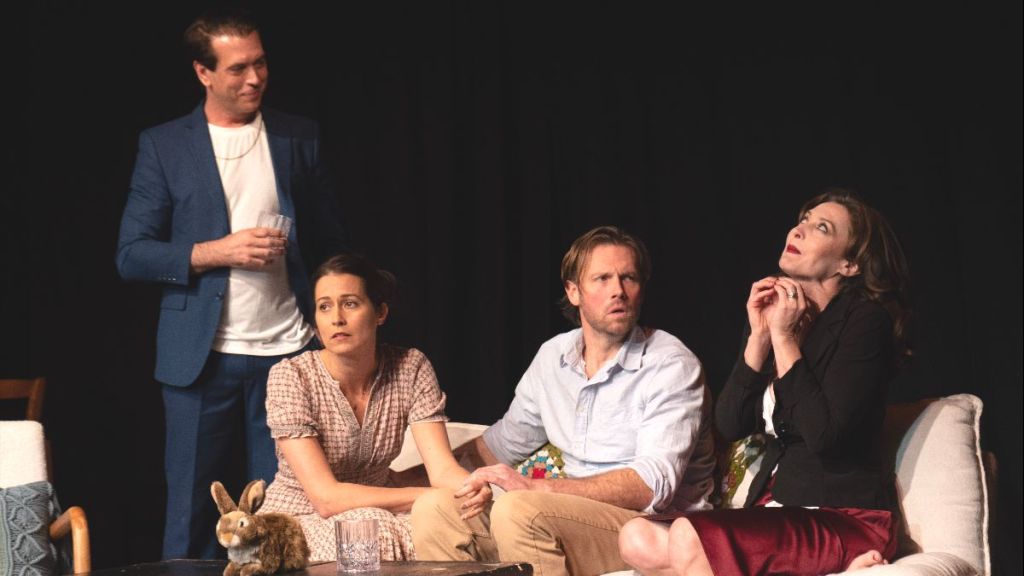
Michael Shaw Fisher is pushing boundaries again with his off-Broadway play The Amazing Sex Life of Rabbits. But this time, the man who gave theater audiences a rock version of The Exorcist is startling them with just four people in one room.
In The Amazing Sex Life of Rabbits, two couples meet for dinner. But one of them happens to be an ex-spouse of another one, which is never a good sign. And from there on, things spin out of control. Michael sat down with TVBrittanyF.com to discuss the play and what he’s enjoyed about something so deceptively simple.
Brittany Frederick: How do you describe The Amazing Sex Life of Rabbits to people?
Michael Shaw Fisher: I usually say there’s a couple, and they are having a couple guests over to their house for dinner—one of whom is the ex-wife of the husband of the first couple. And they are people who are affluent, we could say; very different class and financial just tax bracket than the first people. The second couple has a proposition for the first couple and all hell breaks loose.
It’s really a play about power and about sex being used as a weapon in this sort of class war, and nostalgia and a lot of wild things that kind of fall into place as each revelation upon revelation happens throughout the play.
This couldn’t be more different from Exorcistic, when you did your rock parody version of The Exorcist. So what made this idea stand out to you?
The idea sometimes really chooses you if it’s something that’s so good, and it’s socially critical. I think that it has that in common with Exorcistic. I think both plays are are definitely critical and aware of the world we’re in and commenting on it, in some cases mercilessly.
But the actual idea, if it doesn’t leave you alone, if the thing keeps you up at night for years and years, then it’s obvious that you have to pursue it. You can’t let the thing go unwritten, in my opinion. It’s begging for you to do it, and it’s promising you, in a way, that other people will also be haunted by the same idea.
The Amazing Sex Life of Rabbits is a testament to the breadth of your career. What interests you in trying many different ideas and styles, as opposed to finding one genre or approach that you particularly love?
I don’t know how practical it is that I love poetry and I love novels and I love plays and musicals and so many different types of things within that. It’s not practical at all. It’s the stupidest thing in the world from a business standpoint. But we’re talking about being haunted by ideas; you can’t let it go. You’ve got to finish the thing. You’ve got to do that.
When I was younger, just starting out writing, I was just a poet. That was the only thing that I was really writing. That opened me up, in a way, to all the elements that are within poetry. Dialogue within poetry, sometimes characters appear, sometimes it feels more novelistic, sometimes it feels more musical. And so I approach writing without any sort of rules in my head, because poetry is something so freeform. When I sort of left poetry, I was like well, I’ll write plays; no, I’ll write musicals; I’ll write screenplays, because I felt like I’d already had a taste of everything.
When you’re working on something where it’s so focused, with just these four people in one room, what do you learn as a playwright? What have you taken away from the experience?
I love just the basics of four people in a room, with their objectives colliding and their humanity colliding and opening each other up. I love that. I love the fact that it’s not based off of any other IP [intellectual properly]. It’s its own thing. It’s tackling certain issues that are very close to my heart—certain comments and questions that are directed at the human race, that are very close to my heart.
But mostly I love, like you’re saying, just being in the room with four people and directing them, and being able to work out every little detail in terms of the pacing, in terms of the tension. When you’re writing a novel, you are the director and the writer and the composer and the set designer. You’re doing all of these things. And if you’re a creator of a TV show, or if you are a director of a movie, you have a lot of that kind of input. Just in terms of the stage, I haven’t given myself permission to do that, where it’s just me sitting there.
Mia Criss gave some incredible set design elements to this as well. But [when] we didn’t have Mia yet, it’s just me, just kind of being like, what do we got? Here are the actors. Here’s the text. Here are the moments broken down beat by beat. And what’s the story like? How do we tell that story together? Letting the actors throw their input at me, and their questions and ideas, and all of us just cooking this thing up together without music, without a bunch of big production elements—I love that. That was the core of what we want to get to.
This is another production you’re working on with Leigh Wulff, who plays Elise. Did you write that part with her in mind, and what is it like to have a regular collaborator?
I didn’t write it for her at all. I wrote it and then had the characters in my head, and then I started looking at people, and [producer] Alli [Miller] and I both were like, Leigh for this makes sense. I love her. I would write things for her. But the problem with writing something for somebody is, what if they can’t do it? So you want the truest thing that you could possibly make in your head, and then hopefully they can jump on board.
Her singing is astounding, and in this show, she’s so raw and she’s so open, and she’s so committed to exploring the moment and doing that with honesty and inclusion. That’s something about Leigh that I find to be very interesting is that she’s such an inclusive actor; she brings the audience with her on her journey. She leaves no one behind. Some actors pride themselves on being isolated and being unreachable enigmas, but I feel that Leigh is sort of this human being that if you’re in a room with her, she’s infectious, and that also happens on the stage with her performance.
How would you describe the rest of the Amazing Sex Life of Rabbits cast? What do you love about them?
Schoen Hodges, who’s playing Bobby, is kind of like our a bit like our protagonist; he’s a bit of our viewpoint character. Richardson Cisneros-Jones, who is the husband of the couple that’s showing up; he’s playing the billionaire. What incredible work [from] both those actors, and also Rebecca Larsen. She’s just inhuman in so many ways—so seductive and infuriating at the same time. Just perfectly representing an obtuseness of a certain class of people, a real tone-deaf potential for cruelty.
I love to see them go at each other. I love to hear the knife fight of words take place, the slashes at each other across the stage. In this day and age, it’s hard to imagine sitting down at a play and hearing four people talk without looking at your phone. Everybody’s been really programmed to look at their phones… But this play, these actors, it escalates so steadily. We try not to rest on our laurels. We’re not trying to take that attention for granted. And we build and we build and we build. Revelation leads to revelation leads to revelation, and it grows to the point where you can’t look away.
That’s the gift of this show. That’s what makes this play different than some other play that is expecting to be indulged. This play does not expect to be indulged. It wants to earn your attention and continues to beat by beat, revelation by horrific revelation.
The Amazing Sex Life of Rabbits runs at New York’s SoHo Playhouse now through March 28, 2026. Photo Credit: Courtesy of Alli Miller.
Article content is (c)2020-2026 Brittany Frederick and may not be excerpted or reproduced without express written permission by the author. Follow me on Twitter at @BFTVTwtr and on Instagram at @BFTVGram. For story pitches, contact me at tvbrittanyf@yahoo.com.

 TVBrittanyF.com