
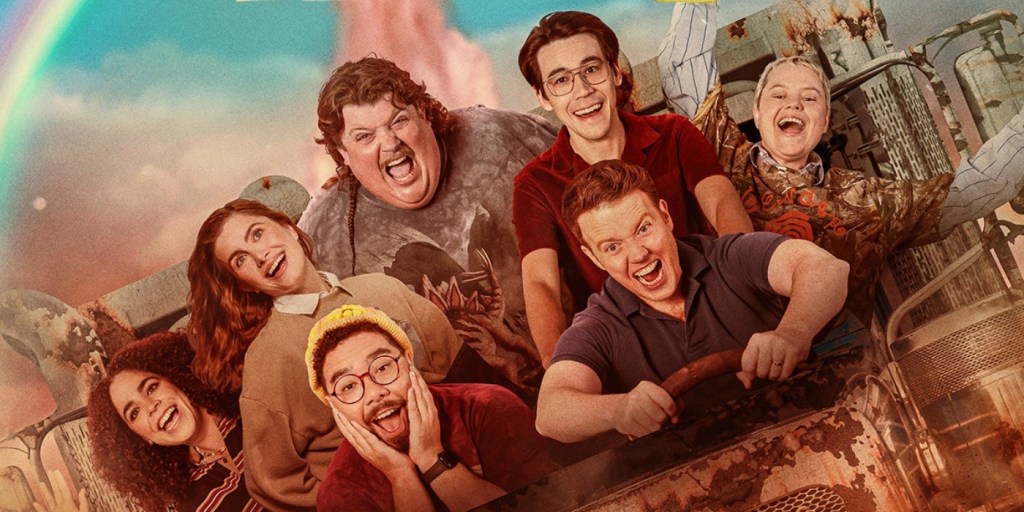
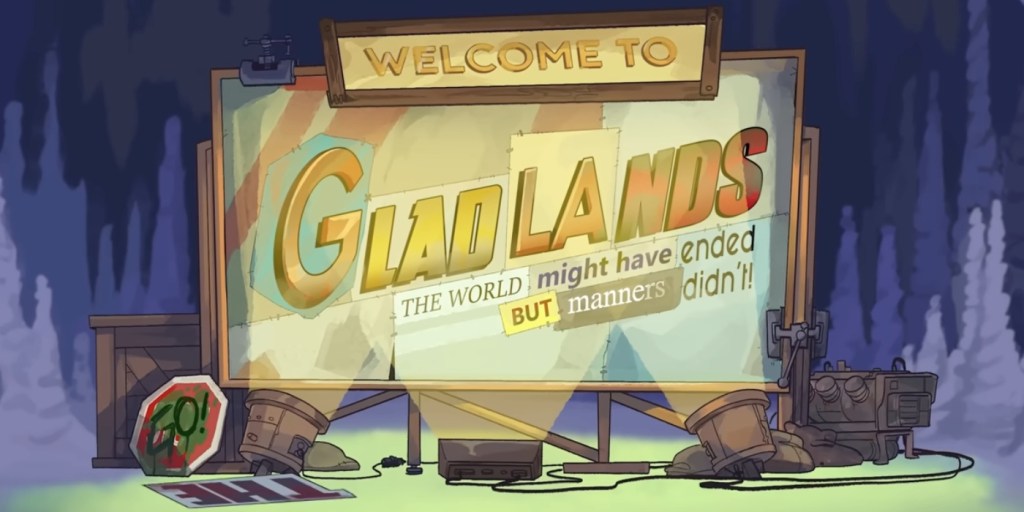
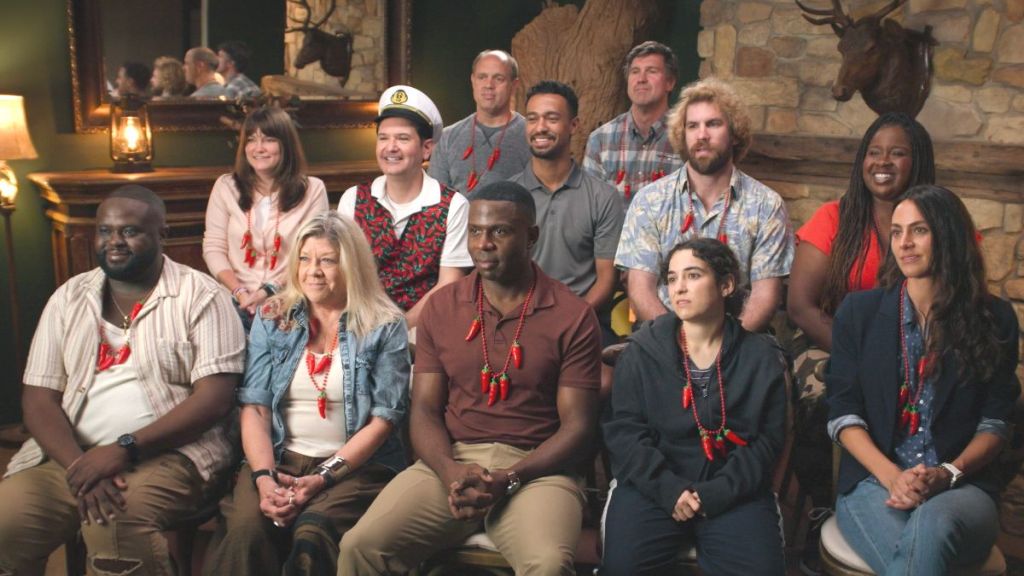
The latest season of Dimension 20 is just as wild as ever, with the hit TTRPG Dropout series bringing together a new, vivid cast of weirdos for a strange adventure. Gladlands takes the archetypes established in post-apocalyptic settings like Mad Max and flips them on their head by introducing the Dusty Do-Gooders, a well-meaning band of travelers who spread joy and peace through the wastelands.
Even compared to other seasons, there’s a real sense of manic comedy to the adventure that fits in perfectly with the Dropout tone. However, the performers behind the characters also brought a lot of surprising vulnerability to their creations. During an interview with TVBrittanyF, four of the season’s stars — Kimia Behpoornia, Vic Michaelis, Oscar Montoya, and Jacob Wysocki — discussed crafting their wasteland characters for Gladlands, the magic of Dimension 20, and the beautiful simplicity of “hot, lovable dum dums.”
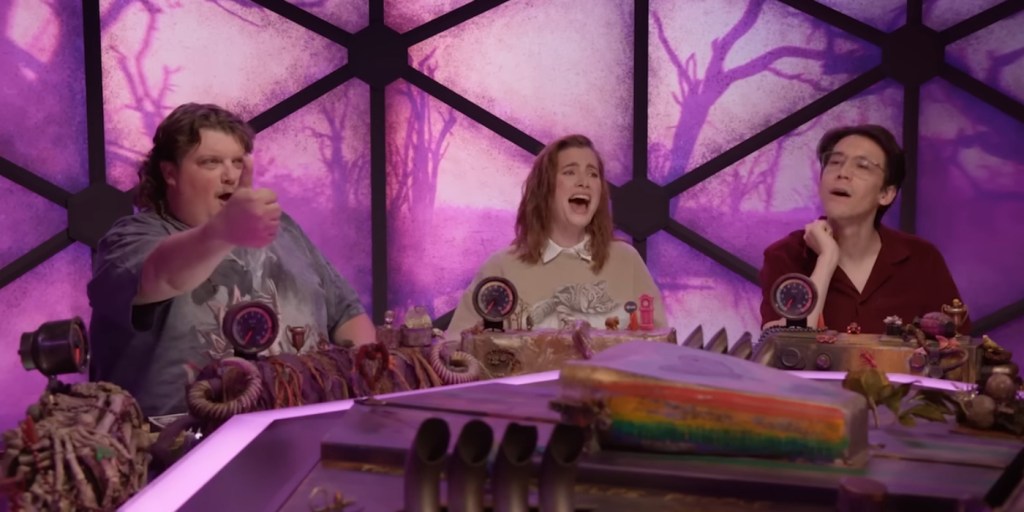
Brandon Zachary: Vic and Kimia, congrats on your first appearances in Dimension 20! What was like adjusting to this approach to long-form improv comedy for Gladlands?
Vic: I can sometimes forget that Dimension 20 is a part of Dropout, because it really is such a singular institution. It holds such a special place for the fans. Even physically at Dropout, it’s really in its own space. I remember when I walked onto the stage for the first time, I was like, ‘I did not know that this was here!’ I’d never opened the door that led to this entire world, which is very indicative of the experience. You literally open this door, and you’re walking onto this dome set that you can only access when you’re on a season of Dimension 20. It really was like, top to bottom, a pretty surreal and magical experience. Then you just sort of go back to your everyday life, where you’re in the regular buildings, and you’re like, I have a secret! [Laughter]
Kimia: That’s totally it It wasn’t that the performing style or the improv or the way we used our brains that was really any different. I’m serious. It was truly just like, this is kind of the top-tier thing they do here. We have to walk in and play to that level.
Vic: On breaks, Kimia and I would keep going, ‘We got to focus. Focus!’
Kimia: Given the chaos of the episodes themselves, that’s the best thing we could do. We knew we had to focus, and we really had to become unhinged and see what we could do.
Oscar and Jacob, this is your second time in the Dome. What lessons from your previous appearances on Dimension 20 did you make sure to keep in mind during Gladlands?
Oscar: The biggest lesson I learned from Court of Fey and Flowers is to not romance Brennen Lee Mulligan. [Laughter] That was the biggest lesson I learned. Seriously, though, I think the biggest lesson I learned is to just make the moves. Don’t think about them. Don’t sit on them. There were things I wanted to do in Court, but because it was my first time there, I was like, ‘I don’t know if I can.’ On this one, I was like, ‘No, I’m gonna do something crazy. I’m gonna do chaotic stuff!’ I just acted on impulse this time.
Jacob: It’s right on the money. I feel like I did a couple of things [in Never Stop Blowing Up] that I was kind of afraid to do. I was worried to take this big of a swing, but then they ended up being some of my favorite moments in that season. I think it just reinforced that this thing lives on big swings, and there’s no big swing Brennan can’t handle and spin into perfect story fiber. He’s just that good. It was just the big swings, man, just take them and they’ll land. You got like five other brilliant people there to help you make it good.
How did you approach character creation for a setting like this?
Jacob: The nature of the premise of [Gladlands] was so different than Never Stop Blowing Up that I think I automatically knew I was going to be playing a really different character. It seemed like I had options to play a character that was less human, more its own entity. I knew it was going to be way different than the punk kid I played before. As far as creation, I really saw this season as a 50/50, split, half post-apocalyptic, half fun kid stuff.
So I was like, well, what’s the fun kid vibe that I want? I kind of found these things in Kokomo, being a helper and being almost a nurse. Daycare sort of ideas were coming to mind. That led to the vibe of Kokomo, and then the aesthetic and name and all that stuff came from extracting information from the Mad Max part. He can be mutated; he can look different. He can be non-human, and that’s all just kind of stacked on top of each other.
Oscar: I don’t have the range that Jacob has, so it’s just the same character that I played before. [Laughter] The inspiration of Gladlands is Mad Max, a post-apocalyptic caretaker. For me, Poppy Persona is an Auntie entity from Mad Max Beyond Thunderdome. I was thinking, in this world, what would be her Thunderdome? It’s the dome of dreams, obviously, we’re helping people out through fiction. But honestly, the difference between Delloso De La Rue and Poppy Persona is not that big. I will say, without spoiling too much is that Rue is the inverse of Poppy, and that’s all I’ll say about that.
Kimia: It was simple. I heard it was going to be an apocalypse, and I went, ‘What’s something that survives that long? I love a yearning and a longing and a mystery. And I was like, what if this guy was here from before, during, and after [the apocalypse] all happened? And I was like, it’s a cockroach. But I hate bugs, so I edited it to be like, he’s also hot, so I can get behind it. He’s hot and stupid, and he survived it all.
Vic: Which are, I think, some of my favorite Kimia-type characters. Just you playing a dumb hottie. It’s a trope you play so well and play with a lot of heart, which I think people forget about. That is the most important piece in playing those types of characters.
Kimia: Dumb dopes are often the ones where you can get the simplest philosophy through their point of view, and that’s often what speaks to people the most, because it’s so bite-sized, it’s so easy to understand, but it resonates so hard. So I love using a dumb character to push through a big message. I
Vic: At the end of the day, if you really boil down a lot of characters’ philosophies, it’s usually simple things, you know? You want to be liked, you want power, very simple, simple things. We both picked really simple characters. Two hot, lovable Dum Dums. With Hooky, I had recently read this book called From Here to Eternity, which is sort of like an anthropological look at death rituals across the world. It’s a woman who really goes in and, once you take the grieving process out of it and realize that it’s something that everybody goes through, it’s something that everybody has to do.
There are interesting ways around the world in which people deal with it. Really looking at grief from a perspective of, rather it being a qualitative thing that’s hard to look at or like a bad thing, just deciding it’s a part of this ritual — talking about it that way and incorporating it that way, I just thought was really fascinating. It made me feel so much better about death as a whole. We also talked a lot about how some of us on the caravan sort of have jobs that people are still going to have. People still die in a post-apocalyptic world. How in this world, where we’re trying to look after our neighbors, would we be handling that? I realized everyone would have artisanal, for lack of a better word, ways in which they handle death.
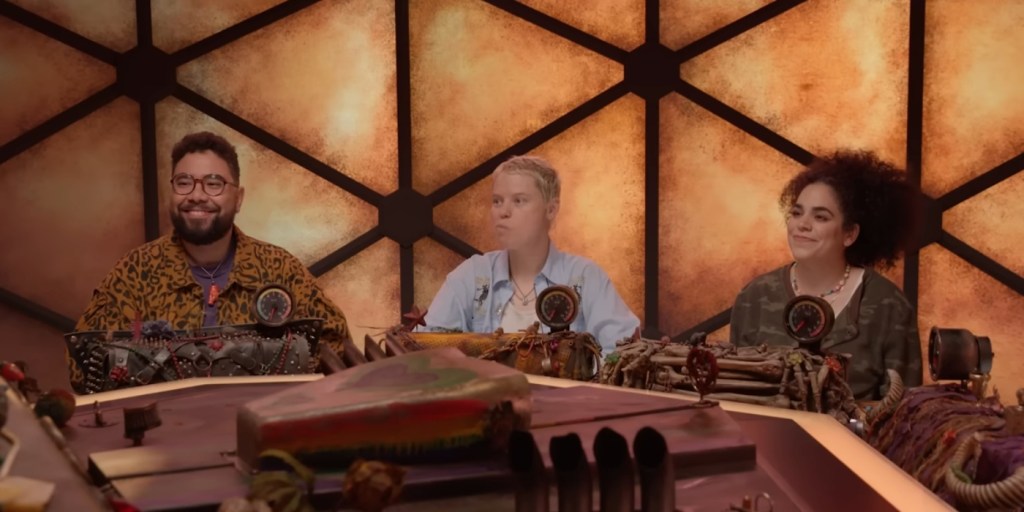
Gladlands has such a fun tonal balancing act between the natural horror elements of this apocalyptic setting and the genuine sweetness of the characters. As performers, how do you approach that balancing act?
Jacob: I just kind of leaned on Brennan, to be honest. I hate to use that as a scapegoat, but I think that — when I initially heard the premise, I did not have an immediate, like, Minority Report screen of the map where I was like, yep, there it all is. If you asked me to do a cowboy Star Wars? Yep, got it. I see it. But this was something that I did have to sit back and think about. Once I kind of figured out that ratio, it was really just kind of presented to us where it was like, here’s a car chase, here’s a chili cook-off. As a performer, you’re like, well, this really seems like the time for us to be Mad Max and pull out a helicopter umbrella. And this seems like a time to be like a sweet chili cook-off, Judge,
Oscar: To Jacob’s point, I think Brennan is so good at creating the environment and just telling us what the tone of every scene should feel like. Throughout the entire seasons of Gladlands, he was just shepherding cats the entire time. We were all like being absolute maniacs, but we all knew when to fully walk in when it came time to. I think the magic of Dimension 20 is that it’s funny, but it also has this deep emotional resonance. You see that in this show, it ranges from wildly insane, chaotic, super height of stupidity stuff, and then you have scenes that are so emotional and incredibly vulnerable. So it sort of runs the gamut, you know? I think that’s a testament to how well Brennan Lee Mulligan GMs.
Vic: Well, I think it just builds stakes. I think a lot of comedy comes from the space between expectation and reality, where you want to be and where you are. I think in a situation like this, where the stakes are so high — they’re literally life and death — it’s one of those things where it’s fun to see those moments where you’re doing little stupid stuff, and then you’re like, ‘Oh no, right, if you touch the water, you burn and you die.’ like, I think there is a lot of comedy there, and a lot of stakes for the characters. It is very fun when we get to roll those post-apocalyptic mayhem checks, where it’s just like, the violence is easy.
Kimia: It wasn’t that hard in my mind, because I wasn’t thinking about the setting so much. It felt like anytime we were making choices, it was Brennan who was reminding us, like, oh, by the way, this is in this world. This is what happens when you do that. It was freeing in that way, to play the human part of all of these characters and then have our teammate, Brennan, be the man of this world. It was a group effort to bring that contrast together.
What surprised you the most about your experiences in the Gladlands?
Kimia: I’ll tell you, I certainly didn’t think I was going to cry as much as I did when we were there.
Vic: Agreed. I know with Dimension 20, it’s a lot of us all building the story, and I knew that going in. But I thought that we were sort of filling in a mold that had been built for us already. I thought it was going to be a lot of us figuring out where the walls to the mold were, and what we were making — have you seen those videos where it’s a person and they have those molds, and they’re like, ‘I bought 500 molds!’ And they pour goop in it, and then open it up, and it’s a cow. I thought it was like a surprise mold where we were trying to figure it out, while Brennen knew exactly what it was we were building.
I think after the first day, I was like, ‘Oh, no. We’re all building this. I don’t know that that is the case for every season, but certainly in this season, it was a lot of us making choices and talking about stuff, rolling dice, and giving attributes to the location that we’re about to go to. It truly was such a creatively fulfilling process. It was so fun. I was going to use the word collaborative, but I knew it was gonna be collaborative going in, but it was so much more than I thought it was going to be, in a really wonderful way.
Kimia: You’re so right. We had a lot more control than I thought we were going to have. I thought, especially since we were new, we were just going to be little players in the corner, pawns to add little things here and there. But… it was like everything everyone said mattered and had to exist. It was needed. We needed every part of it.
Jacob: I’m going to maybe sound a little cynical, and I’m going to jump because I can tell that Oscar’s going to think of something very nice, but I’m not big on D&D. I’m not trying to take shots at anybody here. It’s just not necessarily my default cup of tea. I think we all, and I especially, participated in [Gladlands] in a way that didn’t feel how D&D normally makes me feel. I think that’s because it was truthfully being built and actually being locked in. It was people really locking with each other and acting and reacting, instead of somebody going, ‘I’m going to take my big emotional moment here that hasn’t been earned, but it feels like it’s time for that.’ I think there is a maturity to our storytelling because of the level of performers and improvisers that we are, that we can actually lock in and have a moment of heart, or have a moment that’s a little heavy, and it doesn’t come off as hokey. I think that’s what surprised me the most.
Oscar: I’m surprised that we were able to do a show! I’m surprised that we were able to tell a story. We were goofing so much. Are you kidding? I think we had 10 episodes worth of content, but they were like, ‘We can only use six.’ We were just joking. We were just having the best time. I hope that resonates. I think people can tell, but you all don’t understand how much fun we were all having in that dome; it was an absolute blast. And how can you not have fun?
Dimension 20: Gladlands is now streaming on Dropout
 TVBrittanyF.com