
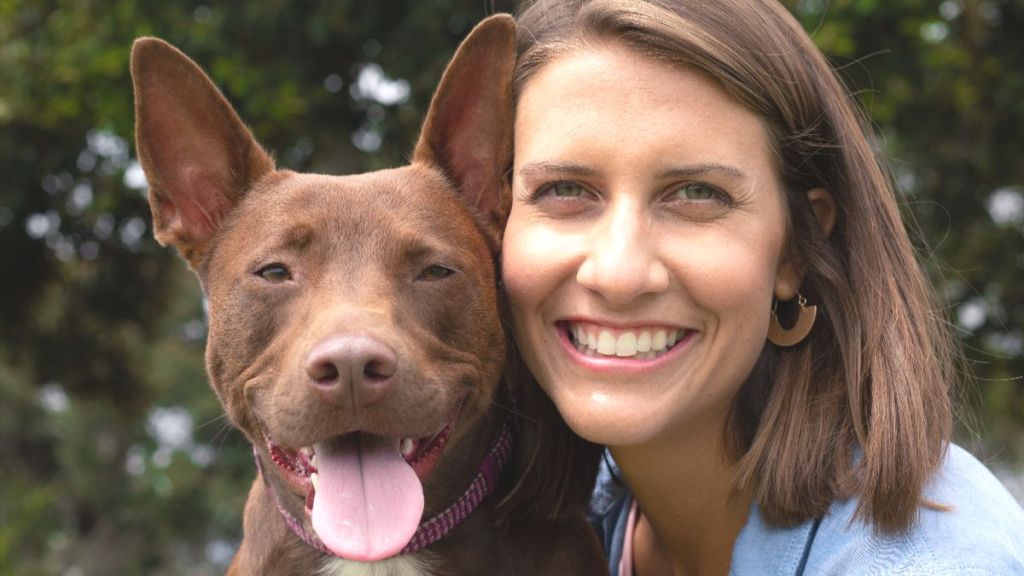
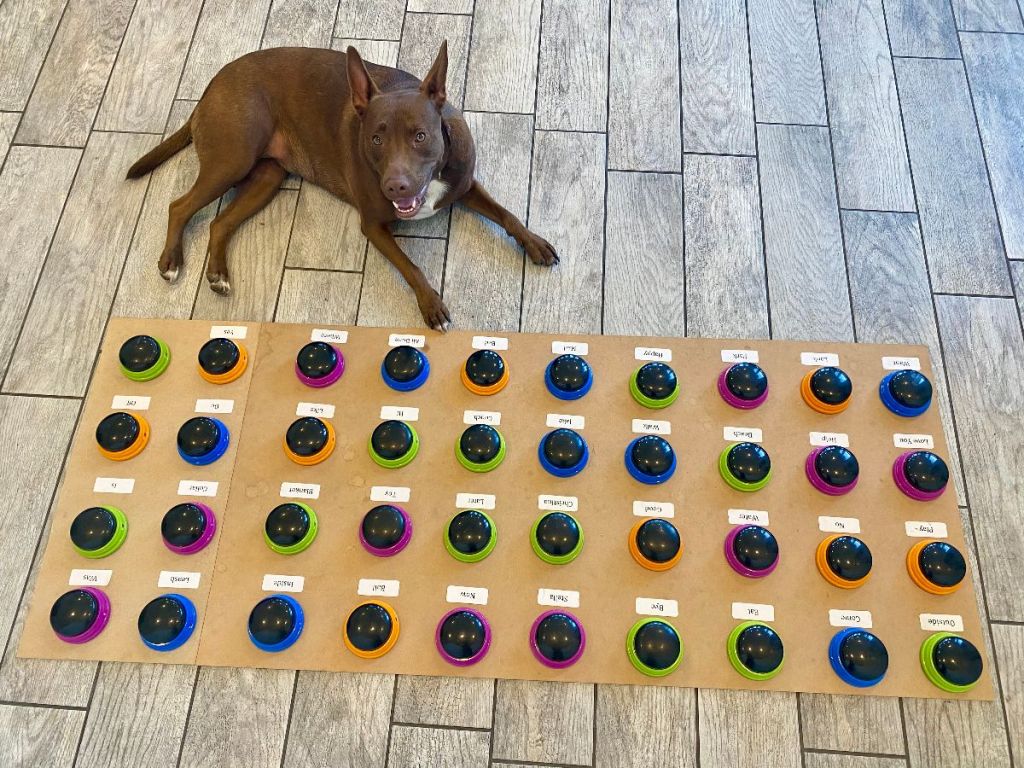
People have always wanted to communicate with their pets—and that’s what speech-language pathologist Christina Hunger set out to do. The PBS series NOVA documented the story of Christina and Stella, her beloved Catahoula—Blue Heeler mix who became the first “button dog,” using recorded sound buttons to communicate.
Before “Can Dogs Talk?” premieres on NOVA, TVBrittanyF.com spoke to Christina about her work with Stella and their journey in the public eye. Readers can also learn more about Christina’s work with both dogs and humans on her website (where they can purchase their own Talking Pet buttons!), and check out her two books: How Stella Learned to Talk and Your Dog Can Talk.
Brittany Frederick: Let’s start at the very beginning. What’s your history with dogs? Have you always been a dog person?
Christina Hunger: I always loved dogs. When I was growing up, I desperately wanted a dog. I had really bad asthma, and so it took until I was 10 or 11 before we got the okay from my doctor that we could have a dog. But before then, I had robot dogs, all the stuffed dogs—I just dreamt of having a dog someday.
And so as soon as we got the all clear, I convinced my parents to get a puppy that summer. We had her—a boxer named Wrigley—until she passed away just a couple months before I got Stella, actually. So I’ve always loved dogs.
You work helping children communicate as a speech pathologist. Was teaching Stella to talk simply a natural extension of that, or how did you become interested in that idea?
It was a really natural extension of what I was doing with kids. And it truly came from my passion and curiosity about AAC—which are assistive communication devices. That’s what I was doing pretty much all day at work; was working with kids who were nonverbal or minimally verbal, and teaching them to talk with an assortment of different devices.
When I brought Stella home as a puppy, I really observed all the ways that she was already communicating and all the communication strengths that she had. It reminded me of the language development that toddlers go through, right before they start talking, because language doesn’t start with a toddler’s first words. It starts with all of these skills that develop leading up to that point. They’re pointing at things, they’re watching what you’re doing, they’re crying, they’re making different vocalizations. That’s exactly what Stella was doing too, just as a puppy.
I knew that dogs could understand words, just anecdotally from having dogs. I did a little bit of research into how many words dogs could understand. And then I just had this epiphany moment of, if dogs understand words, they just need a different way to say them. What would happen if I made a device and taught her like my clients?
How much of your prior knowledge about how humans communicate was then applicable to this project?
When I decided I wanted to try this whole idea out, I wasn’t looking at this as, can I train Stella to push buttons that say words? I didn’t think that would be true communication… I decided to test it out by saying, what if I do all of my speech therapy techniques with Stella? Could she learn in the same way that kids learn?
And that’s a really important distinction, because the fact that she did learn to say words and then what she learned to say is amazing. But also the fact that she could learn in a similar way to human children is something that isn’t appreciated enough. We’re so used to dog training techniques and how to condition them to do things, when in reality, they can pick up on a lot just by modeling, which is showing them what to do, listening to the words that we’re saying, and tapping into their intrinsic motivation to communicate.
Dogs are so communicative already; it’s building from their natural communication of what they’re already able to do. And I just had this question in mind of, if they’re showing these same early language skills that kids also demonstrate and then develop the ability to talk. What if I just gave Stella the ability to say words through a device? Could she do that as well?
What was your experience like going public with your work, putting yourself and Stella front and center for things like this NOVA special?
It started so unknowingly. I truly was just doing this for fun. I loved AAC, I loved communication, I loved my dog. I wanted to see what was possible. I really don’t have many videos from the early days of teaching, because I wasn’t doing it for something. I was just doing it for me. I took a couple videos early on to show my speech therapy friends and whatnot—and those are probably the early videos that are online or that you’ll see in the documentary.
But it wasn’t until about between a year and a year and a half in [that] I started realizing, Stella’s using about 30 different words. She’s combining words together every single day to create phrases. It’s not just with me; it’s with other people, with dog sitters, it’s in multiple different homes. This is something real happening here, and that’s when I wrote a blog. I launched a website, created a blog sharing videos of Stella, and then my observations of what I was noticing as a speech pathologist and why it was significant.
At first it was just me filming from my phone in our apartment and showing what Stella could say. And then in 2019 I got an email from a journalist at People who had seen my blog, had seen the videos of Stella… and that’s when it went crazy viral. Like number one story on People that day, trending on Apple News, it was insane. And so at that point is when the public attention started, and people started coming to my house—news stations, media outlets filming Stella interviewing me… It was like we’re on display. And it was obviously overwhelming, for all the reasons that you can probably imagine. But it was also really exciting to see this natural interest in it, and that so many people wanted the answers of how is this working, and can I do it with my dog too?
Is there anything in particular that you want people to take away from watching the NOVA documentary, or anything else that you want to share with the audience?
I want people to see what dogs are capable of, because that’s why I started sharing my work publicly to begin with. I thought this cannot stay in my living room. This is something very incredible that people need to be aware of—that dogs are capable of learning and saying.
And it didn’t stop there. It has inspired millions of people to introduce this in their own homes with their dogs, and now this humongous research study that I can’t wait to see in the documentary, about what the science is showing. I think that’s the really powerful part about this, is how far it’s gone beyond me, and that it’s really showing us as a society what our dogs are capable of.
I did, at the end of 2025, release a second book called Your Dog Can Talk. It’s a step-by-step guide to button training. My first book, How Stella Learned to Talk, was a New York Times bestseller. It was the whole story of invention, through teaching her and coming out to the world. And then this book was written after I spent years working with other people who were teaching their own dogs. So it’s the full methodology all in this book. Every single question that anyone would have is answered here—all the how tos, everything is there.
The NOVA installment “Can Dogs Talk?” premieres Wednesday, Feb. 4 at 9:00 p.m. ET/6:00 p.m. PT on PBS. It will also be available to stream on the PBS website, YouTube and the PBS app.
Article content is (c)2020-2026 Brittany Frederick and may not be excerpted or reproduced without express written permission by the author. Follow me on Twitter at @BFTVTwtr and on Instagram at @BFTVGram. For story pitches, contact me at tvbrittanyf@yahoo.com.

 TVBrittanyF.com