
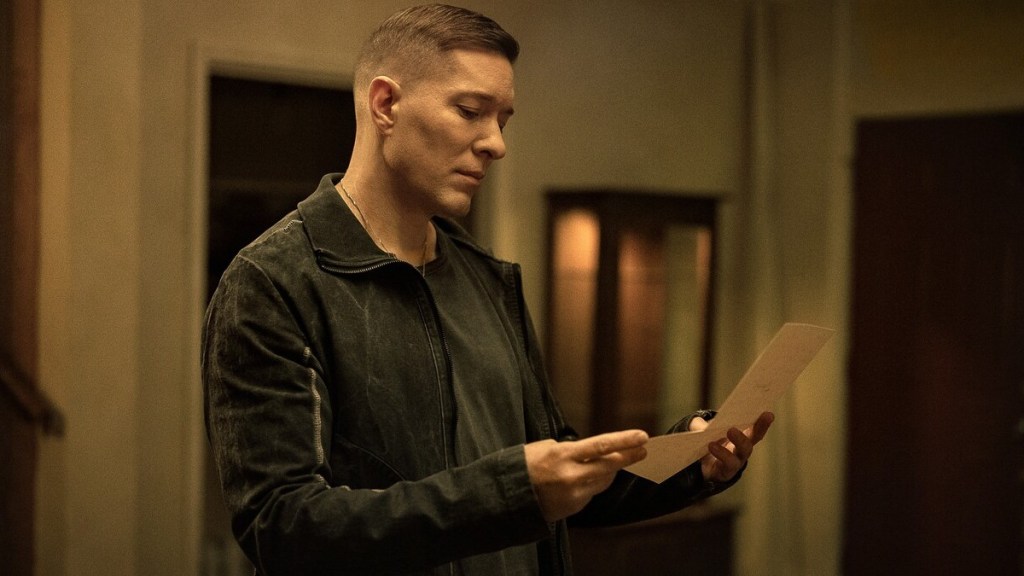
SPOILER ALERT: The following contains spoilers for Power Book IV: Force Season 3, Episode 10.
At the end of Power Book IV: Force, Tariq St. Patrick talks to Tommy Egan about the idea of legacy. That’s the perfect word to describe Tommy, as in Force, the question of his legacy truly comes to the forefront. At the same time, the show—particularly in its third and final season—builds a legacy for Tommy in the big picture of television antiheroes. Tommy Egan may not be a Walter White or a Don Draper, but he’s a far greater character than he’s ever been given credit for.
The “it factor” of Tommy Egan obviously goes back to the original Power. What creator Courtney A. Kemp did so well was take a crime genre trope and make it authentic. So many series (and movies) have played with the dichotomy of a criminal who is also a businessman or other public figure; in most cases, the latter is an act, a cover for them to more easily get away with the former. Countless procedurals have built their villains this way. One example is Eric Mabius as Jack Nesbitt on Chicago Fire—club owner using the business as a front for his criminal enterprise and charmingly evil until he got busted by Jesse Spencer’s Matthew Casey. The difference in Power was that there was a genuine dichotomy for James “Ghost” St. Patrick, as wonderfully played by Omari Hardwick. Ghost actually did feel like two separate people, and so the show wasn’t just using a dramatic device; it was the truest exploration of this idea.
Tommy was the biggest part of that journey. Of course Ghost had his relationships with Tasha and Angela, but the brotherhood between Ghost and Tommy was always at the core of Power. From his very first scene, Tommy represented—on a surface level—what the audience was expecting to see. Of course he was the brash guy torturing someone in a back space until Ghost came in and straightened him out. Tommy was rough around the edges, a clear counterbalance to Ghost, which made excellent sense for that series dramatically. For Ghost to go through an effective journey, he needed that similar yet opposite enough voice to play against. Even when they were at each other’s throats, they were still two parts of one narrative whole.
And over six seasons, Tommy made plenty of impact. When there’s an episode titled “Why Is Tommy Still Alive?” that’s an example of how much of a disruptor Tommy Egan could be. It’s also why his story, by the end of Power after six seasons, felt unfinished. As much as Kemp and her creative team accomplished with all the characters, Power was first and foremost Ghost’s story. Tommy was in second position; he was the right-hand man, the foil, the ride or die. So what the hell was Tommy Egan’s story, when Ghost wasn’t there anymore? There was only one real way to find out.
Giving Tommy his own spinoff with Power Book IV: Force was the natural progression of the character. Tommy was fantastic in a supporting role, whether it was in Power or in Power Book II: Ghost, and that speaks to the content of his character. He’s an example of loyalty in a world (and in a genre) where there is none. One of the backbones of gangster shows and movies is that everyone starts turning on everyone else—a hallmark that Power Book IV: Force particularly leaned into, but we’ll get back to that. Tommy ultimately cared about people, even if he took the long and sometimes violent way around to affirming it, such as everything that went down with Tariq and Tasha in Ghost. And when in this genre that is almost always seen as weakness, for Tommy Egan it became a strength.
That element is why Tommy was worth following across three shows. In a genre where toughness (real and performative) is in overwhelming supply, Tommy was capable of viable emotion, and yet that never took away from his being a gangster. He got burned, and he made decisions that didn’t work out, because he also never quite settled. But he could be both intimidating to an audience and someone that they connected with. That tone was set by the Power writers, yet it was also so well-executed by Joseph Sikora.
Each one of the series was distinct in style, so even though it was the same character, audiences saw different aspects of Tommy. And that requires an actor who can navigate those different tones, but also puncture that surface stereotype of “the gangster” and invest into what’s inside. Sikora has that talent to be charming when Tommy needs to be, fearsome when he wants to be, but at his core he’s just honestly relatable. He created an emotional connection with the audience. Because he cared so much about the the character, they cared about the character, like that friend everyone has who can be hard to handle, but you know they’re going to be there. If Tommy wasn’t walking around with a gun and/or drugs so often, he would be that guy you could invite over to the neighborhood barbecue—because of the actor playing him.
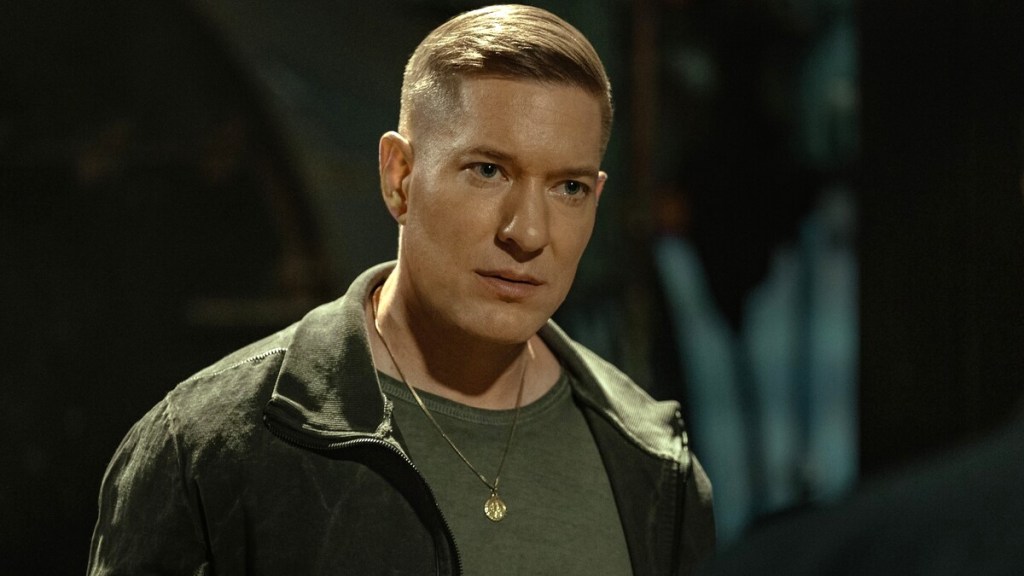
But how does one tap into that? What is the effective end to Tommy’s story, which is this search for identity—both who he is without Ghost, and who he is as a main character? The answer is simple: bring him back to basics. To fully understand Tommy Egan, fans needed to know his past beyond what had been discussed in Power, and they needed to see him in a new environment that he could make his own. Setting the spinoff in Chicago was a clean slate for Tommy (and the writers), with no expectation of references to the past, and very few preconceptions about who he was.
Power Book IV: Force took a great look at who Tommy Egan was through the most effective lens: his family. So much of Tommy is defined by family—found or otherwise. He’s a character who is searching for something, some sense of connection beyond the bottom line, as it continually slips through his fingers. We would not truly know Tommy if we didn’t meet his brother JP Gibbs (a fantastic Anthony Fleming, wonderful down to his bitter end). One could make the argument that Power Book IV: Force was as much a family story as it was a gangster drama, and that’s why Season 3 was almost perfect.
Over three seasons, Tommy and Diamond Sampson built an empire, but they also built their own relationship—a sort of parallel to Tommy and Ghost, as if Tommy got a second chance with the benefit of all his hard-earned New York experience. Audiences saw him make different choices, and he bonded with Diamond in a different way than he did with Ghost, because it was Tommy who was driving the train on this show. It was absolutely spot-on that what ultimately came between them was family, as Diamond’s reckless brother Jenard was finally able to get in Diamond’s ear and turn him against his partner.
The split between Tommy and Diamond was but one example of how Power Book IV: Force showrunner Gary Lennon—someone who knew Tommy’s character going all the way back to Season 2 of Power—used Season 3 to test Tommy’s growth and peel his character back to the bone. By Force Season 3, Tommy and Ghost had developed the biggest possible commonality: Tommy, like Ghost, was now seriously looking at his life in three-dimensional terms. Ghost had wanted to quit the drug game; Tommy wanted to build his life around it. But he still had his best chance at a life, thanks to his relationship with Mireya Garcia.
Season 3 challenged that by taking out almost everyone Tommy gave a damn about, and some people he didn’t. Killing Claudia Flynn provided a chance for Tommy to move up or potentially just move on. It was massive to lose JP, because losing JP was like losing half of Tommy. He was Tommy’s anchor. And to follow that up with Diamond dying from a bullet meant for Jenard—Season 3 wasn’t just Lennon going for broke because he knew the series was ending. It was him systematically tearing down Tommy’s world to see how the character would respond. If he even survived, would he revert to his old ways? Would he consider getting out? How did he react to loss now as opposed to losing Ghost years ago? And why did it feel even more personal this time, because this was the proverbial house that Tommy Egan built?
Which brings us back to the Power Book IV: Force series finale, the return of Tariq, and the future of Tommy. There is an element to the open-endedness of the finale that is frustrating; it’s expected to be a conclusion, and yet there is so much of it that is left unresolved. Based on Episodes 8 and 9, viewers are waiting for that last emphatic punch at the end that never comes. But from a character standpoint for Tommy, to leave it on that rooftop with Tariq is reasonably fitting. He still can’t quite stop. As much as he can slow down—as evidenced by his genuine joy at building a family with Mireya—he’s not going to completely walk away. He can’t do what Ghost tried so hard to do. Power Book IV: Force Season 3 explained why: he’s lost so much and he carries those scars. Within this world is where he feels safe, where he has control, even if it means living on the edge. We will never see him on a beach somewhere sipping a margarita (that should have been Vic Flynn, but that’s a separate argument).
Tariq showing up—and saving Tommy—is bringing the Power version of Tommy back into the picture. It’s coming full circle. Tariq not only is the physical representation of who Tommy was, but he has Tommy dead to rights when he says the other man loves a challenge. So will Tommy stay in Chicago and rule over this newfound empire, or does he go back to New York and go around again? What defines Tommy Egan’s legacy? He’s certainly created one in Chicago, but the last thing he says is that he likes the sound of Mireya and his kid “being on the streets where I grew up.” His legacy is in Mireya and his child. His legacy is in Tariq. It’s in the lives he affects in a positive way (even if it’s in an illegal and violent line of work), not how much product he moves. For Tommy, it all comes back to people.
In coming back to New York, Tommy can now take everything he’s learned and experienced in Chicago and apply it where it matters most to him. He can stand shoulder to shoulder with Tariq the way he did with Ghost.(Using the original Power theme song to sonically illustrate that was a nice touch.) Power Book IV: Force is actually just the second chapter of Tommy Egan; there’s a third chapter out there, because he’s not done growing. He may never feel completely at peace. But what happened in Chicago was what needed to happen for Tommy to evolve and come fully into his own, and now the progression of that is to go back home and look at that through a different lens. Chicago became home, but New York was always home.
And for the audience, Tommy Egan has a legacy as that rare character who had the chance to evolve over an entire decade—and who actually did it. Most characters don’t stay on our screens that long for a wide variety of reasons, and many actors may not be willing or able to inhabit a role as long as Joseph Sikora has. But that unique intersection of opportunity and commitment created a character who cracked the gangster stereotype. Tommy started in the most familiar place, but every step of the way, the more audiences got to know him, he was incredibly human.
He particularly found his humanity in Power Book IV: Force—not only because putting him front and center created the space to do that, but because standing on his own prompted that look in the mirror. And there’s a lot to love about Tommy Egan, beyond the coolness factor and the sharp one-liners. He’s driven as much by his heart as he is by winning; there’s a reason to root for his success beyond his being the protagonist. It’s because his success is motivated by that character growth, not the other way around. Although it’s not over yet—because let’s make one thing clear: the way that finale scene ended, we definitely haven’t seen the last of Tommy Egan.
Power Book IV: Force is now streaming on the Starz app. Photo Credit: Courtesy of Starz.
Article content is (c)2020-2026 Brittany Frederick and may not be excerpted or reproduced without express written permission by the author. Follow me on Twitter at @BFTVTwtr and on Instagram at @BFTVGram. For story pitches, contact me at tvbrittanyf@yahoo.com.




 TVBrittanyF.com