
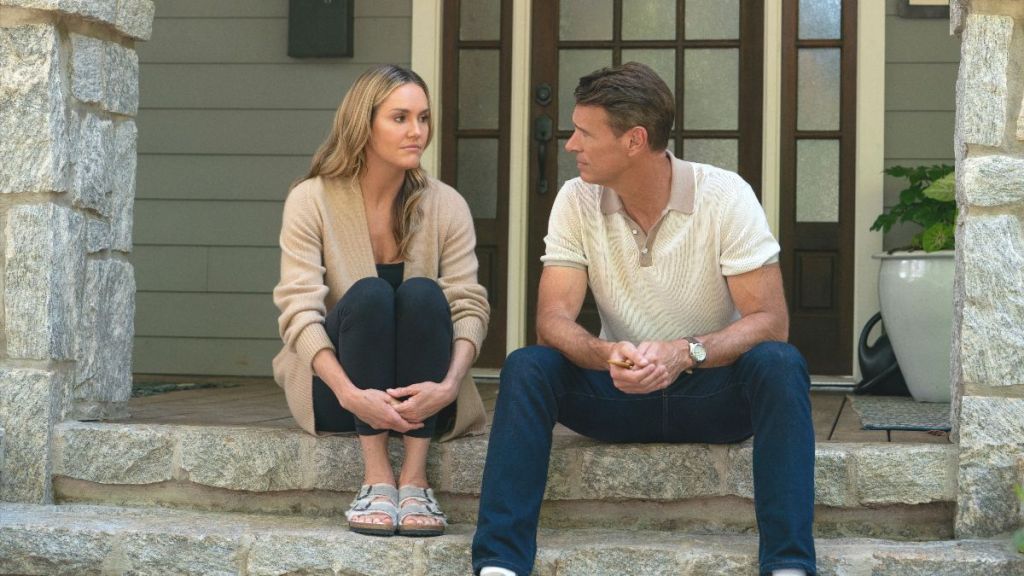
Ian Deitchman and Kristin Robinson are about to melt audiences’ hearts with their Wonder Project series It’s Not Like That, which takes viewers on a journey of second chances and new opportunities. Scott Foley and Erinn Hayes star as Pastor Malcolm Jeffries and Lori Soto, who navigate a shared loss when Malcolm’s wife—who’s also Lori’s best friend—dies. On top of that, Lori is going through a divorce. In the aftermath, both of these friends face new challenges in life, but they also find something special in each other.
It’s Not Like That covers a wide variety of topics and a wide breadth of emotions as Malcolm, Lori and their families adjust to their new normal. In an interview with TVBrittanyF.com, Robinson and Deitchman spoke about why they’re drawn to family-centric storytelling and what they want to accomplish. They also spoke about how their experience on the NBC drama Ordinary Joe influenced It’s Not Like That, which premieres Jan. 25 on Wonder Project on Prime Video.
Brittany Frederick: What was it about the idea of It’s Not Like That which resonated with the two of you as creators? What made you so excited about telling this story?
Ian Deitchman: This story kind of comes from real life—from our own lives, but also from the lives of close friends and family. We had a mutual college friend who passed suddenly from cancer and left a family behind. And my wife and I had very close friends who we had gotten to know through our kids… Then they very suddenly got a divorce.
That moment in the pilot—where Lori just hands the iPad to Malcolm and is like just pick one, I can’t—that literally happened to me in my life. My friend handed me her iPad, and I just started making fun of all the guys. And then Kris and I talked and [were] like, oh, there’s a story there. There’s a lot there that’s emotional but funny, like tragi-comic, which is kind of where we live, and so we just immediately dove into writing it. That’s our sweet spot.
It’s Not Like That bears some similarities to another show that you worked on, Ordinary Joe. Both are very character- and emotionally- driven, and both deal with different possibilities. Did that series have an influence on this one?
Kristin Robinson: We were very fortunate enough to work with Garrett Lerner, who created that show. He is the other executive producer on this show… Everybody, as we go through life, are faced with choices that take us in different directions. There’s certainly things [like] that here, especially with with Malcolm and Lori. What choices are they going to make moving forwards that will affect them, their families—the ramifications ripple out, right? So it has to be a very thoughtful conversation and progression. So yeah, we definitely tapped into that experience.
Deitchman: I’ll just add that Garrett and his creative partner Russell Friend, they really let us be involved in every aspect of that show—get our hands dirty in post, in production. So it was an incredible learning experience for us, to be able to take all of that knowledge into the prep, production, post of this show. And then also to have Garrett with us on this show, kind of as a sounding board. That was a dream show. We love that show.
Many of your previous projects, from that to Parenthood, are about family in some way, whether it’s biological or found family. What is it about that subject that continues to appeal to you creatively?
Robinson: We love writing stories with family at the core—usually [one] that isn’t necessarily sort of traditional-looking. It’s taking many different shapes. There is an inherent messiness to those kinds of relationships that is appealing, because there are lots of levels to that. That’s always the space that we’ve lived in and worked in, because there can be so much pain, and there can be so much laughter too. So it’s a nice balance.
Deitchman: We both have varied tastes and love all different kinds and types of shows and movies. But the Venn diagram, in a huge way, meets in the middle of romantic comedies, romantic dramedies, family dramedies. That kind of movie and show has just always sparked both of us. When they’re really done well, those characters live in you. And for both of us, that’s what we want. What gets us most excited is being able to create something like that.
What is special about It’s Not Like That is that every character is fully fleshed out. It’s not the Malcolm and Lori show with everyone else on the second tier. How were you able to service so many characters so well?
Robinson: It is not easy. We probably honed a skill set on Parenthood, of juggling multiple characters and creating situations where you can tell all those stories. There are not a lot of shows like this around. As Ian likes to say, there’s no cops and lawyers or murders. It is just these relationships.
But that means you can really tell the stories about these relationships. So there are stories for each and every kid. That was very important to us. They’re all experiencing grief in their own way. We didn’t want to shortchange that; they’re intertwined. So it affords us the opportunity to tell all those stories.
How did you approach the writing of the children specifically? That tends to be something most TV dramas fail at.
Deitchman: It ties into what we were just talking about. The original version of this script is what actually got us onto the show Parenthood. We wrote it as a spec pilot, and Jason Katims read it and brought us on. We started [in] Season 5, which was a 22-episode season… It was such an education and such a soft landing for us, coming out of features.
The reality is you just treat each of these characters as people and multi-dimensional people, and you try to live in the small moments. You try to tell enough story that it’s always moving, but you’re living in the small moments that everybody can connect with. That’s when small things feel big and feel universal. And it’s no different for kids.
One of the things we got a little nervous about at when we were casting was, reading through we were like, we wrote some hard scenes for kids here. But we got incredibly blessed by all the young people who came onto this show. They all were ready for prime time and eager to learn, and eager to get their hands dirty and really dig in with these characters.
And then we had Scott and Erinn and J.R. [Ramirez], who brought all of them under their wing in this phenomenal way, and just created this space on stage where everyone was just so happy to go and be there.
Now that you’ve gotten it off the page and onto the screen, what scenes or lines from It’s Not Like That stand out to you? What are some of your highlights?
Deitchman: For me, one of the things that was personally a favorite moment was the scene in the pilot with Malcolm and Lori in the car. That was a scene that really changed very little from our very first pilot draft to the current version. And when we were actually able to film that scene, it was such a magical moment for the two of us. It’s so good. They’re [Foley and Hayes] so good in it. That’s a really special one.
Robinson: I would say there’s a line in the pilot where Justin, who is Malcolm’s youngest, says who do you talk to, Dad? I love moments where the kids sort of provide insight into their parents without meaning to, in small moments that are sort of eye-opening, and his ability to tune into his dad is pretty sweet. So that’s a moment.
It’s Not Like That premieres on Wonder Project on Prime Video on Sunday, Jan. 25, 2026. Photo Credit: Steve Dietl/Courtesy of Amazon MGM Studios.
Article content is (c)2020-2026 Brittany Frederick and may not be excerpted or reproduced without express written permission by the author. Follow me on Twitter at @BFTVTwtr and on Instagram at @BFTVGram. For story pitches, contact me at tvbrittanyf@yahoo.com.

 TVBrittanyF.com