
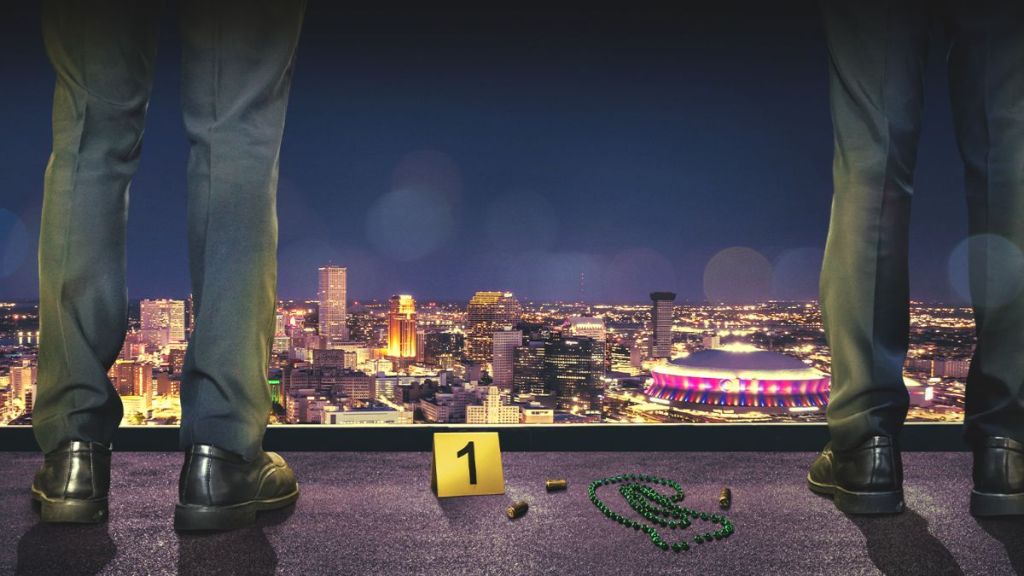
SPOILER ALERT: The following contains spoilers for Homicide Squad: New Orleans Season 3, Episode 1.
Homicide Squad: New Orleans and The First 48 have a lot of things in common. They air on the same network. They cover the same subject. They use some of the same narrative devices. And in the Homicide Squad: New Orleans Season 3 premiere, viewers were watching one of the detectives who originally appeared on The First 48. But when one looks at the two shows side-by-side—as is possible to do since they air together on Thursday nights—Homicide Squad makes an argument for the longevity of The First 48, as much as it does its own success.
It makes sense to pair Homicide Squad: New Orleans with The First 48, because A&E viewers know the New Orleans homicide squad from the years that they were featured on The First 48. Det. Rayell Johnson, the detective featured in the Season 3 premiere “Teenage Tragedy,” was also front and center in episodes of The First 48, and he wasn’t the only one. Homicide Squad has provided a much-appreciated opportunity to see where these detectives are now. But the series itself is handled in an entirely different way, by an entirely different production team; it’s a product of the intersection between true crime and entertainment. And that works on its own level, but it needs The First 48 to balance it out.
As we’ve discussed previously, the massive popularity of true crime has created not only an overwhelming amount of new content across all mediums, but a shift in the way that content is produced. Homicide Squad: New Orleans is still following Rayell Johnson’s pursuit of justice, but it’s doing so in a way that’s more oriented toward television viewers. In the Season 3 premiere, almost every time there’s a major development, the episode cuts back to Johnson telling audiences what he’s thinking. There’s also a considerable use of on-screen text so people can read what episodes don’t show. These explanatory devices have the side effect of promoting passive viewership. Viewers don’t have to actively watch, because everything important is told to them in one way or another. That’s fine for folks who just want to watch a good story, but it misses out on a lot.
In contrast, The First 48 is more about the journey within a homicide investigation than it is getting to the end of that story. The core concept of following the first two days of a case means that there’s a relatively straight line for audiences to follow, with all the extra detail and engagement that provides. Any skipping ahead in time comes after the show’s only catch-up device: the “in the first 48” mid-episode rewind. But that’s summarizing what viewers have already been able to see; it’s not a replacement. And the to-camera interviews in First 48 episodes are far more organic and used more sparingly. They happen as events develop, not after the fact in a separate room. The show is still entertaining, yet it’s geared toward giving people greater insight into the investigative process. And in so doing, it provides A&E an immense amount of credibility as a true crime brand.
One of the most common complaints about the entire true crime world is not wanting to exploit or trivialize tragedy. That makes it critically important to have a series like The First 48 that provides education and prompts discussion. It’s easy to get lost in the suspense and drama that’s inherent in true crime, for the same reason that TV has a massive number of scripted crime shows. True crime has the opportunity to go beyond that—whether it’s raising awareness amongst the public, or as a platform for victims or their families to be heard. The First 48 is the one series that doesn’t just show what happens, but continually adds something to the discussion. Without it, the true crime genre would be much more one-dimensional. By putting these two series together in a two-hour block, A&E is giving viewers a much broader picture.
Homicide Squad: New Orleans and The First 48 are two totally different shows, and there is a place for them both. Each one serves a separate purpose. Homicide Squad has plenty of entertainment value as it comes from a production company that’s also behind some of TV’s most popular crime dramas. But if anyone is still wondering why The First 48 has lasted decades and dozens of seasons, and deserves to last even more, it’s also an example of that. Aside from all the things The First 48 does right creatively, it fills a need that no other true crime show can—the series that emphasizes the true part. There probably wouldn’t be a Homicide Squad: New Orleans without The First 48. And as true crime leans further into its entertainment side, there still isn’t anything as incisive as The First 48.
The First 48 and Homicide Squad: New Orleans air Thursdays at 8:00 p.m. and 9:00 p.m. ET/PT on A&E. Photo Credit: Courtesy of A&E.
Article content is (c)2020-2026 Brittany Frederick and may not be excerpted or reproduced without express written permission by the author. Follow me on Twitter at @BFTVTwtr and on Instagram at @BFTVGram. For story pitches, contact me at tvbrittanyf@yahoo.com.

 TVBrittanyF.com