

Netflix’s Stranger Things has been a cultural phenomenon since it launched back in 2016, and Dean Zimmerman has been around for the whole ride. The editor has been active in the industry for almost two decades, working on several high-profile projects like Deadpool & Wolverine and Free Guy. But Stranger Things earned him an Emmy win and several more nominations.
With the series coming to an epic conclusion, Zimmerman is back to help the Duffer Brothers stick the landing. During an interview with TVBrittanyF.com, Zimmerman reflected on how working on Stranger Things has evolved over the last decade. He spoke about how he and the larger team approach the show’s unique balance of tones, and the way his early edits on the series helped influence the trajectory of the show.
Brandon Zachary: You’ve been a part of the Stranger Things team since the very beginning. What has been the biggest way that the show has evolved, from your perspective?
Dean Zimmerman: The Duffers definitely have a very unique style of editing. It’s something they enjoy immensely. They’re in there, 9 AM to 8 PM, every day in the cutting room. We do not leave that office. We are just banging away for 11 hours. It’s very intense, and it’s very focused, and they are laser-focused on exactly what they want. What I’ve taken from the multiple seasons is just getting into their heads, so that we can be closer to what they actually want from the get-go. That lets them really focus on some of the very important, smaller details.
They can focus on the music; they’re very heavily involved with the music—not only from the selection of the songs, but they’re also trying new things in the edit. They can emulate something in a piece of music that they like, either an instrumentation or a melody or rhythm, even just bass lines. It can be something very simple or something very complex. They articulate that to the team, and they’ll come up with the Stranger Things version of that.
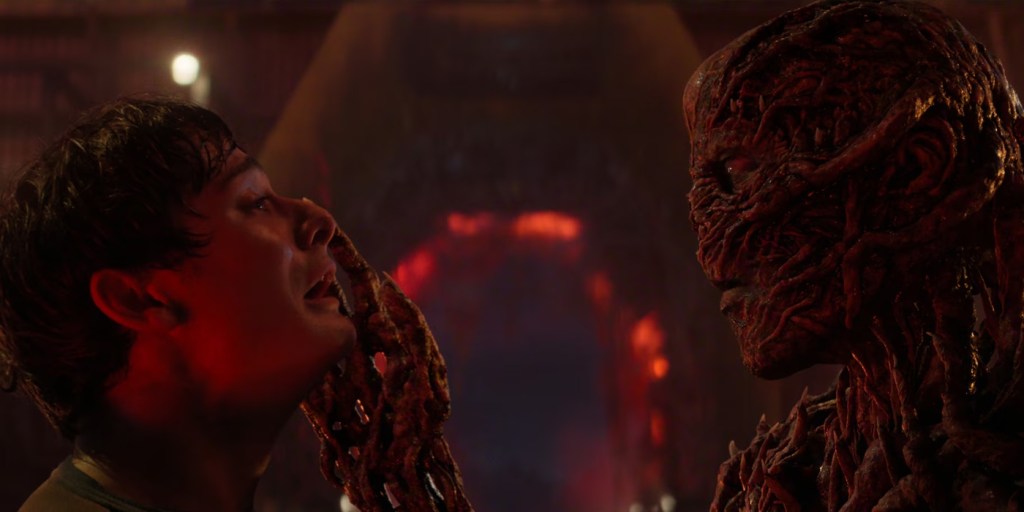
My goal every season is to get the cut as close as possible to what they have in mind, so that we have time to devote time to other things, like the visual effects. We started with 100 visual effects in Season 1, and I think we’re over 8,000 in Season 5. It’s ridiculous. With that kind of growth, you need way more time. So the more time that we can devote to that, the better things are going to look. With a closer cut, we can turn over sequences sooner, so we can get to that finish line with the visual effects quicker and make them look better.
What are some of the biggest lessons you’ve learned from your time working on Stranger Things?
What I think we’ve all learned is that there’s a space for everybody, and there can be a moment for everything. I’ve really learned a lot through this show about the magic of sound and how to turn that into a score. The Duffers and I have learned to really let [supervising sound editor Craig Henighan] do his thing and let him break down a scene. We’ve done that since Season 1, and it’s been great. Craig is a master. He’s literally the best I’ve ever worked with. I usually only work with him, because he’s just so fantastic. I can’t live without him.
His sounds are exactly what I have in my head, which is so hard to articulate sometimes. I’ll be like, ‘I want it to sound like this!’ And I’ll say a pterodactyl scream. But he knows exactly what I want. He gives it to me every single time, on the first try. There is a space where you have that music and those sound effects really dial in. As the seasons matured and grown, we’ve really nailed that balance together. We did a great job from the outset, but it’s become very fine-tuned, where everything is done meticulously to the frame. Once we’ve stitched all the pieces together to create something new, then we can jump out and restart the chaos of it all.
Then you can go in and move around dialogue to create moments where we’re not just assaulting the audience for five minutes with all these guns, demogorgons, screaming, people flying everywhere. I love to create these moments, and that’s where Craig becomes so valuable. We have to collaborate together. It’s a real collaboration. I really like to keep an integrated editorial approach, not only with the visual effects but the sound, the music, the colors—all of that can influence the edit. Then once we have some ideas, we can do something sonically, where Craig can suggest having a Demogorgon in one scene, or he’ll suggest we hold a beat. There are just so many different facets. To have all that expertise on the series that is so specialized makes the collaboration better.
What has surprised you the most about your experience working on Stranger Things?
I didn’t realize how much I would influence the Duffers in injecting comedy into the series. I remember the exact moment—it was the dinner table scene in Season 1 with the Wheelers. They were having dinner. Nancy wanted to go see Steve Harrington. Mike wanted to go find Will. There was a curfew. They couldn’t leave. Their mom was like, ‘No, you can’t go anywhere. You guys gotta go to your rooms. You have chores. Blah, blah.’ They had these shots of the little sister, Holly, in her high chair eating pancakes. The scene was written as a full drama. It wasn’t supposed to be a comedy. And I said, ‘You know what? I’m going to cut this through her eyes.’ Just doing her thing. I vividly remember when I showed it to them; they were not expecting it. From that point on, they were like, ‘This is what the show needs! It needs more comedy.’ So they went back and started putting in some more comedy.
For me, that was one of those proud moments where I was able to contribute something substantially to the series. Because I think what you need in this kind of a genre—I’m not a genre guy. I am not this horror guy. I’m a family comedy guy! I’ve been cutting movies with Shawn Levy my whole career—Night at the Museums and Cheaper by the Dozens and Date Night, all these comedy movies. I was the last person to do this series! But I think that’s what this needed.
It needed someone a little more inclined to interject that stuff, because if you’re constantly hitting the audience with this dark stuff, it can really wear on them and leave them fatigued. You need to have those moments where you have the audience sit back and laugh and forget about the drama. I think that’s the balance that they ended up striking so brilliantly, especially once they started bringing those comedic elements more into the show.
The Dufffers are such incredible writers; they’re so magnificent in storytelling. That’s what attracted me to this show more than anything when I first read the pilot script. It was everything my childhood was and wanted to be, with all this fantastical stuff. It really resonated with me. I knew then, hell or high water, that I was doing this show. I’m super grateful that I got to join the show, and I’m very proud of the work that we’ve done together as a team. It’s a real team effort, and the Duffer Brothers are amazing leaders.
Plus, I mean, all the guest directors this season alone—I got to know Frank Darabont because of this season, and now he’s one of my best friends! It’s a very unique situation, not only to be able to work at this level with this caliber of people, but to be able to call them friends outside of work. Without this show, I might not have met so many of them. I’m so incredibly grateful for this experience.
Stranger Things Season 5, Volume 2 is now streaming on Netflix. Photo Credit: Courtesy of Netflix.
 TVBrittanyF.com