
SPOILER ALERT: The following contains spoilers for Mayor of Kingstown Season 4, Episode 9.
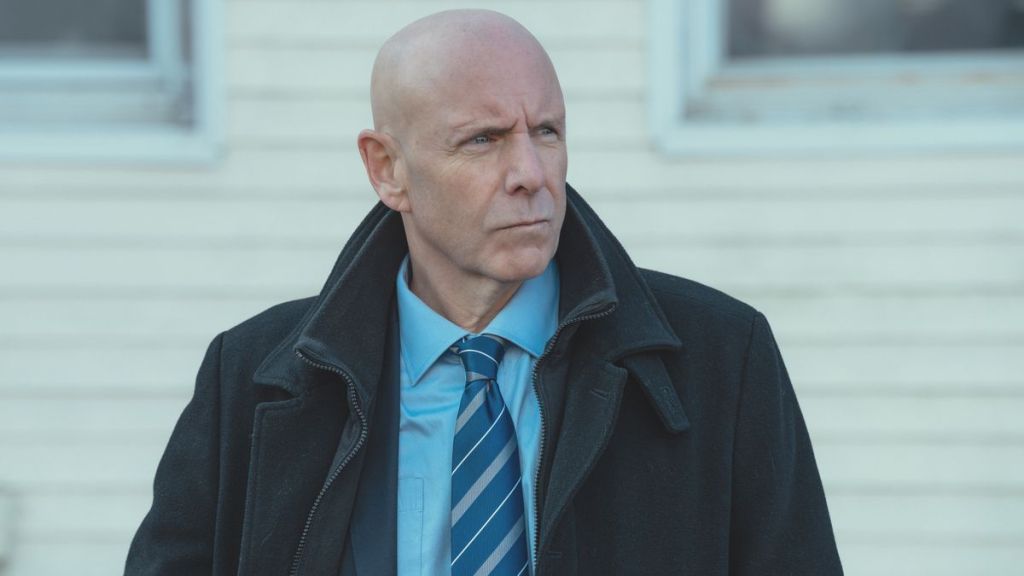
Mayor of Kingstown fans know how great of an actor Hugh Dillon is. As Ian Ferguson, Dillon has smoothly played what could best be described as the “heavy,” doing whatever it takes to get the job done. He’s easily able to take the character from deadpan hilarious to honestly frustrating, sometimes in the same episode. Ian’s shocking moves in Season 4—he’s directly responsible for Robert Sawyer’s death and almost killed Evelyn Foley—wouldn’t be palatable without Dillon playing the role. He has the gravity to do the ruthless things, but also the heart and humor to keep Ian feeling like a human being who just makes very stark choices.
But audiences have seen the impact Dillon brings on-screen for decades now. He also navigated plenty of grey areas as Mike Sweeney in Durham County, going to emotionally difficult places that had fans on the edge of their seats. On the flip side, his work on Flashpoint as Ed Lane was a moving portrayal of how much stress police officers have to deal with—and how much of themselves they put into the job. He gave viewers one of the most underrated crime drama characters. Then just on TV alone, there’s X Company, Continuum, The Killing and obviously, his collaborations with Taylor Sheridan. Everyone is familiar with Hugh Dillon’s abilities as an actor.
It’s time that they become more familiar with his talent as a writer. Mayor of Kingstown is primarily known as a Taylor Sheridan series, but it’s important to remember that Dillon co-created it and serves as an executive producer, and he’s written several episodes along the way. His screenwriting has the same clear and authentic voice that his acting performances do. What’s been really interesting to watch is how every script he’s written is better than the last; he’s always been a good writer, but his latest—Season 4, Episode 9, “Teeth and Tissue”—is the best of Mayor of Kingstown Season 4 and one of the best single TV episodes this year. It comes together in a way that feels four seasons in the making.
Dillon has an unenviable challenge in front of him: carry the momentum from Tracy McLusky’s controversial death so viewers stay connected to the story, and set everything up to make sure the Season 4 finale will be successful. That mission is even harder in Mayor of Kingstown Season 4, since the show has had two major storylines all season with Frank Moses and Merle Callahan. With double the plot and a tanker truck’s worth of emotional baggage, Episode 9 is not an easy episode to write. Wrap up too much, and risk shortchanging the numerous layers that have made Season 4 so dynamic. Don’t wrap up enough, and then there are too many unanswered questions in the finale. But Dillon gets it all done with a bold efficiency.
Off the top, he makes the choice not to dwell on Tracy’s death. Other shows would lead with that and get as much angst as possible out of it, especially given Tracy’s huge importance in the Mayor of Kingstown world. But where everyone else would go left, Dillon goes right—choosing to open “Teeth and Tissue” with the visual confirmation of Robert’s death instead. He doesn’t drag out the pain when there’s no reason to; Taylor Handley and Jeremy Renner did amazing work in Episode 8 that made it unbearable enough. It’s not going to get more impactful than that.
The decision to pivot to Robert early also immediately knocks out one of those plot to-dos: audiences now know that Evelyn’s legal case is also dead and they can move on from that subplot. And like the cherry on top, there’s something to be said for the fact that Dillon opens with a scene that paints Ian in a particularly harsh light. It’s ballsy for him to stand there and talk to Mike as if Robert died by suicide when he knows exactly what he did. Dillon has the confidence as a writer to not be precious about his character. That scene also sets the tone for the whole rest of the episode: it’s going to be a bitter pill to swallow. In just a few minutes, Dillon has accomplished three different things.
And that’s only the beginning of an episode that has so much to offer, both in terms of entertainment value and in terms of how well-crafted it is.
THE BRUTAL BALLAD OF FRANK MOSES

The majority of “Teeth and Tissue” is devoted to closing the Frank Moses chapter, because Mayor of Kingstown needs to pick a proverbial lane for the finale. Trying to service both the Frank and Callahan plots at the end would make both of them lesser. The Callahan story has far more personal stakes, so that’s the one that will be the most rewarding as a finale. That means it’s up to Dillon to give Frank Moses the exit that both the character and actor Lennie James deserve, and he takes the plan Mike has been brewing and pulls it together perfectly. Because the best thing Dillon does across the whole episode is know when to get out of the way. Despite the show being called Mayor of Kingstown, this plotline isn’t Mike’s story. It’s not even, at this point, Bunny’s story. It’s Frank’s story—and so Dillon gives him (and James) the audience’s complete attention.
Mike does what he has to do to tighten the noose, and Ian is waiting in the car with Stevie, but the clear focus is on Frank. The scene in which Frank kills Lamar sings on so many levels. Dillon’s writing and the great work of the Mayor of Kingstown crew come together to put everyone’s undivided focus on Lennie James’ performance; the moment taking place in an empty, almost bare room means there are no visual distractions, and Lamar being duct-taped and stuck in a chair means there are barely any interjections. In crafting this key scene in that way, however, Dillon opens himself up to a huge risk: the cliched, overdone, often hackneyed villain monologue.
Everyone knows those scenes: the ones where the villain delivers their manifesto, ranting or rambling about their plan or how the hero messed up their plan, usually moments before the bad guy meets their end. It’s very rare that one of these monologues doesn’t feel forced or overly dramatic, with viewers wondering why the villain doesn’t just shoot the hero already. Hugh Dillon makes the Mayor of Kingstown version not just great, but brilliant by imbuing it with more than one purpose. It’s not just a soapbox for Frank Moses to stand on. It’s a mini emotional arc for his character, and it’s also making a statement about the entire show. Mayor of Kingstown Season 4 has put the whole series under its own microscope, and Frank’s monologue is the result.
His monologue is a downward spiral, a crash and burn in a matter of minutes. Everything about Frank Moses up until this point has been controlled. He’s very deliberate in his moves, and James has made him the same way as a character: purposeful and quiet. But Lamar killing LJ is something from which Frank cannot recover. What makes it exactly the right method of his downfall is how universal it is. He gets tripped up doing something human, that every audience member can relate to. Dillon takes the beautiful step of legitimizing that in an earlier meeting between Frank and Mike. Viewers know Mike is setting Frank up being there, but Mike still opens up about his brother Mitch’s murder. A logistical scene becomes an emotional scene. Even knowing what he did and has to do, Mike still genuinely empathizes with Frank’s loss. Later on, Mike points out to Evelyn that Frank lost “a brother” in LJ. He truly understands the cost. And because he treats Frank like a human being and not a target, the audience is reminded of Frank’s humanity, too.
Frank Moses: This town, it’s like a vortex that sucks you in and under and swallows everything. And you are in that vortex, and I am in it now too, with your sorry ass.
Frank’s speech is not just an indictment of Lamar; it’s an indictment of Kingstown. It is pointing out the horrible truth of the city: that it has a prison, but it also is a prison, and there is no way to escape. The only way out is death—and viewers know he’s speaking the truth because they’ve seen it. They’ve seen how many people end up in body bags. They’ve seen Iris have the path to freedom and yet choose to end her own life before she ever got off the bus. And just right now, still in their minds, is that Tracy McLusky got out of Kingstown and yet death still followed her. Dillon takes that moment that fans are wrestling with and utilizes it as the biggest piece of evidence to pay off this plot. He blurs the line between Frank’s pain and their pain, because it’s the same thing. In that moment of his end, when most antagonists are meant to be hated, Dillon turns the tide and makes the audience see Kingstown through Frank Moses’ eyes. And then the viewers have to ask themselves: What the hell are we even doing here, if it all ends like this?
“Teeth and Tissue” has an interesting, even more terrifying, way of answering that question. No one thought Will Breen would overshadow Frank Moses, and yet he does.
CITY OF GHOSTS

In “Teeth and Tissue,” Hugh Dillon reveals why Mayor of Kingstown bothered to bring back Will Breen—when the disgraced corrections officer grabs a shotgun and murders almost everyone in Ad Seg. This is one of the most disturbing sequences in the show’s history, and first it’s worth pointing out that again, it doesn’t happen for shock value and trauma porn. This episode reinforces that in Mayor of Kingstown, acts of violence are extensions of character, no matter how unfortunately common they are. Breen’s storyline reinforces the point Frank Moses made before he ended up in a jail cell, and then some.
Strictly speaking, this isn’t a story that has to be told. There’s enough happening in this episode with Frank and Callahan; Dillon could simply focus forward with his two major villains. The creative team could have taken the easy way out and just had Breen exist to antagonize Cindy Stephens the same way he did Tracy, or they could have taken the even easier way out and not brought him back at all. Exactly no one in the audience was asking for this guy’s return. But instead, Dillon turns a one-season, seemingly one-note subplot character into something even scarier than Moses or Callahan. Breen’s direct body count is more than either one of those two, and it happens a whole lot faster.
This also isn’t a story that could have been told with any other character. Breen’s cringe-worthy actions in Season 3 are the catalyst for what he does in Season 4, and they’re the reason that viewers get so blindsided by the shooting. Having some other random corrections officer snap wouldn’t resonate, because the audience wouldn’t know that character long enough or well enough to understand why. Fans are also automatically biased against Breen because of Season 3. They don’t care as much about how he’s treated because they’ve seen how he behaves, and know he hasn’t changed thanks to the earlier episode that includes him watching Cindy in the parking lot. They may even be enjoying the heckling. But that all goes away very quickly when Breen starts shooting. Then there’s a feeling of remorse, because no matter what their feelings toward him, they didn’t want him to be a one-man mass casualty event. They may even feel complicit, because they’ve been hating him, too.
Breen’s story arc is a reminder that everyone in Kingstown is capable of violence, no matter what side they’re on or who they are. It’s not only the inmates or the gang members who fight each other. And it’s not solely him that’s referring to; it also means Cindy, who has no choice but to shoot Breen before he can murder Kyle McLusky. Cindy has been relatively innocent in Mayor of Kingstown Season 4, but no one keeps their hands clean in Kingstown forever. This decision pushes her character forward in a major way, while also giving her a part of her story that isn’t connected to Mike—something that can’t be overlooked when so many other TV shows focus heavily on characters’ romantic relationships. But in pulling that trigger, Cindy also illustrates why viewers have to hang on to Mayor of Kingstown: because the city is worth fighting for. Dillon balances out the collapse of Frank Moses with Cindy Stephens stepping into her power, however tragically.
People like Cindy and Kyle (no matter what he thinks of himself) are trying to do the right thing, and they’re worth rooting for. One could even have put Doug Carney in that category before his murder, which makes even more sense now because Carney would have been the first one to step up against Breen if he’d been there. With him gone, Cindy suffers the consequences. But as much as that will leave emotional scars, she’s still a hero. And the shooting sequence even says something about Kyle, as Dillon gives Taylor Handley that one heartbeat of a moment to reflect how blank Kyle is inside. That pause is a reminder that Kyle is dead emotionally, but not physically; there’s still a chance for him, even if nobody knows what it looks like.
There’s a creative accomplishment here, too: the fallout at Anchor Bay is illustrated by events set to The Doors track “End of the Night.” It flies in the face of everything one knows about needle drops on TV. They’ve become the single most overused element, as shows utilize music to replace what they can’t just communicate on the page. “Teeth and Tissue” actually makes the music work for Mayor of Kingstown. Aside from the appropriate title, the tone and the lyrics make what’s on the screen sink in even further. The song is not a substitute; it’s an enhancement, and it only stays as long as it accomplishes that.
It’s no surprise that Dillon is a writer who knows how to effectively utilize music—he’s also the lead singer of Headstones and has an underappreciated solo album. Between the acting, the writing and the music, he’s a Renaissance man.
BURN ALL THE SHIPS
“Teeth and Tissue” is an episode that is so completely Hugh Dillon. It has the same no-nonsense feel that he brings as an actor, whether he’s playing a straight arrow like Ed Lane or Ian Ferguson’s questionable relationship with morality. His personality shines through in every one of his performances and this script is the same. It has so many lines that sound and feel exactly like Mayor of Kingstown. This is an episode written by someone who’s not just lived four seasons of making this show, but who’s lived in this world. This is in his bones in a way no other writer can claim—and it spills out more clearly here than in any other episode he’s penned before.
Mike McLusky: Anyone who chooses this world knows the cost of it. If they didn’t, then they never belonged.
The dialogue in “Teeth and Tissue” is some of the sharpest of the season, because it speaks to both the immediate now and the big picture. Dillon gets directly to the point with his words, and when he gets there, he doesn’t pull any punches. The scene between Mike and Hobbs is the best example of that; both characters are blunt, yet these former rivals treat each other as humans, and their talk might be brief but it leaves fans reminded of the unwritten rules of Kingstown. It’s also an effective way to button Hobbs’ arc, no matter what happens to her in the finale; she’s learned her lesson, and the message has been sent. Kingstown is ultimately its own ruler.
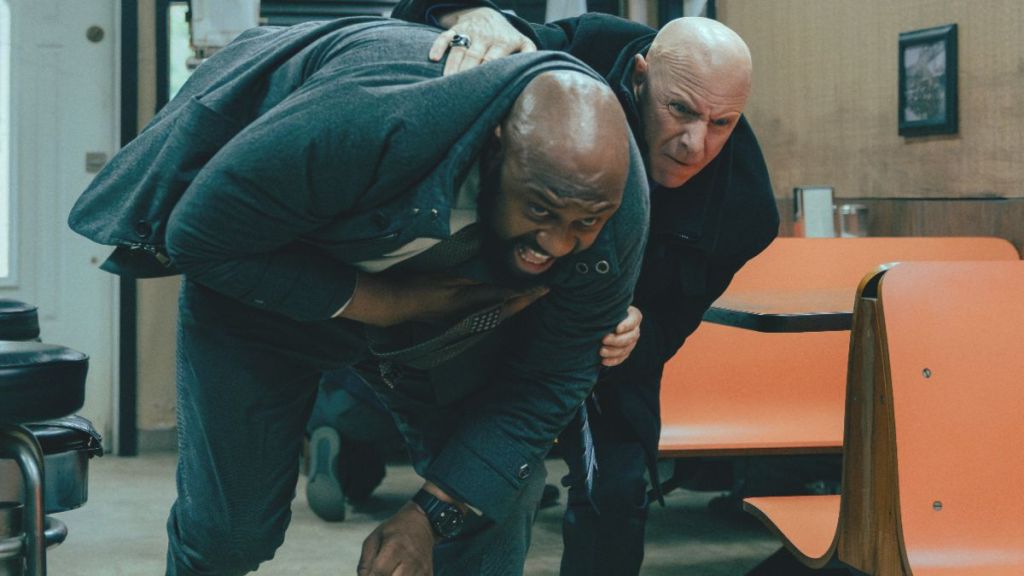
That’s something Mike alludes to when he has his own moment of frustration, admitting “I’ve lost too much to this town.” It is literally his job, as he reminded Lamar earlier, to keep the place together and even he’s seeing the score. “Teeth and Tissue” is an accounting of everything that has built Mayor of Kingstown up to this point. Viewers are seeing the wear and tear on characters not just because of Season 4, but the whole damn thing—whether it’s going all the way back to Mitch’s death or how Dillon chooses to end the episode. Shooting up the diner isn’t solely an “oh shit” cliffhanger, though it does provoke that reaction. It’s symbolic of how everything viewers know and love is getting burned to the ground.
Mayor of Kingstown has been throwing toys out of the proverbial pram all season. From murdering Carney and Tracy to destroying Mike’s place and the McLusky home, there are numerous examples of the series going scorched earth. Wrecking the diner is the last one because there isn’t anything else significant left to ruin. (The only thing remaining of note would be Anchor Bay itself, but then the writers would be pulling a Melrose Place.) Dillon gets that last box to tick and he makes it count. There’s the necessary few beats to let the audience come down from the sadness and angst of the shooting at Anchor Bay, but then there is a literal burst of gunfire. What’s particularly interesting is that Episode 9 could have ended when Ian opened the door; the shock of that and a possible question about his survival would have been enough. It would certainly have stopped there on a regular drama. But Dillon keeps going, which makes it even more intense because audiences aren’t left guessing. They can see the full scope of the problem, and they don’t have to be told who caused it.
Interestingly, “Teeth and Tissue” makes the biggest argument for Mayor of Kingstown Season 5 regardless of what happens in the finale. Dillon has layered so much into the episode that the potential for the future is obvious beyond whatever happens with Callahan. Everything that Kingstown is, is within this episode. There’s unflinching violence, there are moral conundrums, and there’s sarcastic humor. But most of all, there’s a real humanity. It’s messy, it’s flawed, but it feels so real just like all of Hugh Dillon’s characters.
Hugh Dillon has crafted an episode that has not one, not two, but three major events in the Mayor of Kingstown chronology. It’s an ambitious undertaking but he hits every target, while also structuring the episode so that each one of them has the space to be experienced on their own. He balances tone perfectly. He writes the characters so honestly and their dialogue has the rhythm not only of Kingstown, but of each particular actor in a way that shows how well he knows his colleagues. He makes choices that run contrary to the television mold, because he has the confidence to do so and the ability to back them up. All of this displays a thoughtfulness that most TV shows are lacking, but Hugh Dillon has always had in spades, whether as an actor or a creator. “Teeth and Tissue” is a microcosm of Mayor of Kingstown, written with clear purpose and ferocity but also love for it.
As excellent an actor as Hugh Dillon is, it’s time to admit that as a writer, he’s also a badass. And creating Mayor of Kingstown, telling his own story, is the coolest thing he’s ever done.
Mayor of Kingstown streams Sundays on Paramount+. Photo Credit: Courtesy of Paramount+.
Article content is (c)2020-2026 Brittany Frederick and may not be excerpted or reproduced without express written permission by the author. Follow me on Twitter at @BFTVTwtr and on Instagram at @BFTVGram. For story pitches, contact me at tvbrittanyf@yahoo.com.


 TVBrittanyF.com