
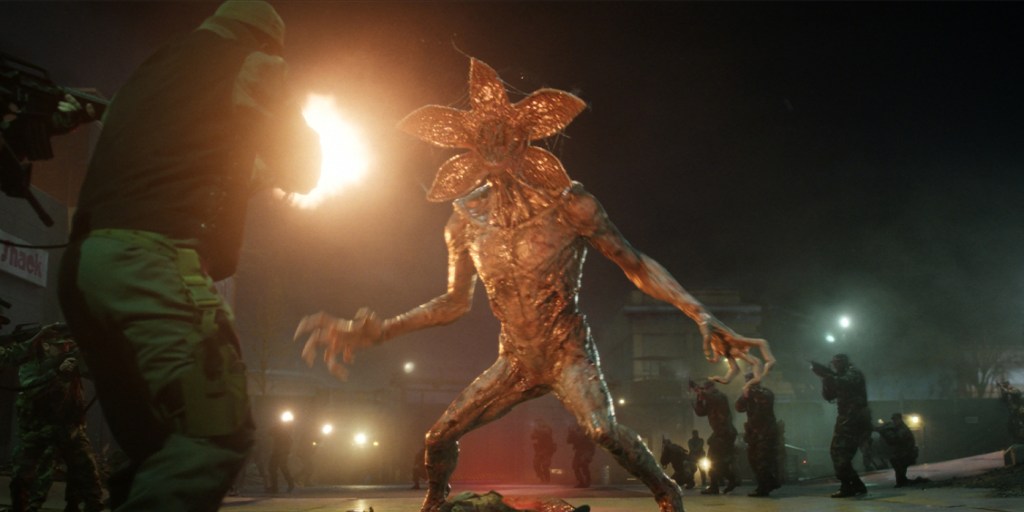
Netflix‘s Stranger Things has grown into one of the biggest hits of the streaming era, with the vivid atmosphere of 1980s Americana melding dangerously with the chaos of the Upside Down. The show’s execution across the board has been impressive, especially from the below-the-line team that brings the world of Hawkins to life.
During an interview with TVBrittanyF.com, Stranger Things‘ supervising Sound editor/re-recording mixer Craig Henighan discussed the biggest lessons he’s learned over five seasons of the Netflix show. He spoke about the challenge of balancing action and character beats. Plus, he broke down the editing process that brings an episode together.
Brandon Zachary: Congrats on completing Stranger Things!
Craig Henighan: Thank you so much! We’re all very happy; it’s been a massive team effort. I’ve been involved since the beginning. It’s pretty amazing to be part of something like this, in this sort of zeitgeist of popular culture and all that kind of great stuff. I really appreciate it.
What would you say has been the biggest lesson you’ve learned from the series over time?
I remember in Season 4, I had to come up with a clock. That was such a main element. It’s very Stranger Things, and it’s very omnipresent on the page. When they wrote it, it was just “clock ticking.” It’s part of the gig to interpret that and find what the guys want. I tend to do a lot of things early for them. They get to live with the stuff and get a feeling for it, and I think it pays off. I think it makes the difference—we’ve always approached it from more of a cinematic ideology. We’re even putting Season 5’s finale in theaters this year, because they deserve to be seen on the big screen with the best possible sound and the best possible picture.
It’s one of those projects that, since the beginning, I just really clicked with. I had a good beat on what I thought I could bring to the show, even all the way back in Season 1. It’s not just me who does it all. I have a great team with me. We’ve just been able to really lock in, and it’s just been a pleasure to work on. The guys have been nothing but supportive in terms of time and creativity, and feedback.
Fans saw a lot of chaotic turns in Stranger Things Season 5. How do you approach intense action moments in sequences like the conclusion of Episode 4 without distracting from the rest of what’s happening?
It’s a challenge, right? That was a scene where our picture editor [Dean Zimmerman] was like, “We got to get this to the others soon” I’m talking like eight months ago. I had a version of that at the same time they were turning it over to visual effects. They have to get scenes finished pretty quickly for visual effects. They have to get a pass on it to see what’s working and not working.
That’ll get sent to me. I live with it for a bit, I can look at it and go oh, okay. Well, there’s a bit of a Saving Private Ryan vibe going on here with the gunfire. Maybe we’re not going to do full-on music. We’re going to be able to parcel out areas that are sound effects and sound design, and then we’ll use music over here.
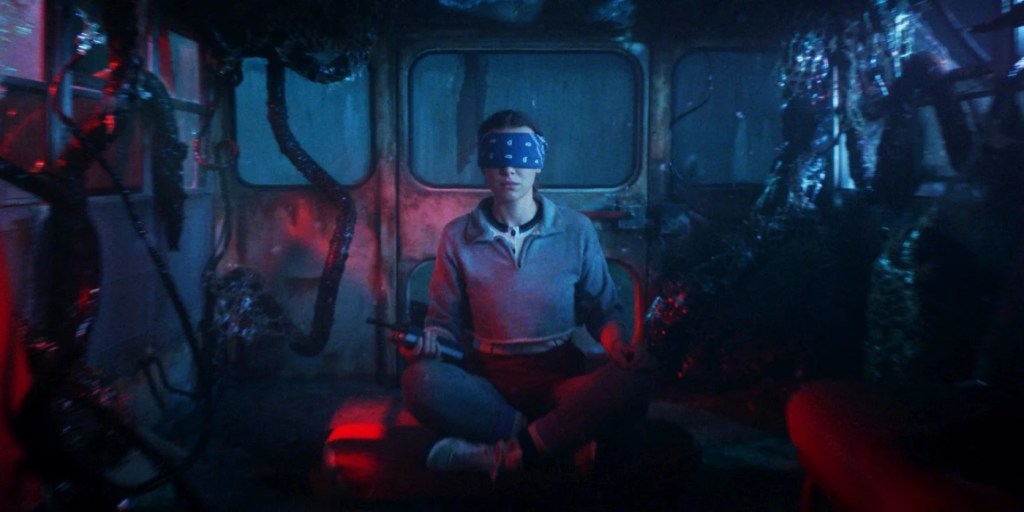
I kind of broke it down. There are five or six Demogorgons that are in the middle of the battle. There’s all the gunfire, there’s the Army, there’s Mike and the kids trying to get through. There’s the whole storyline of the demo vision. There are all these things; you start mapping out what you need to do. That scene started with getting period-correct gunfire, getting AK-47s, the different types of rifles, and Humvees—mapping all the Army stuff out first. Then we started to put in the Demogorgons and the other stuff. It’s a delicate dance between all the gunfire and the explosions and the roars of the Demogorgons.
It’s a scene that I had for a while, and I was able to sort of chip away at it and step away from it—go do something else, come back, look at a couple of other things. I will say the scene as a whole didn’t really change a whole lot from a picture standpoint. From an editing standpoint, it was pretty together.
I [get] it to a level, and then I hand it over to our final mixers, Mark Paterson and Will Files, who actually finish the mixing. Part A is a lot of the sound design and the editorial, and the early mixing on my side. Then Part B is finishing things, which is the final mix. That’s when all the music comes in, all the cleaned-up dialogue comes in, all the sound effects come in.
That’s when Mark and Will can really roll their sleeves up and sort of start digging into what the battle is going to really sound like. They take all the stuff I’ve done, they take all the dialogue that Ryan Cole, our dialogue supervisor, has done, and then they take all the foley and music. They’re the guys that have to put it together. It’s certainly an evolution of sound.
The early job for me is to just get the scene up on its feet and we sort of just slowly chip away at it. But the important thing is to have the right Demogorgon sounds, the right gunfire, the right Army [sounds], the right stings, the right booms, all that kind of stuff. That’s all the stuff I sort of do early, so that the DNA of the scene is kind of set. Everything else from that point on is kind of refining, and just working on it to polish it up and up.
What’s been the biggest surprise you’ve experienced over the course of working on Stranger Things?
I thought there was really only one Demogorgon initially! [Laughs.] In Season 1, there’s really only one Demogorgon. I clearly didn’t know where the story was going to go. Then you get into Season 2 with the Demodogs, and you start making another palette of sounds. Now the Demogorgon has a larger palette. Then you get to Season 5, there are six of them, or seven of them, or however many of them!
They’re not necessarily communicating with each other, but they all have a similar [set] of vocal sounds. They also have to be different enough that you, as an audience member, understand that this one’s on the left, this one’s on the right. I think those are the interesting things that, when I look at Season 1, I’m glad I didn’t back myself into a corner with just a certain sound.
It has such a vibe to it—for lack of a better way to describe it—that I needed to maintain that. Every season, I have to push it a little bit more. Sometimes, I’ll go look for sounds. I’ll look at an old episode and wonder, “How in the world did I make that sound at Season 2?” I’ll listen to it, and I think it will work for the Rift or something—but I have no recollection of how I arrived at that sound initially. It’s a good trait, I guess. It means you get out of your own head.
I’ve been fortunate to work with some directors and creative people for a number of years, and I’ll bring up something we did in a movie from 15 years ago, and people I worked on it with won’t remember anything about that movie. It’s almost like it’s all been expelled from their brain after it’s finished. When you record something specifically, and it’s just captured in a moment of time, it can just be that—and it’s something that can pay off 10 years later. It’s by no grand design. But that’s what I take away from the sonic journey of what Stranger Things has been for so long.
Stranger Things Season 5, Volume 1 is now streaming on Netflix. Photo Credit: Courtesy of Netflix.
 TVBrittanyF.com