
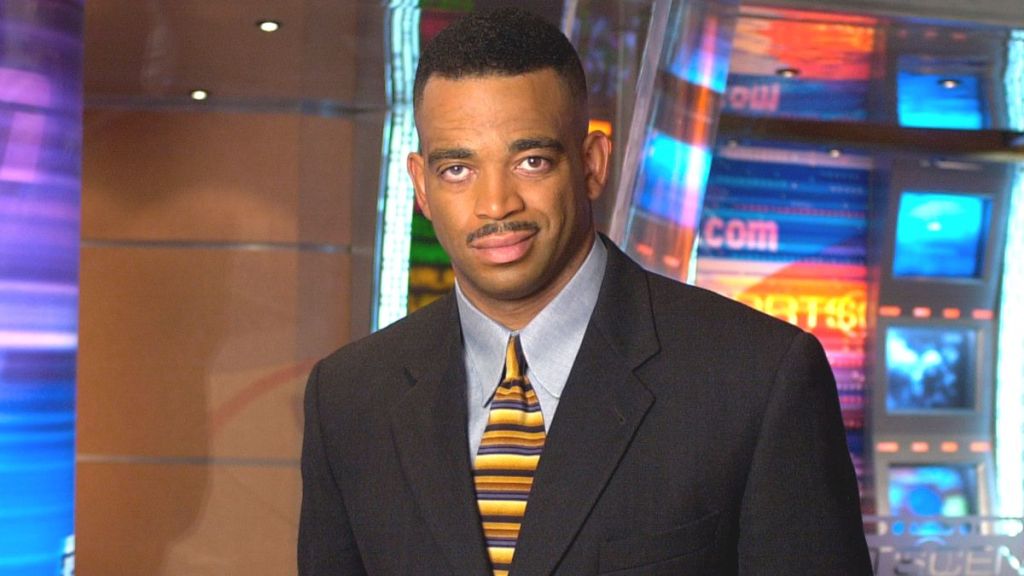
ESPN Films has given us Boo-Yah: A Portrait of Stuart Scott, a well-deserved and thoughtfully crafted look at one of the most memorable journalists of our generation. The 30 for 30 comes on the tenth anniversary of his passing, putting his name back into the cultural conversation. But perhaps it will also start a renewed conversation about what he meant to so many people, and what’s possible with the platform he and others helped to build.
Boo-Yah, as directed by Andre Gaines, reminds us that Stuart himself stood on the shoulders of earlier trailblazers both regional and national, including the icons Robin Roberts and John Saunders (who passed away in 2016, the year after Stuart’s death). But he became a legend because while he wasn’t the first Black sportscaster, he was the first one to bring the Black voice emphatically to television. As we continue to speak about representation, and the importance of visibility in furthering representation, what Stuart did and continued to do throughout his career was huge. It might be one of the best examples of that principle in motion—because of the massive platform that sports provides and because Stuart brought so much energy and life that you couldn’t help but pay attention.
It’s surprising, but not that surprising, to learn from Boo-Yah that Stuart had a theater background. His ability to play to an audience was amazing, because his energy uplifted whatever he was talking about—which is saying something when sports are already high-energy hype machines on their own. The man could make anything seem like the coolest thing in the world. But at the same time, it always felt intimate, like he was speaking directly to you or your family or your friends. To watch him with Rich Eisen, in particular, felt like hanging out for an hour shooting the breeze.
He proved through years of work that you don’t have to divorce yourself from personality to report the news. He stood out because he felt real, because he was real. Even in his coverage of the Centennial Olympic Park Bombing in 1996—the most serious thing in the world at that time—audiences could still feel him. They felt his compassion and his emotion. It’s so often taught in the journalism field that professionalism means a lack of emotion or opinion. And in some cases, that’s true; you never want to make yourself the story. But it’s been taken more often than not as an absolute. Stuart Scott bucked that trend. He showed that you could be a person behind the desk or the microphone, without sacrificing any of your credibility.
Yet what is even more important, and which colleagues draw attention to as the documentary ventures into the ESPN years, is how much work Stuart put into his craft. He was a remarkable writer and that happened because he poured effort and discipline into being one. The charming personality was just one part of what made him successful. The catchphrases were the cherry on top of the proverbial cake.
As journalists work these days in an arena with countless sources constantly shouting for attention, where readers rightfully complain about clickbait headlines making meaningless noise, and AI is doing whatever it’s doing (it says something that Boo-Yah has to start with a disclaimer that Stuart’s voice hasn’t been manipulated), to talk about Stuart Scott is a reminder that catchphrases don’t matter without meaning. Stuart’s personality shone through because he backed it up. His clever turns of phrase came in highlights contextualized with statistics or in interviews with engaging questions. It wasn’t just how he said something, but why he was saying it—which is something that’s worth being reminded of.
Boo-Yah: A Portrait of Stuart Scott inevitably gets to Stuart’s battle with cancer, which was just one of the health challenges that he fought against in his lifetime. He may not say that anything he did was courageous, but I can’t think of a better word to describe his story, because another thing the documentary does well is illustrate how he never let anything stand in his way. He was not immune to fear; he says so, and in another moment reveals that he likes being nervous. But he worked with those emotions to do things he shouldn’t have done. The incident at New York Jets training camp that caused his eye injury was because he wanted to actually do training camp and not just a piece about it—which the film notes likely goes back to the childhood dream of playing NFL football that he never let go of. No, he wasn’t going to make the Jets roster. But what kind of courage and commitment does it take to find out? To put yourself out there and lunge for that brass ring just because you can? The way Stuart lived his life was remarkable, separate from what he did for a living, and we’re just lucky that he did so much of it on a national stage.
I chose to write this article in the first person because that’s the most emblematic of what Stuart Scott taught me and so many other people. To be yourself, no matter who yourself is, even though others will want you to be something else or maybe not be in the game at all. That’s an even harder task today, in an industry that is increasingly less human and a world that’s become much colder, too. Boo-Yah: A Portrait of Stuart Scott is a little bit of a wake-up call, like Stuart’s giving us one more “expression of energy.”
I can’t fully speak to Stuart’s impact because I’m not Black and so I don’t have that part of his experience. I can say that the earliest voices I heard growing up were SportsCenter anchors. As a disabled kid, I still wanted to be an athlete; I pretended I was an NFL quarterback, despite having small hands and no wheels. I went to sleep listening to the late-night loop of SportsCenter reruns… that day’s show four or five times in a row. My initial influences as a writer—not just a sportswriter, but a writer full stop—were Dan Patrick, Keith Olbermann, Rich Eisen and Stuart Scott. My first gig, before I was even old enough to get a driver’s license, was auditioning for ESPN’s short-lived TV show Dream Job, as hosted by Stuart Scott.
No real spoiler: I didn’t get onto the show. I had just turned 16; I barely made the cut to get into the building. But that audition led directly to me getting my first sportswriting gig, which led to the next and the next and a now 25-year career as a sports and entertainment journalist. It was a chance I would not have taken if not for the examples of those folks, but especially Stuart Scott. I wanted to be one of those kids at the cool table. And more importantly, they made me feel like I could be. Because Stuart’s message, as repeated often in Boo-Yah, was to be yourself. He wrote like he spoke, and the world heard him.
For me, it erased the memory of my very first attempt at becoming a sportswriter for my local newspaper. I had written some copy about the San Diego Padres, which I showed to the sports editor—who told me that they didn’t need me because I was too young and a girl. Two years later, a few weeks after that ESPN audition, I had my first professional byline. I got to write articles like “Who the Hell Is Kevin Walker?”, which I blurted out after Kevin Walker made his first relief appearance for the Padres, which Kevin Walker apparently read and thought was funny. I was able to write in my own voice, and I could do that because Stuart Scott showed America that could work.
I am obviously far from the only one who needed to hear that. Scott Van Pelt had a wonderful tribute to Stuart to open his show, in which he pointed out Stuart gave him that confidence, too. Now he’s anchoring his own D.C. version of SportsCenter with his name on it. What we learned from Stuart Scott touched anyone, regardless of your skin color or where you came from. His outlook was universal. Stuart Scott was not just a great sportscaster. He was not just a great Black journalist. He was a great journalist any way you want to slice it. And he was also a great human being. He didn’t see stories; he saw people. His ability to see the whole universe is the other thing that made him so universally beloved. Everyone embraced him because he did it first.
I never had the honor of meeting Stuart Scott. I will never do with my career a hundredth of what he did with his. But I think we can all do well to continue talking about him, because we can continue learning from him and being inspired by him. Maybe even more now than we did back then. We can be reminded to speak in our own voices, to celebrate our differences instead of argue over them, and to just have fun while we’re doing whatever we’re doing. Stuart Scott was one of a kind—but Boo-Yah is evidence that his proverbial “coaching tree” is going to go on forever. We can all carry a little bit of Stuart Scott with us. Even writing this piece, I didn’t think I had anything to write today, wasn’t sure I could write at all, and then Stuart Scott came along.
Thank you, Stuart. For everything you did and everyone’s lives you touched along the way.
Boo-Yah: A Portrait of Stuart Scott is part of ESPN Films’ 30 for 30, which streams on ESPN+. Photo Credit: Lead image by Rich Arden/Both photos courtesy of ESPN.
Article content is (c)2020-2026 Brittany Frederick and may not be excerpted or reproduced without express written permission by the author. Follow me on Twitter at @BFTVTwtr and on Instagram at @BFTVGram. For story pitches, contact me at tvbrittanyf@yahoo.com.

 TVBrittanyF.com