
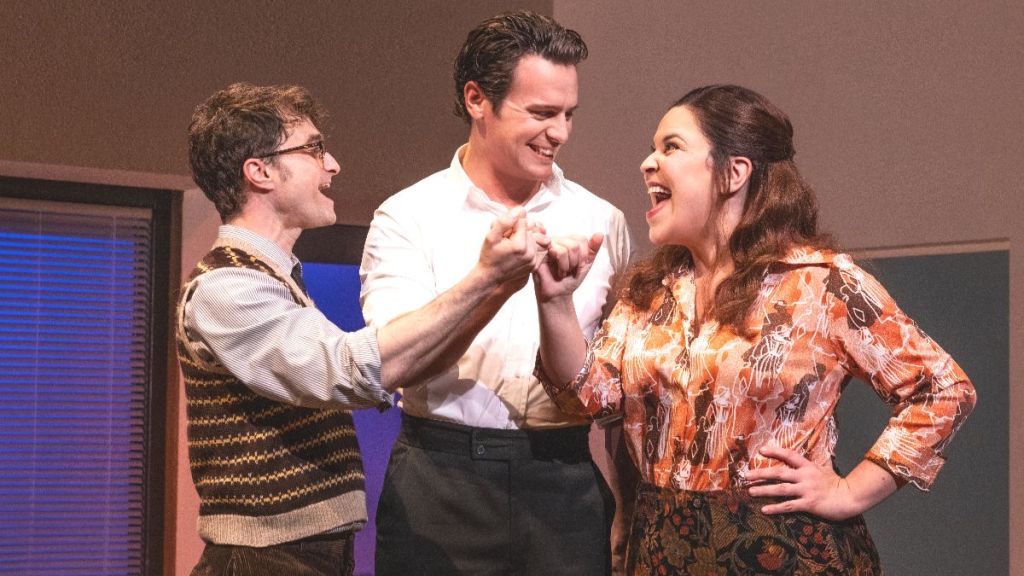
The Tony-winning revival of Merrily We Roll Along is one of the best Broadway musicals ever, full stop. It’s a welcome treat that it was put on film so that even more people can experience it. And the movie version, released by Sony Pictures Classics and now playing in select theaters via Fathom Entertainment, is a noble effort. But it falls short of realizing the same bittersweet magic.
This version of Merrily isn’t just a great revival; it’s a brilliant production all the way around. Jonathan Groff, Daniel Radcliffe and Lindsay Mendez all give some of the best performances of their careers, while the cast is filled out by actors who all add something to the tableau, no matter the size of their part (or how many parts they’re playing). Anyone who missed the Broadway revival before it closed in 2024 needs to see the movie, simply because the play itself is that remarkable. There’s a lot to love about it, from the major—the leads really are lightning in a bottle—to the minor details that immerse the audience in the world.
However, the film version seems to forget its source material. An easy comparison is to the streaming edition of Hamilton, which was about capturing the play and simply opening it up to a broader audience. In contrast, this version of Merrily We Roll Along is less a preservation and more trying to reshape the play into a movie. The direction doesn’t quite understand what made Merrily so special.
The most significant issue is a heavily reliance on close-ups of the actors, which makes sense in a movie but less so in a play, especially this play. For example, the opening number is a dynamic piece that has the entire cast working in harmony, but the impact of that is blunted by the choice to focus so closely on Groff as Franklin Shepard. This comes up time and time again, when some of the beautiful details in Merrily come from seeing not just how someone delivers a line, but how their scene partner reacts to it. Yet the movie version makes it impossible to see some of those reactions, meaning that the audience misses out on valuable beats. In the scene where Gussie Carnegie is approached by her ex-husband, the emotional button to that scene is Krystal Joy Brown stopping and saying “I’m sorry” before she exits. Her tone and her facial expression are clues to her character. But the movie Merrily leaves that line entirely off-screen, choosing to keep the camera on Reg Rogers instead.
Merrily We Roll Along is a true ensemble piece, whether it’s the back-and-forth between the three leads or the little details that the members of the ensemble add as they populate the story. Yet the movie too often puts its eye on only one or two people, which shortchanges the production as a whole. It’s as if the camera is trying to guide the film audience through the story, whereas in Hamilton the camera was there in service of the story. There’s an energy and a vibrance to Merrily We Roll Along, even in its saddest or most introspective moments, that is present but not fully realized because of that difference.
There are a few instances when the film approach does work to the viewer’s benefit. The close-ups allow an audience member to see details that would not have been as easily visible on stage, such as Groff’s actual tears in one of the most important scenes or small shifts in Mendez’s body language. Eagle-eyed fans will also be able to make out things like the title of the book that Mendez’s character Mary Flynn wrote, or what else is on everyone’s desks during “Opening Doors.” The camerawork is not without merit, but those moments don’t happen enough to balance out the times when it doesn’t work.

Another point of note is that this movie was filmed in June 2024, the month before Merrily closed on Broadway. It’s very rare, but there are moments where it does feel like the end. Brian Sears’ absolutely spot-on deadpan delivery as the Newscaster is noticeably missed because of the later filming window, although Steam! alum Coby Getzug does his best in the role. Sears just had a perfect approach to that small but memorable character.
None of the movie’s limitations should dissuade viewers from seeing Merrily We Roll Along while they have the chance. Could it have been a whole lot more? Absolutely. But is it still an incredible piece of work, even while filtered through a film lens? Also absolutely. The revival has a genuine outpouring of heart and more thought-provoking than audiences may expect. Jonathan Groff navigates the transformation of Franklin Shepard as well as any actor ever possibly could. Daniel Radcliffe goes for broke as Charley Kringas, with his rendition of the showstopper “Franklin Shepard Inc.” worth the price of a movie ticket alone. Lindsay Mendez makes Mary Flynn sassy and vulnerable at the same time. As a trio, they’re perfectly matched.
This production won four Tony Awards for very good reason, and it will be impossible for any moviegoer to get through the closing number without feeling something. It just isn’t quite as marvelous in the cinema as it was on the stage, because the movie treats it like a movie and not one of the best Broadway experiences in ages.
Merrily We Roll Along is in select movie theaters now through Dec. 18, 2025; for showtimes and tickets, click here. Photo Credit: Courtesy of Fathom Entertainment.
Article content is (c)2020-2026 Brittany Frederick and may not be excerpted or reproduced without express written permission by the author. Follow me on Twitter at @BFTVTwtr and on Instagram at @BFTVGram. For story pitches, contact me at tvbrittanyf@yahoo.com.
 TVBrittanyF.com