
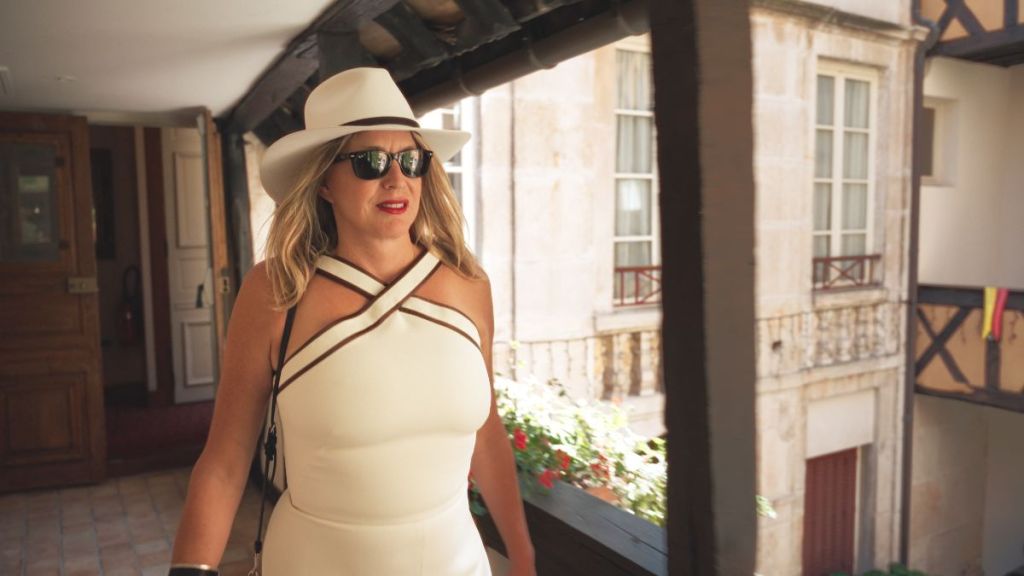
Marcia Kimpton is not your ordinary indie filmmaker. Nor is she your ordinary comedian or host. All of that is apparent in her new film An American Abroad, which is one-part comedy, one-part chance to see the world and one-part culmination of Marcia’s own fascinating life story.
TVBrittanyF.com spoke to Marcia about the creation of An American Abroad and what she loved most about making the film. She also gave readers a deep dive into her multifaceted career, which has taken her around the world. Plus, she spoke about what she’s hoping audiences gain from joining her on her adventure.
Brittany Frederick: Your career has been incredibly varied. What interested you in getting into entertainment in the first place?
Marcia Kimpton: I knew at 12 years old I wanted to be a late-night host. I know that sounds kind of crazy, but I was watching Dick Clark, Johnny Carson and The Midnight Special. It took me eight years to finally get on TV. Having lived in New York and LA, I finally got on in San Francisco as entertainment reporter for the Fox morning show. And the producer had seen my demo, and she said, you know, you could do comedy on Fridays. I was like great, because then I could get my own late-night show.
So I did that for four years, and then I got my own late-night show with Budweiser, sponsoring their first local late-night show. I went from the Fox morning show to ABC late-night, competing against Saturday Night Live, and actually beat them in the beginning. I met everybody in Hollywood. I mean everybody—and all these male executives in 1998 said the world’s not ready for a woman late night. Joan Rivers had done it, and then of course Chelsea Handler, and there’s a bunch of other people that had tried later. And I was devastated. I was pulled off the air. 14 weeks later.
How did you venture from that into filmmaking?
I had a spiritual crisis, where you realize that you have talent, but you’re not being valued because the industry doesn’t value you, especially women… So in the process of this spiritual crisis and wondering what was I going to do, I knew that I really wanted to direct films. I had this comedic character that I was doing in the late-night show and on the Fox morning show. The spiritual crisis forced me to learn how to write a screenplay, how to direct.
When I lived in New York City in my 20s, I did go to the night class at NYU, where you learn about filmmaking. And it was phenomenal, but it was only six weeks. So I learned how to write a screenplay. I learned how to direct by watching David Fincher’s movie The Social Network, which I thought was the most boring subject and the most brilliant movie. I saw how David Fincher could make such a boring subject so exciting, and that was really the way I learned how to become a director. And so I learned directing. I was already naturally a producer since I was 12 years old, doing the fairs and the floats and the parades and then became president of my class. And then I had taken acting classes for years in New York and barely got cast. The only person that would cast me was myself. So that is how I ended up learning how to do all roles. It was out of survival and not having enough money.
Now today [I have] this really epic kind of thesis movie of everything that I’ve ever wanted a movie to be, even though it was a TV series made into movies. It doesn’t have three perfect acts, but it’s a pretty epic movie that goes around the world. I feel like I don’t care if I ever act or produce again, I just want to write and direct and do a late night show around the world. So it’s wild that out of suffering [came] something great for me. It was transcending against all odds. I did it, and I’m really proud of it.
There’s an interesting intersection between art and life for you in An American Abroad. How much of you is in the movie?
It starts with that [the character] had a late-night show, and the only real clip in American Abroad is my late-night show clip. All of it’s acting, all of it’s the character… but I thought, let me put the image in there, right in the movie, so people see exactly what I want to do. I think that there is a void for a late-night show that goes around the world, that finds artists and asks the artist’s journey. There’s an interesting story usually with every artist, because to make art is not easy. It’s almost universal. Some people make it and it just flows and it’s easy, but almost every artist struggles.
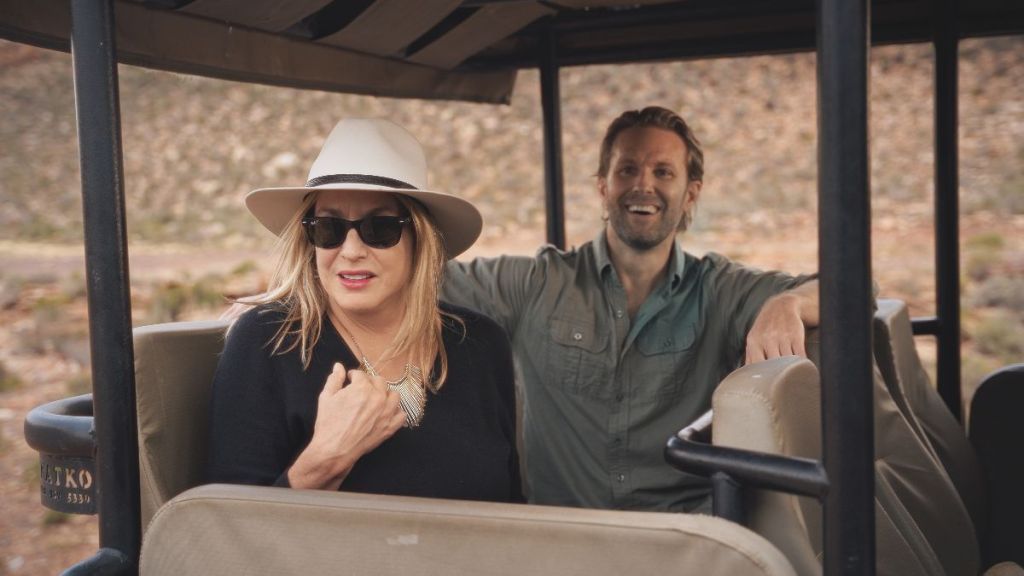
That around the world part, the travel component, is very important to the film. It also highlights how meaningful it is just to get out and see other countries and other cultures. What was that part of the experience like?
There’s so many good people in the world, and we need to unite the world instead of separate it. So that’s why I wanted to be very particular about where I went and the places that I knew where I could film easily. We went to Turkey, which is a Muslim country. We went to Greece, which, of course, is European. And then we went to Portugal. France is my favorite country in the world, and I had to go to my French wine in Burgundy. That was just because of that. (Laughs.) And then I’ve been on safari 13 times, and I know a lot of people cannot afford to go on safari. I did want to get that out there, because there are some more inexpensive safaris I just thought, what if I could bring the safari to you and do great white shark diving? And I did it.
It starts in Amsterdam, because the film before this was made for a lot less budget, and never really got finished because of COVID. I put it up for free on my YouTube channel Kimpton’s World Travel, Comedy and Film. It’s called American in Amsterdam. So we’ve got a little bit of Amsterdam that opens the movie.
I just think that travel is key in inspiration; I often get so many ideas of what I want to write. My next screenplay will be based out of Tanzania, and it’s about the elephant-human conflict that I became aware of because of going to Africa. I get inspired to write screenplays and comedy. But the thing that I want to do with this film specifically—I want to fill the void of Anthony Bourdain. I was trying to get travel jobs when Anthony was out there, and I couldn’t get [them]. And so I made myself the fictional travel reporter with the idea that if I went to all these countries and you couldn’t afford to go, you felt like you traveled too… The movie is to also inspire you to travel.
Do you have a favorite scene in An American Abroad, or a favorite aspect of the movie that was particularly fun for you?
The hardest scene is the scene I’m most proud of, and that’s acting drunk in France. It’s the hardest thing as an actor to act drunk and not overact. I’m just so proud of it, and we had to cut it down from the TV series, so you don’t see half of the slow build.
Also the script was too long, and so we had to improv. Most of it’s not improv, except I truly am allergic to wi-fi; it’s a real problem. I have this whole improv scene of trying to block the wi-fi. I’m really proud of that scene, because [co-star] Brian [Gross] has to have his lines down. I said let’s just improv it, because this is what I do every night; we’ll just exaggerate. And he did such a great job. We did that in one take. The cameras are just following me, and Brian’s just reacting to the truth, and he can’t believe that I have all this stuff.
You mentioned hoping to inspire the audience, in addition to entertaining them. Is there anything else you want viewers to take away from An American Abroad, or anything else you’re working on that they can follow next?
I have this app, Kimpton Travels and Film, and that’s where I have my favorite films. At least half of them you’ll know, but half you won’t. I tirelessly spend time trying to find cool independent films, and then the other part of the app is all my travel tips.
But the most important thing that I always want to communicate is that I wrote a memoir called Escaping the Hollywood Bardo, and it’s on Amazon. It’s really about women against the odds in Hollywood. I’ve never given up, and I want people to never give up on anything they dream.
An American Abroad is streaming now, including on Prime Video. Photo Credit: Courtesy of Marque PR.
Article content is (c)2020-2026 Brittany Frederick and may not be excerpted or reproduced without express written permission by the author. Follow me on Twitter at @BFTVTwtr and on Instagram at @BFTVGram. For story pitches, contact me at tvbrittanyf@yahoo.com.
 TVBrittanyF.com