
SPOILER ALERT: The following contains spoilers for Devil in Disguise: John Wayne Gacy.
The Peacock miniseries Devil in Disguise: John Wayne Gacy is an example of the overwhelming interest in true crime. These days, any kind of major true crime story is quickly followed by a fictionalized version. And in this case, it seems even stranger to revisit one of the most chilling true crime stories of all time. But there’s a reason why, and a noble one—even if it doesn’t always come through.
It helps to put Devil in Disguise into context. The Peacock miniseries arrived near-simultaneously with Hulu’s Murdaugh: A Death in the Family limited series—both based on real events, but from two totally different eras and angles. The Murdaugh story is more recent and more talked-about; that miniseries is trying to satisfy a public curiosity. John Wayne Gacy’s crimes are well-known. They’ve been the subject of books and TV shows and documentaries for years. This prompts the understandable question of why go there again? What’s to be gained from repeating this story?
The answer becomes apparent early on. Devil in Disguise: John Wayne Gacy wants to tell the story through the eyes of the victims and their families. It’s a noble endeavor—something that the Paramount+ series Happy Face tried and got a chilly reception for. But Devil in Disguise is also attempting to remind true crime enthusiasts that crimes are about more than investigators and suspects. That victims and those closest to them have entire lives beyond this point of tragedy. It also attempts to answer the lingering question of why Gacy was able to commit so many murders, by discussing the institutional failures along the way.
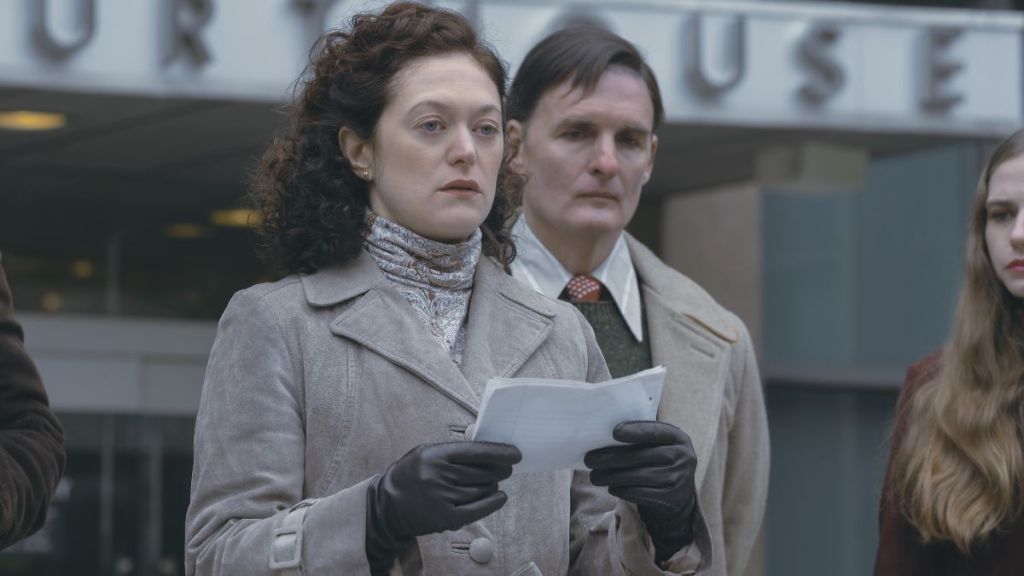
The miniseries is more successful at the former than the latter. The victims are best represented by Marin Ireland‘s no-nonsense performance as Elizabeth Piest. Elizabeth and her family were key to Gacy’s capture, and Devil in Disguise does a wonderful job of bringing Elizabeth’s story to light and making sure she gets the greater awareness she deserves. One of the best scenes in the entire miniseries comes in its seventh episode, “David,” when Detective Joe Kozenczak sits across from Elizabeth and talks to her about blind spots and failures in communication. James Badge Dale (24, Hightown) is excellent in the role of the beleaguered detective who is unwilling to accept these flaws, and Ireland is even better as a woman who has had more than enough. She is powerful to watch as audiences feel her pain.

When it comes to explaining what happened, though, Devil in Disguise doesn’t necessarily offer anything new. Not that any answer this fictional version could give would be wholly satisfying. But the scenes that tackle this issue are the usual arguments full of bureaucratic non-answers. It’s cringe-inducing when a Chicago cop tells the detectives that most missing teenagers are just “troubled” kids. Of course many of them have issues, and not all of them become crime victims, but to use that as an explanation is so dismissive. And these scenes don’t feel much different than what one might hear in a regular scripted TV procedural.
There are plenty of the usual creepy serial killer scenes, of course. Severance alum Michael Chernus does his best to unsettle the audience as Gacy. No one will ever match the heights of Cameron Britton in Mindhunter, but this is the uncomfortable viewing experience that it’s supposed to be. The series earns its TV-MA rating. Stylistically its biggest criticism is one shared by so many other crime shows—it’s too dark in many places. The visual use of darkness does not necessarily enhance the metaphorical darkness. And with eight episodes, the series was probably better set for a weekly release instead of a binge-drop. It’s the kind of show that the audience has to step back and process.
Devil in Disguise: John Wayne Gacy may not be revelatory in what it’s saying, but it’s definitely worth watching for how it’s saying it. The emphasis it puts on victims and their families is welcome, and that message comes through more clearly because of the excellent actors playing those characters. Why did audiences need to see this story again? Not for Gacy, but for Elizabeth Piest and everyone who stood with her. And that is something viewers can carry with them beyond the suspense of a typical true crime show. (Peacock has also simultaneously released a documentary miniseries with the reversed title, John Wayne Gacy: Devil in Disguise, for anyone who wants to learn more about the true story after watching this one.)
Devil in Disguise: John Wayne Gacy is now streaming on Peacock. Photo Credit: Courtesy of Peacock.
Article content is (c)2020-2026 Brittany Frederick and may not be excerpted or reproduced without express written permission by the author. Follow me on Twitter at @BFTVTwtr and on Instagram at @BFTVGram. For story pitches, contact me at tvbrittanyf@yahoo.com.



 TVBrittanyF.com