
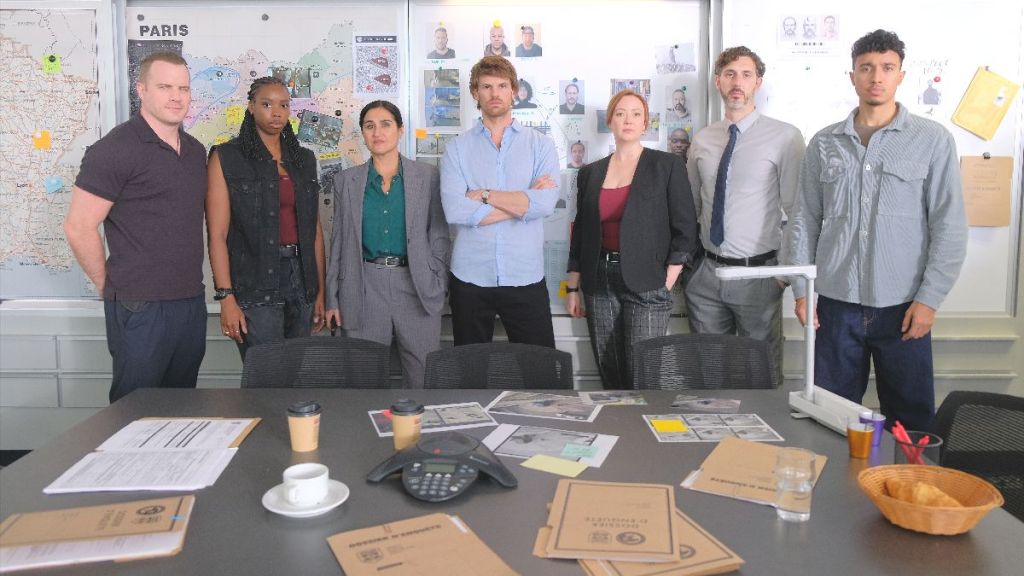
Jules Maigret is returning—but not in the way fans expect. Maigret comes to PBS Masterpiece as a modern interpretation of the iconic detective, with all the challenges and new possibilities that entails. This version of Maigret is the brainchild of veteran crime writer Patrick Harbinson, who knows the genre inside and out with a career that includes Red Cap, Homeland and Law & Order: SVU.
In an interview ahead of the Oct. 5 premiere of Maigret, Harbinson spoke to TVBrittanyF.com about why he wanted to adapt the French detective for a new audience. He also discussed what went into modernizing the character and his world. Plus, find out what made Benjamin Wainwright the perfect actor to play Maigret.
Brittany Frederick: You’ve done plenty of crime procedurals and mystery shows over your career. So what made Maigret stand out to you creatively?
Patrick Harbinson: I’d watched the two most recent British versions of it—one starring Michael Gambon in the 90s, and one starring Rowan Atkinson around about 2015—and as much as I admired them, I felt that they weren’t quite capturing everything that [author Georges] Simenon has, that the character of Maigret has. And so when [production company] Playground came to me and said, are you interested? I said yes, because I felt that Simenon, who writes very short books, is a funny, pacey, racy, interesting writer with hundreds and hundreds of fascinating characters. And I saw it as a chance to give the world a modern version of Maigret.
Contemporary reboots of crime dramas have been in vogue for the past few years. Playground also just gave fans an excellent new version of Lynley. What are the conversations you have when you decide to go in a modern direction?
When I first looked at it, I didn’t think immediately it should be contemporary. But then I had this sort of epiphany. It was that Simenon himself did not write period pieces. He was writing Maigret for 40 years. They’re always written in the present. And it was like okay, so we’re going to make him in the present.
And that meant Paris in the present, with all its beauty and ugliness. Diverse cast, much younger cast. I can put a different edge on the crimes. It just opened up a whole world. It gave me problems, because I had to deal with CCTV and GPS and all those appurtenances of the police state that we live with. But I knew I could cope with those. And it suddenly refreshed everything, especially having a younger Maigret.
The casting of your lead character is so critical. What was it about Benjamin Wainwright that you felt he was the right actor to play Maigret?
We auditioned probably 130 extremely good English and Irish and Australian actors. And what Ben has is a stillness without being stolid. You can see, feel the intelligence behind the eyes. The fact that he’s very good-looking was almost an obstacle. [Laughs.] But there was so much intelligence in his read and so much emotion when I gave him emotional scenes.
The ability to—as I used to say to him—to brood quickly, that was key, because they didn’t want another Maigret where [he was] very noir, sort of staring into the middle distance forever. They wanted someone who is restless and has energy, and Ben has that.
Behind the camera, not only are you running the show, not only did you write all the episodes, but you directed a few as well. What motivated you to both write and direct on Maigret?
It wasn’t the original plan for me to direct. It just happened to happen once we were in Budapest, and it was decided by people above me that I was probably the best choice to do it. And thank God it didn’t go horribly wrong. [Laughs.] Because I’ve been on film sets and television sets for 30 years beside brilliant directors, beside less brilliant directors, in a sense, I know what I’m doing. But it did give me the opportunity to help this young cast find really quite complicated, complex roles.
It’s a big cast. There are sort of eight regulars, and I needed to give them space to find their characters and interact with each other and have all those lovely little relationships that are not scripted. I basically gave them room. Do what you can—find something in the scene, keep yourself busy, have an interaction. And they gave me so much. And as I watch it, this is one of those series that I genuinely believe repays rewatching, because that cast gives us so much emotion, humor, undercurrents of tension. It’s just a lot going on, which I love in a procedural. I hate procedurals that are just about crime boards.
One of the pleasant surprises is those subversive moments where Maigret bucks some of those genre tropes, such as when Maigret’s big speech gets interrupted. How did you find the right place for those beats, and how did you execute them so well?
My sister says I have an irresistible urge to levity. That line, the brilliant, brilliant Kerrie [Hayes] delivers it. Ben has just given this heartfelt speech about, who are we working for? [The] grieving mother or the international banking system. It’s in the middle of emotion. There’s music under it. We’ve just had a flashback to the grieving mother. That’s the right place to puncture the mood.
I just knew that. And just as I was writing, the line came to me and then you rely on the actors to deliver it. I think there are some lovely little moments you trust your actors to deliver, and they did.
You’ve written on those more standard procedurals like Law & Order: SVU, and you’ve also done less conventional shows like when you created Red Cap. How much did the breadth of your experience in the genre apply to the work you did on Maigret?
It’s a bit of a nightmare, because I’m fairly determined not to repeat myself. I’m sure I have, but that’s it’s that I want to be different. I remember my mistakes more than whatever success I’ve had. It’s the things I did wrong that, as always, they stick with you. And so I wanted this to be different.
Law & Order: SVU had Mariska [Hargitay] and Chris [Meloni], so I had big stars. This was taking an iconic character and reinventing him. That was a pressure I had not had before, and I was dealing with the [Simenon] estate all the time. That was an interesting pressure, and that was new to me. And I enjoyed that, and I think it helped the show.
What was the most rewarding part of Maigret for you creatively? Did you have a favorite episode or an aspect of the production that resonated with you?
Of the six hours, I think the [sixth] one works best, just because everything comes together naturally that we have built up over the previous five hours. But also in terms of the acting from Ben and the guest characters. The direction by David Evans is peerless. That I think is the best, thrilling episode.
My favorite scene is actually in the first episode, and it was the very first day I was directing. Maigret delivers the news of someone’s death to a grieving mother, played by Amira Ghazalla—brilliant Egyptian actress. And there’s a cat in it and a fish. It’s a very Maigret scene. So lovers of Maigret will recognize it and enjoy it. It was just the quality of the acting, the lighting… It just caught the warmth that I wanted from the series, and the emotion that was key to me. I felt previous Maigrets, though honestly really good, did not find the emotion in the stories as well as they might have. And I think that scene shows how profoundly emotional Simenon is as a writer, and those actors nailed it.
Budapest works as modern Paris in an incredibly good way, an interesting way, lovely colors to it, lovely moods. And it’s got a beautiful, big river right through the middle of it. Every character that Simenon writes is odd in a really fascinating way, and just put together in great stories… I enjoy the warmth of the whole thing and the emotion and the journey you go on.
Maigret airs Sundays at 9:00 p.m. ET/PT on PBS. Photo Credit: Courtesy of Playground Entertainment and Masterpiece.
Article content is (c)2020-2026 Brittany Frederick and may not be excerpted or reproduced without express written permission by the author. Follow me on Twitter at @BFTVTwtr and on Instagram at @BFTVGram. For story pitches, contact me at tvbrittanyf@yahoo.com.


 TVBrittanyF.com