
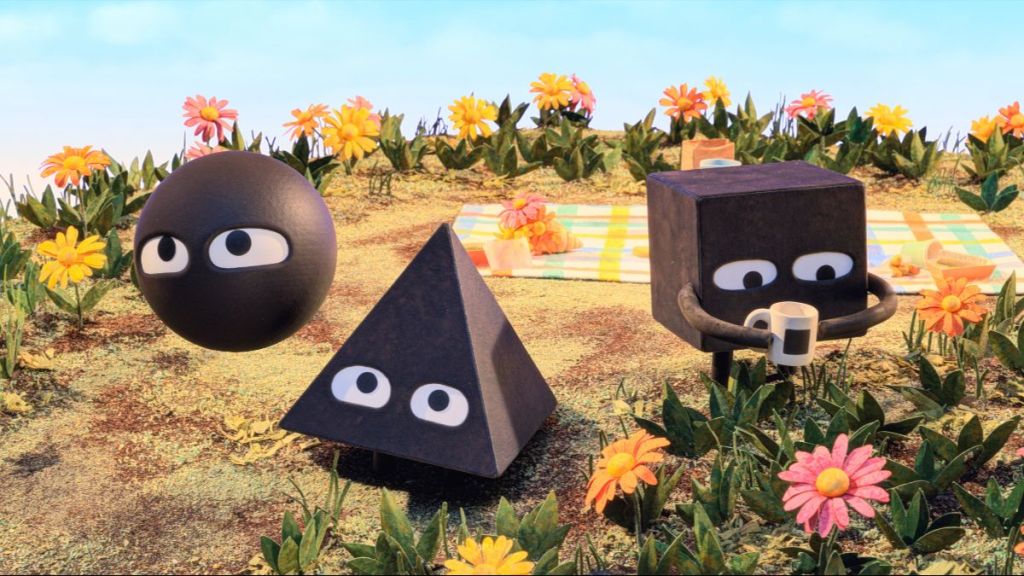
It’s time to return to Shape Island, and it couldn’t be a better moment for more of the Apple TV+ series. The program is the most charming show for both kids and adults, and the fresh adventures of Square, Circle and Triangle are a pleasant diversion. For creators Mac Barnett and Jon Klassen, Shape Island Season 2 is an opportunity to expand their idyllic island world.
In an interview ahead of the season’s August 29 premiere, Klassen and Barnett talked about the joys of writing toward their talented cast in Season 2—including an episode focused on Yvette Nicole Brown’s wonderful Narrator. They also discussed whether or not they’ve thought about making another Shapes book, and just how complicated it is to create basic shapes on television.
Brittany Frederick: What’s it like simply to make a second season, and know that TV viewers are loving the characters just as much as the book audience?
Mac Barnett: It’s really meaningful. We really wanted to translate the soul of these books to screen, and to find out that kids who love our characters in the books, they love watching this show, it goes the other way, it means a ton.
Jon Klassen: It would be disheartening if they said wow, we love these characters in the show. The books, we didn’t like them in those.
Barnett: That would be the worst case. (Laughs.)
One character who gets a well-deserved spotlight in Shape Island Season 2 is the Narrator. Was giving her an episode something you’d always wanted to do, or was it a reaction to how excellent Yvette Nicole Brown is in that role?
Barnett: It’s a little of both. It was an idea that came out of the very first conversation we had with the writing team, even before Season 1. It was an idea for a thing that we couldn’t let go of. When we were talking to our head writer, Ryan Pequin, we would always talk about the Narrator episode. We just [wanted] an episode where it was just all about the Narrator, where nothing was happening, and so the Narrator just made up her own episode. How it worked, though, really came from Yvette and Yvette’s performance. She’s just so incredible.
Watching her during the records, Jon and I would have to get on the phone afterwards and talk for an hour to process what we had just seen. Because she would give us three takes, radically different, totally dialed in, boom, boom, boom, different emotion, and all three you’re like, that could be the take that we use. She told us she had always wanted to be a narrator. She’s done so much voiceover work, but she’d never done narration before. And I think and hope that our Narrator was a fun one to play, because our Narrator really is a character. Our Narrator is not objective. Our Narrator has feelings about what’s going on.
There was a little moment in Season 1 where she was narrating this expansive shot where the shapes were traversing the island, and she’s like, can I give you a wild take? And she delivered the story of their journey in this British accent. And all praise to Yvette—this British accent was terrible. (Laughs.) It was such a bad British accent, and she started laughing. As soon as the take was finished, we were all laughing. We’re like, that’s the one we want—a Narrator who would try this British accent and not have it quite work.
That moment underpins her episode here. She is a nature documentary narrator. That is how she sort of comes into our own, narrating the story of this little bug. It was her performance—that accent, but just the humanity she brought to that role generally, that underpinned the writing of that.
Klassen: That episode is sort of the story of the second season generally, though. That evolution, and even though we had the idea, the execution about what her strengths were, and the fact that she could really pull off something like that. The realization of that kind of thing—to be like oh, our animators are this good, and our Narrator is this good, and our set people are this good.
To then begin to use them in new ways, and be like let’s press the gas on our Narrator and get a whole episode behind that. Let’s really hopefully give the animators something to chew on because we can trust them, and we always did, but just in what way. How to maximize what we’re seeing them be so good at. The story of the second season, I think, is just getting to lean on all that.
Barnett: That moment where she says, “Can I level with you? I love being a narrator, but it’s a hard job.” I think when adults admit their imperfections—when a show that’s on the air says we don’t know everything—as a kid, I just remember that feeling so electric and so honest. I think it’s a fun mind-bending episode of Shape Island. But I actually think that what’s happening there is Yvette is sort of breaking down and then coming into her own. It’s as much pathos as you can get out of 11 minutes, too.
How much have your ideas in Season 2 been written toward the rest of your cast—Harvey Guillén as Square, Gideon Adlon as Circle and Scott Adsit as Triangle—now that you’re also more familiar with what they bring to each character?
Barnett: What we saw out of our cast, what we saw out of our animators, all of that—we all kind of had this general sense that every episode we are going to try to explore and go deeper on these distinct points of view. But we learned more about these characters from our cast. We learned more about these characters from our animators. When weeklies would come in, we would see a gesture or a moment, a blink, and we would just say, “We need more of that.” So it did feel like, all these separate parts of the production, we were all in pursuit of the truth of who these characters were, and it would all feed back into the writing of new episodes.
Klassen: It was tricky, because you don’t want to ever break your characters, right? And so you want to evolve along things that feel consistent with your conception of them. But they also can’t stand still. You’ve got all these episodes to go, and so you have to find out new things about them. I remember talking to Mac about Harvey, who voices Square. And the more he was doing the jokes we were writing, the more we were finding out that he was his funniest when he was kind of mean in a sarcastic way, where he’d be making fun of the situation, or reading a line almost overly sarcastic or sweet.
Barnett: I think [that] comes out of who Square is. The conception originally is Square is sort of the most upright. He is the sweetest character of these three. But the way that Harvey could peel back the mask a little bit to show that Square was frustrated or was over it… It’s in this beautiful way. You get to the truth by him playing the opposite of the core of the character. And he can hold both of those.
Klassen: Our read was that he was enjoying those takes the most, too. That’s a big indicator as well. When you can feel the actors enjoying that take the most, and it feels like that’s where they really found it, then you’re like okay, well, let’s write in more of those.
Barnett: The worst you get into with something like this is that it becomes rote. That’s the danger. Like something happens and Square’s like, “I think we should follow the rules,” and Triangle’s like, “I think we should break the rules,” and Circle goes, “It’s complicated.” That gets boring really fast. And I think that we got more nuance out of everybody than that, and and a lot of that came from the cast.
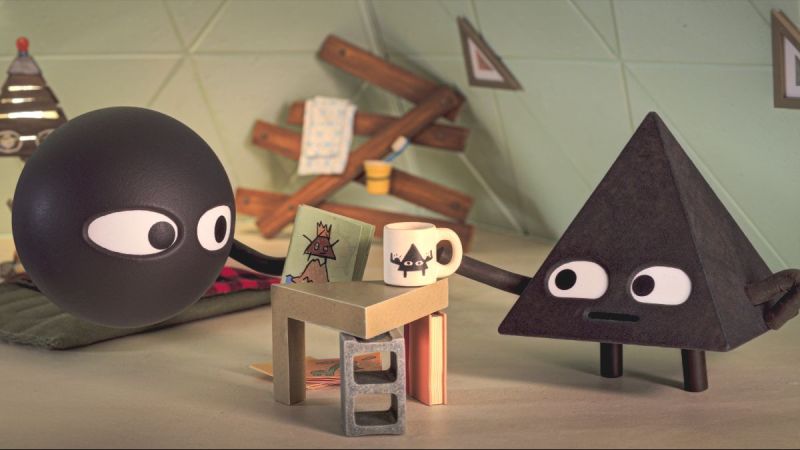
You’ve got the three most recognizable shapes in Shape Island. Have you thought now about expanding the group with something new, like a rhombus?
Klassen: It’s the only one we talk about! If there was ever an expansion character, he would be the one. We had some roughs of a rhombus sailing into onto the island… and falling over on the beach immediately.
Barnett: A rhombus in three dimensions, it’s tricky. We thought that these puppets—a sphere, a pyramid and a cube with eyes—were going to be the easiest thing in the world to make. And all of our puppet makers were like, these were the hardest puppets we have ever made. (Laughs.)
Klassen: I think rhombus would actually be the easiest, though.
Barnett: I think it would break them, because I’ve never seen… I remember in preschool, you have your little shape blocks, right? I never saw a rhombus shape block. I don’t think they know how to do it. I don’t think we have the technology to make those in three dimensions yet. But you know what, with the help of Apple, I think we might be able to do it.
With the experience and inspiration you’ve had doing Shape Island the TV show, have you given any thought to writing another Shapes book? Or what would you say to viewers who haven’t read the books yet?
Klassen: The drawings are really good. (Laughs.)
Barnett: When kids who love the books ask us that, we do say maybe, but honestly, right now, any idea for a story we have goes to Shape Island. We do treat this show and these episodes with the seriousness and the ambition and the belief in what is possible that we bring to books.
I am the National Ambassador for Young People’s Literature; that is my job. I’ve been designated that by the Library of Congress. I am supposed to say “Yes, books, read,” and I do believe that—but I also want to say I am a firm believer that some of the best storytelling that has ever happened for children happens on television, too. There’s been nothing better on the air than that first golden run of 15 years of Sesame Street. I think Adventure Time is a miracle and some of the most ambitious, sophisticated, important storytelling that has been done for kids. It happens in books. It happens on TV. It happens in songs and poems. What is important is that brilliant people are working hard to make good stories for kids.
Klassen: That’s sort of our way into helping kids read, too. You can tell them to read, and then they pick up a book they don’t like, and they’re like, you told me to read. And we’re like, “Well, not that one.” I think you can hopefully just promise them that the depth of enjoyment and illumination they’ve gotten from any number of forms—whether it be shows or movies or video games or anything—is also available in the form of books. That’s kind of our best way in, is to be like, it’s in there too. Just don’t think that that’s some dusty medium. You can find everything you found in these other things there. Working in concert with all of that stuff, and to see these properties even jump from one to the other in hopefully, a pretty seamless way, has been really great.
Shape Island Season 2 is now streaming on Apple TV+, where viewers can also catch up on Season 1. Photo Credit: Courtesy of Apple TV+.
Article content is (c)2020-2026 Brittany Frederick and may not be excerpted or reproduced without express written permission by the author. Follow me on Twitter at @BFTVTwtr and on Instagram at @BFTVGram. For story pitches, contact me at tvbrittanyf@yahoo.com.
 TVBrittanyF.com