
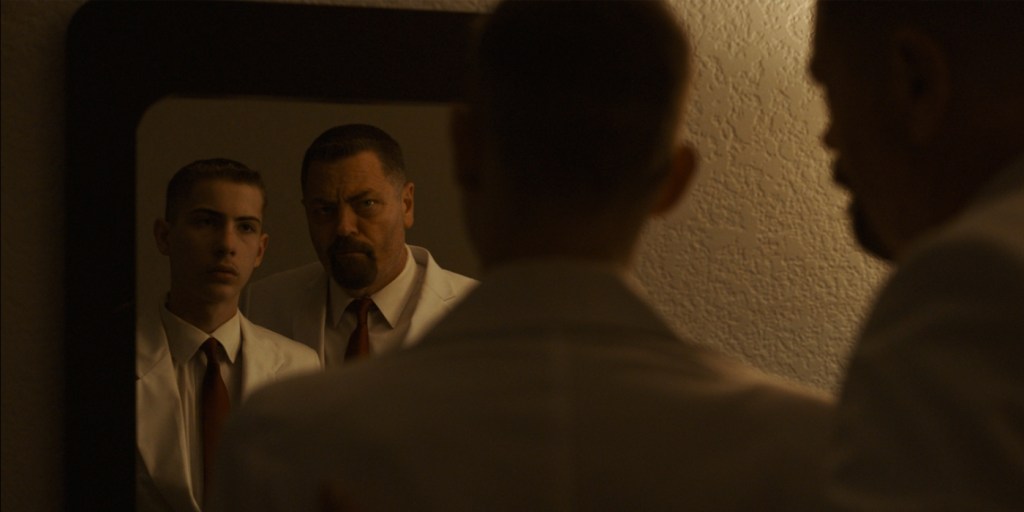
Based on the police shooting involving Jerry and Joe Kane that occurred in 2010, Sovereign is a hard-hitting character drama that serves as one of Nick Offerman’s most impressive performances to date. The critically acclaimed film follows Offerman’s Jerry Kane as he preaches his belief in the idea that he is a “Sovereign Citizen” and therefore exempt from the law — a belief that leads to tragic consequences for him and his son.
For writer/director Christian Swegal, the story of the Kanes remains as timely as ever because of how it reflects the enduring challenges of modern society. During an interview with TVBrittanyF, Christian Swegal discussed why the story of the Kanes resonated with him, how the experience of the production changed his view on actors, and helping Nick Offerman suppress his natural kindness for a complex dramatic role.
TVBrittanyF: What was it about the story of the Kanes that really caught your attention as a storyteller?
Christian Swegal: I’ve always been drawn to these kinds of fringe movements. I’ve been interested in how people find themselves in these positions. Sovereign citizens weren’t something that I was super familiar with, but I had some personal experience with people who were close to me, who became involved in some conspiratorial anti-government thinking, and it was due to a mental health issue. In trying to understand that, I started researching sovereign citizens, and I discovered [the Kane] case, and I just found it to be really fascinating.
I found the father-son dynamic at the center of it, that relationship, to be really moving. Trying to just understand it, especially from the perspective of a 15-year-old boy, what a coming of age story looks like when the world you’ve been raised in is so isolating. When your father has a completely delusional worldview, I think rejecting that delusion and wanting a normal life can feel like a real betrayal of them. I loved the emotional tension at the center of the story as well, the themes that it touches on, in terms of just sort of broader sort of societal critique that I was interested in.
[Looking back to the situation in 2008 and 2010], society broke down for a lot of people. I think there was a lot of technology coming online for the first time in 2008 — I don’t know when the iPhone was invented, but it was around when Facebook and social media migrated from chat rooms into [what we have now]. I’m sure the roots go back way further than that, but this story, the problems that it’s talking about, is still very relevant today.
The film doesn’t just explore the Kanes, but it also showcases the establishment authorities in the form of John Bouchart. Why was it important to you to showcase both sides of this story?
I’m really interested, I guess, in systems. I think the reason I was drawn to this story to begin with is because it’s an incredible way to inhabit someone else’s perspective. I think these extreme perspectives are sometimes kind of the most interesting to try to inhabit, because usually when you step into somebody else’s experience, I wouldn’t say there’s a logic to it, but there is sort of a cause and effect to it… I feel like there have been examples that I’ve known in my life of being very judgmental of somebody, and then you find out this person actually was mentally ill. They were suffering a psychotic break, and this is what happened.
I think mental illness is sometimes part of the equation. I think that desperation is a part of it, too. I think there’s a very rational distrust of official systems in this country right now. I don’t think you have to be a conspiracy theorist to think that. I think there has been a breach of trust, and I think that you can’t convince some people to not think that way, because they’ve lived it. Through my research, the people I’ve spoken to who have been adjacent to this movement, the one thing I found in common with many of them is that they suffered a real injury of some kind. They lost their homes. Their money. Maybe they had a medical condition, and they were denied insurance.
They filled out their taxes wrong, and now there’s a mountain of penalties they have to pay. There are so many small bureaucratic loopholes that can really have effects on people if they get tangled up in them in our country. I think it starts with that injury. Then, without an official, responsible societal response to that, I think you have people like Jerry Kane show up in that vacuum. That’s my long-winded way of saying all of that was more interesting to explore instead of judging or condemning flatly.
RELATED: ‘Everyone in this show is phenomenal’: Outrageous star Bessie Carter dishes on BritBox comedy

This film also flips the typical expectations of a Nick Offerman performance, especially after something like Parks and Recreation. What was it like bringing that out of Nick?
Nick and I had a lot of conversations about the character. Nick is such a professional. He’s such a deep artist. I feel like my value to Nick was just in being sort of like a road guy, being able to talk through the text of the writing, and say, ‘Here’s where I think they’re coming from. Here’s where I think the mindset is.’ If there is anything we did have to do, I feel like it was pulling back on Nick’s natural warmth. Nick is such a warm person.
Especially in some of those more difficult scenes with him and Jacob towards the end of the film, it’s so out of character for him — there would be times I would need to remind him, here’s where your character is coming from. Nick and I talked about this; he couldn’t really be playing a villain. I think as an actor, or at least what he talked to me about, is that you have to try to connect with that part. You need to find something you feel you can relate to. Even bad people, even very bad people, have good or appealing parts to them. I think it’s kind of courageous to try to engage that.
What was the biggest surprise you encountered making Sovereign?
I think the power of the performances — you go into an experience like this is a director, especially a first-time director in this case for me, and you’re kind of armed with your look book and your references and the kind of music you’re listening to when you’re writing it. I felt very confident in the beginning. But then you’re thrown into a situation where you have to make 1000s of decisions. Do you change anything about this cup sitting on the table? Is it empty? Are they eating fries at the table, or are they finished with their food?
These minute, little decisions, down to colors and placements, you’re making a judgment call in each of those cases. I think along the way, through those 1000s of decisions, your taste is kind of revealed. I think you can have your target, but then your natural inclinations will be revealed through that process. I think that was surprising to me was to learn sort of that my tastes are different from what I thought they were initially as a filmmaker. It’s so much the actors who bring it all together.
Sovereign is now playing in select theaters

 TVBrittanyF.com