
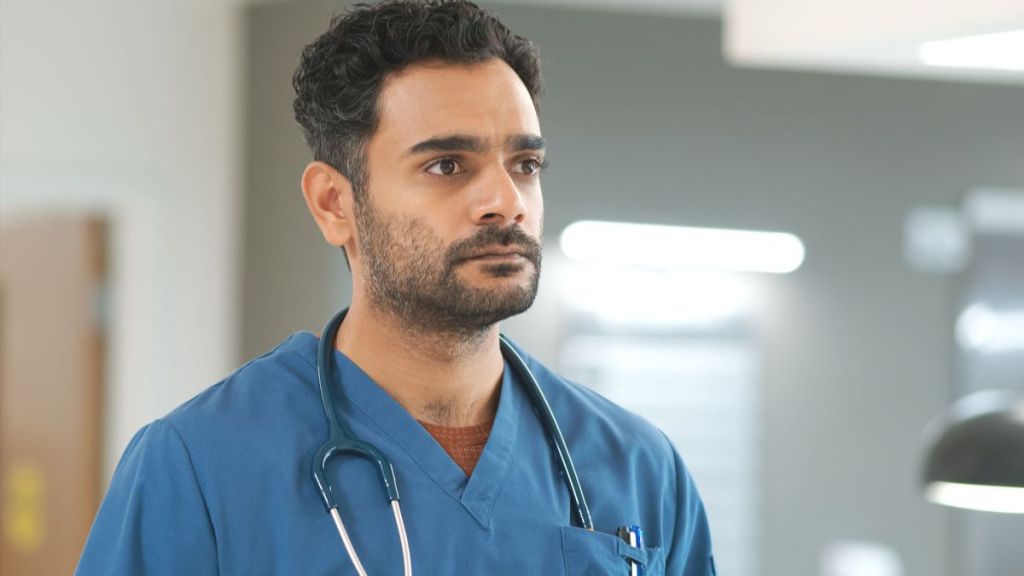
WARNING: The following contains spoilers for Transplant Season 4, Episode 8, “All I Have Is How I Feel.”
The end is near for Transplant, as NBC audiences continue to enjoy the show’s fourth and final season. But it’s bittersweet to be saying goodbye to Dr. Bashir “Bash” Hamed, as Bash’s constant drive for positive change and his unique story as a refugee have made him a breath of fresh air in the medical genre. Bash’s idealism and what audiences can learn from him have helped Transplant be about far more than cases of the week.
Transplant star Hamza Haq, who plays Bash, joined TVBrittanyF.com to discuss what it was like to let go of the character after four seasons leading the medical drama. He also spoke about finally getting to play Bash and his longtime love interest Dr. Magalie “Mags” Leblanc as a couple (including that crushing development with Mags’ heart), and how Bash and his sister Amira’s journey as refugees continues to be important in Season 4.
Brittany Frederick: You and many of your co-stars have been with Transplant from beginning to end. What was it like on an emotional level to make Season 4 and move on from the character of Bash?
Hamza Haq: The beautiful thing about this fourth season is we finished filming it almost two years ago. You guys are getting it on the tail end of it. As we were going, the story presented itself in a way where Bashir was also coming to terms with the end of a couple of things and all of that. So very much based on what was written, I kind of got to process the the completion of this chapter in real time based on what was on the page. That was really great.
But now revisiting it, it’s kind of been beautiful… To watch it a couple years after the fact, and I finally [have] a moment to take it in, and that it is the final season. Usually around this time, we we get our emails and our schedules of when we’re going again. it’s funny how that shaped the landscape of my life for all the years that it did. And to not have that, and to get that opportunity to just sort of sit back and enjoy the show once more as a completed product, it’s been wonderful. It’s really nice.
Did you approach your performances in Season 4 any differently, knowing that it was the last season and the last time you’d be doing all of these things? Did that add any extra pressure?
It’s all the mentality that you choose to go into it with, in a very real way. The stakes are higher in terms of what you want for the character. You want to go off on a good note. You want to serve the character. But I feel like any actor worth their salt, if you feel like you’ve done your job and you’ve done service to the character itself, you just go in and continue to do that and continue to be honest and continue to be truthful.
Because in a very real way, on a commercial level, the stakes are actually very low. We’re not looking to get renewed. We don’t have to perform well in order to get picked up for another season. If anything, the pressure is really on for the first couple of seasons. So when you know it’s the last one, it’s kind of just like, hey, just enjoy this one as much as you can, because it’s the last go-around.
Transplant creator Joseph Kay and the writers really put an emphasis on Bash’s personal growth, both as a doctor and as a human being, each season. What was your favorite part of his arc in Season 4?
I think there are moments where where bash finally allows himself to be happy. There are moments in this season where he’s kind of bracing against joy. He’s bracing against accepting that he has worked very, very hard to get where he has. Because of his anxiety and because of his past, and because of his trauma and all of that, he doesn’t really allow himself to feel happiness.
There’s a particular point in this season where things are just good, and that’s something that’s completely new for him. To be able to give that to the character—a character I’ve spent so much time with and felt his pain and brought that pain forward—for him to finally accept that he is deserving and worthy of love, acceptance and not being so hard on himself, that’s something that I feel like everybody deserves. And it was nice to give that to the character I was playing for all those years.
One of the highlights of Transplant Season 4 has been finally getting to see Bash and Mags as a couple after years of wanting them to get together. How would you describe playing that, both the happiness of it but also knowing there would have to be challenges like Mags’ heart transplant?
There had to be some massive shift. And very early on, even around the third season, we’re going into the last one, and we’re just like all right, there’s going to be a big thing that happens. Who is it going to happen to and what’s going to be our relation to that? So the fact that we got a couple episodes where everything was all good, it was amazing. And then when we both read what was going to happen next, it was devastating.
But it was written so beautifully that it was we both kind of agreed—Laurence [Leboeuf, who plays Mags] and I—when we both read it together, we’re just like, this is good. It makes sense on how it’s supposed to happen and how their journey supposed to progress, and it’s the right thing to do. Not everybody’s going to be a fan of that. And I think a lot of people even to this day are, why did that have to happen?
I’m just like because in life, rarely [do] things just happen nicely, and there’s always something to work on. Now, this was an extreme version of that that Joseph threw at us, but the fact that we got to experience the entire spectrum of human emotion, we were happy to do that together.

It’s also very important that the romantic relationship hasn’t overshadowed the rest of their lives, as happens on other TV shows. Namely, Bash and Amira’s story is still prominent in Season 4. What can you say about that part of his journey?
They didn’t choose to come to Canada. This wasn’t a concerted effort. If Bashir and Amira both had the choice, they would have stayed in Syria, but they were forced out. And the fact that they landed in Canada through the circumstance they did, that had to be an important through line throughout the whole [series]… It was constantly this fight of will they ever find a notion of home ever again, and that anytime that they’re at work or at school or in a relationship or anything, that question is always there. Is this going to be permanent, or is this too going to be taken away from us?
The way the series ends, there’s sort of a full circle moment, where I think there’s an opportunity for both of them to plant some roots, and to stave off that that anxiety of things being taken away from them because they feel confident enough in their accomplishments and their love for each other that now we’re going to start over here, and it takes a long time to get there. And I imagine that anybody who has gone through that is longing for that feeling.
But that’s what has made Bash such a memorable and even aspirational character. He’s always wanting to do better, not necessarily for himself, but for everyone else around him, even total strangers. Have you learned anything from him that you’ve carried forward after Transplant?
it was, and still is, a true gift to be able to have Bash in my resume, because there’s a sincerity with which he behaves, and there’s an attitude towards service. Obviously as a doctor, you take your Hippocratic oath, and you have to take care of people. You have to fix them, and you have to treat them. But the way that Bashir does that unapologetically, sometimes to his own to his own harm and to his detriment, it’s a good way to live.
And to have that balanced with eventually, when he finds this value within himself and who he is as a person and forgives himself for things that were completely out of his control, that’s a very important lesson. We all have gone through things that we don’t have control over, and that have shaped our experiences in life, and that we either regret or that we wish we could change. And even in fiction, somebody who comes to terms and forgives himself and allows himself to see value in himself—that’s aspirational for for anybody, I think, and I take that moving forward.
Transplant airs Thursdays at 8:00 p.m. ET/PT on NBC. Previous episodes from Seasons 1-4 are streaming on Peacock. Photo Credit: Courtesy of NBC.
Article content is (c)2020-2026 Brittany Frederick and may not be excerpted or reproduced without express written permission by the author. Follow me on Twitter at @BFTVTwtr and on Instagram at @BFTVGram. For story pitches, contact me at tvbrittanyf@yahoo.com.

 TVBrittanyF.com