

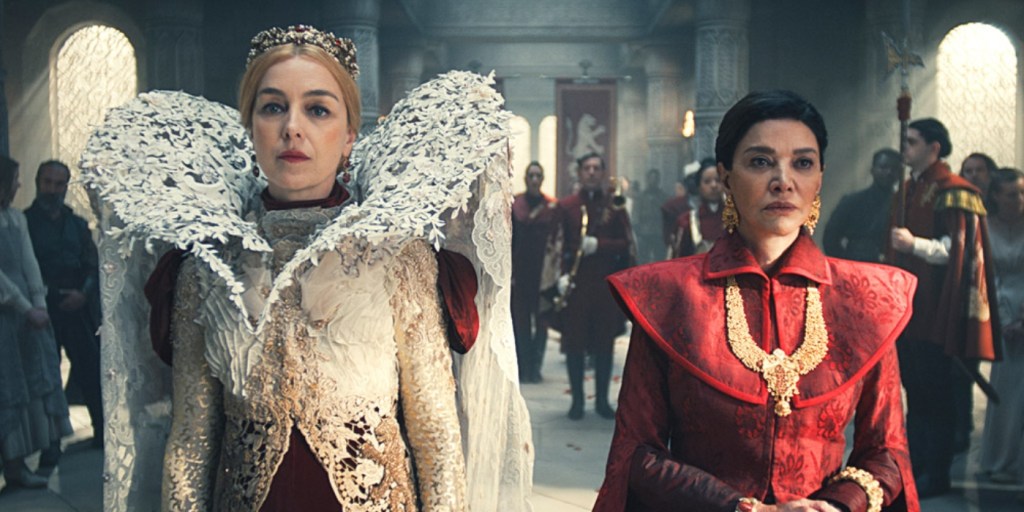
The Wheel of Time was an ambitious project from the jump, but the work of filmmakers and creatives like Ondrej Neksavil and his team helped make the fantastical realms of the Westlands, Aiel Waste, and Shara feel like they exist right outside your window. The production of the fantasy setting was one of the most impressive aspects of the show, with a focus on bringing the costuming, magic, and mystery of the acclaimed fantasy series to life in stunning ways.
This approach was only amplified in season 3, which benefited from some changes behind the scenes. During an interview with TVBrittanyF, The Wheel of Time Production Designer Ondrej Neksavil discussed how proper sets and props can make a fantasy world feel real, getting to approach season 3 with a larger scope, and the biggest surprises he encountered on the fantasy series.
TVBrittanyF: What were the biggest lessons from seasons 1 and 2 of The Wheel of Time that you brought to season 3?
Ondrej Neksavil: Where we started was the idea that the show must have a quality of look. Everything has to have depth, some patterns and details which are visible in every place. One improvement we made… During the first season, we were trying to do positive sets, everything was supposed to be nice and pleasant. In some scenes, it was a little clean and too bright. I think that was one thing we had to find out — we had to find a way to age stuff a little better. It’s not that it’s dirty, it’s not damaged… You create a kind of patina on the props and the sets, which gives the feeling that this has been in place for centuries. There is a history behind that. That was one way to improve upon ourselves.
We were trying to look at these things, and we learned that we always have to work with the texture and the richness of the picture. Everything we produced had to have some texture in colors and the look. It gives it all a lot more history; it gives everything more story behind it. For us, the [central idea] was that this is a world we believe people live in. We didn’t want to create a fantasy series. Look at the Glass Palace. It’s cool, but you have to believe that somebody actually lived there. That was the belief that grounded our environment. We kind of improved the quality of that within the seasons.”
This season had the unique advantage of getting to embrace a wider aspect ratio of 21:9. How did that impact filming for season 3?
That was something that helped us a lot visually. Sony and Amazon approved, for the third season, to change the aspect ratio of the season to a CinemaScope style. That actually changed a lot, because for this season we knew that we were going to see the Aiel Waste, this completely desert landscape. I think it was important — I do understand that, for the streamers, it was a hard decision. They offer streamingly mostly for TV, which everybody has at home, and is 16×9. Suddenly, we are coming with the cinematic scope and the wide lens, and the anamorphic lenses. Because we had that big scope landscape, I think it’s very important that we got the chance to get a more cinematic look at this. I think it helped us visually a lot.
In the third season, everybody improved the quality of their work. It’s not like we had done anything wrong before. I think we just carried it all a little better; it felt like improving yourself and your skills and making them better for the next season. I hope that whoever was there on the sets actually felt that. It’s always nice to have that feeling. Talking with the actors, they told me they could feel the quality of the sets… they had that feeling that they were really in that palace and in that space. The quality of the environment is really very important for performance and filmmaking.
What was the biggest surprise you encountered during the production of Wheel of Time?
One thing that was really important to understand, and that I was pitching from the beginning, was that we had to go to what felt like a real location. We have to feel like we’re outside, we had to really get the scope. We couldn’t do it all in a quarry with a green screen. Production-wise, that’s the easiest approach. You’ll set the screen, and say ‘Okay, we are in the desert,’ but it’s not there… It’s a very classical filmmaking thing, but there has to be a connection between the sets and the locations and how they’re designed, how they’re built, how the light is done, how it’s all connecting together technically. We shot Tanchico in three places, on two continents, and it all looks like one place when you put it all together.
The quality of the work made it feel like it was real. The set wasn’t built physically in the middle of a desert; it was built in Cape Town film studios. But across these different places, they were able to make these matches. If the work is done well from all sides — the quality of the painting, the quality of the surface, the lighting, the costuming — if that’s all there, it really doesn’t matter when and how the scene was shot. If that concept is working, then it helps everyone. One example was this challenge we faced… There was a big scene in episode 4 where everyone steps into this city that is completely covered by fog. It was hard for the director and the actors and everybody — at the time, I was the only one who had the thought on the right location for that spot.
We had to shoot the scenes inside the city first, and after that we had to go to the desert. So we did as much concept art as we could to show it to the actors and the director, and the DP. We were working really hard to express what we are looking for. They didn’t have the experience of being there, seeing the places, having that scope. They had to really be in on that stage of the production. At the end, it’s a really smooth transition, and no one was questioning it because it felt real. What I learned is that if this really works, it doesn’t matter if you’re filming on the same continent. The fact is, if you look at the quality of the work of the whole team and how it connects all these sets together, it makes the storytelling smooth. It’s always about smoothing everything over for the storytelling.
The Wheel of Time is now streaming on Prime Video
 TVBrittanyF.com