

Summer of 69 is a coming-of-age story fueled by Matt Bowen’s score. The film focuses on an inexperienced gamer-girl, Abby (Sam Morelos), hiring stripper Santa Monica (Chloe Fineman) to teach her the skills of seduction to bag her crush, Max (Matt Cornett). I was drawn in by this Trojan Horse of ‘raunchy comedy,’” Bowen told TVBRittanyF during an interview about his work on Summer of 69. “Inside that Trojan Horse was a surprisingly sweet story.”
Matt Bowen is a prolific, ASCAP award-winning composer based in Los Angeles. Known for his work on The Boys, The Binge, and Blood Road, Bowen is a classically trained violinist with extensive experience on both sides of the recording booth. He sat down with us to speak on his latest score for the Hulu-released adult comedy, Summer of 69. The journey to the final score wasn’t easy, shining light on the creative process between him and the film’s writer-director, Jillian Bell.
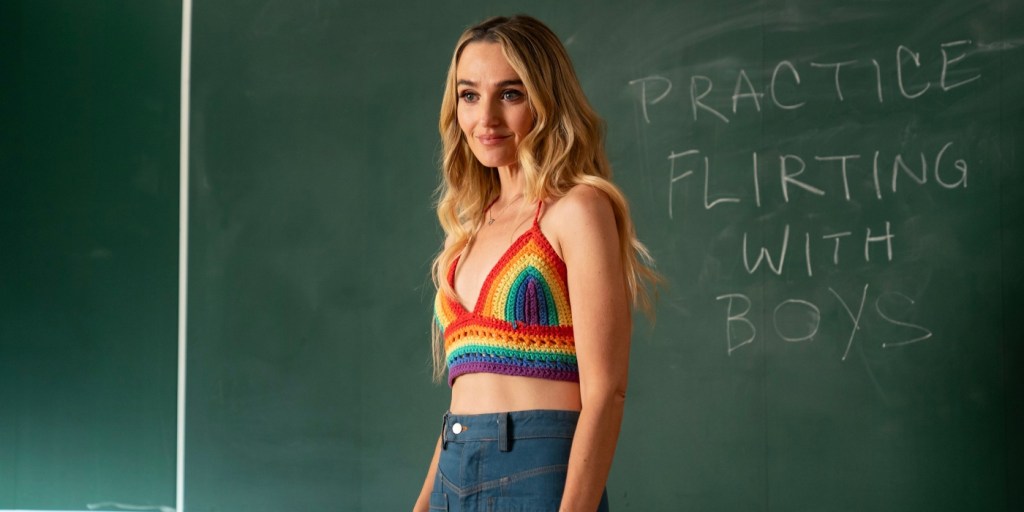
“If you had played me this score as a reference at the time,” Matt Bowen says to TVBrittanyF, “and asked me, ‘What do you think about this,’ I’d have been, ‘Nah, this isn’t going to work.’ We had to go through the process of finding the score. We started to talk a lot about decades. ‘Which decade are we living in?’ Abby has this ’60s innocence to her, and Santa Monica is this very New-Agey badass. So what if [Abby] has a ’60s sound, and [Santa Monica] has an in-your-face, brash Gaga sound?”
“Then we started to realize it was all feeling not connected enough and heavy-handed. The story of the friendship and the journeys they both go on was so much bigger than that musical idea. The first thing we realized that saved us a lot of time was that neither of them needed their own sound. That took us a long time to get there. Music was written that didn’t see the light of day, but you have to explore it to know that it’s not right.”
When asked about the relationship between score and the film’s licensed soundtrack that Bell designed, Matt let us in on how those musical decisions were made. “It was cool because it was me and the music supervisors saying, ‘I know this is a needle-drop right now, but it would be cool if it were covered by score… or vice-versa. That’s the nuts and bolts, but the creative part is what the actual role was playing in the film.”
Bowen noted that “We liked the score only playing the underscore, the emotional arc, the journey that the two were going on. We let the licensed music provide the pacing. In a lot of these comedies, you might have ‘groove tracks’ to provide pacing, to get you from A to B with a certain vibe.” On the direction, Bowen revealed that “Jillian liked the aesthetic of licensed tracks providing the pacing. I would come in and write for the scenes that had to do with that personal journey.”

When asked where the film’s sound came from, Bowen confides that “I was responding to a lot of the tracks that Jillian was responding to. She was honing in on this ’80s sound, ’80s vibe nostalgia, but not in a synthwave sort of way.” Putting a finer point on it, Bowen revealed that “It was more earnest, ‘live performance,’ Bruce Springsteen style. A ‘this piano’s slightly out of tune’ sound.” Turning in his seat, Bowen gestured to his studio setup and revealed “This piano behind me ended up being the focal point of the score.”
“The first major scene that I scored where Jillian and I were like, ‘That’s feeling right,’ was the main resolution scene at the end of the movie.” On this breakthrough, Matt tells us, “It was cool to land on that first, and then we could backtrack. Jillian was able to hear that it was a very minimal, stripped-down cue; she could hear that it was pointing at that finished cue. When you could say there was a guiding light, it was absolutely that cue. That ended up being the main theme that I extracted and used throughout the film.”
“Everything that was chosen was because it had a bit of kitsch to it,” Bowen recalled.“Jillian liked that sense of kitsch. But if it was coming from the score, it felt a little hand-holding to the audience. Especially when there’s vocals, the audience knows ‘this is a needle-drop,’ you have a little more license to push the kitsch.” The score subsequently remained more emotionally coded. Speaking on his collaboration with Bell, Matt noted that he had always “wanted to work with Jillian. I’ve been a fan of hers from afar. Now, having worked with her, I’m a bigger fan.”
Summer of 69 is now streaming on Hulu
 TVBrittanyF.com