
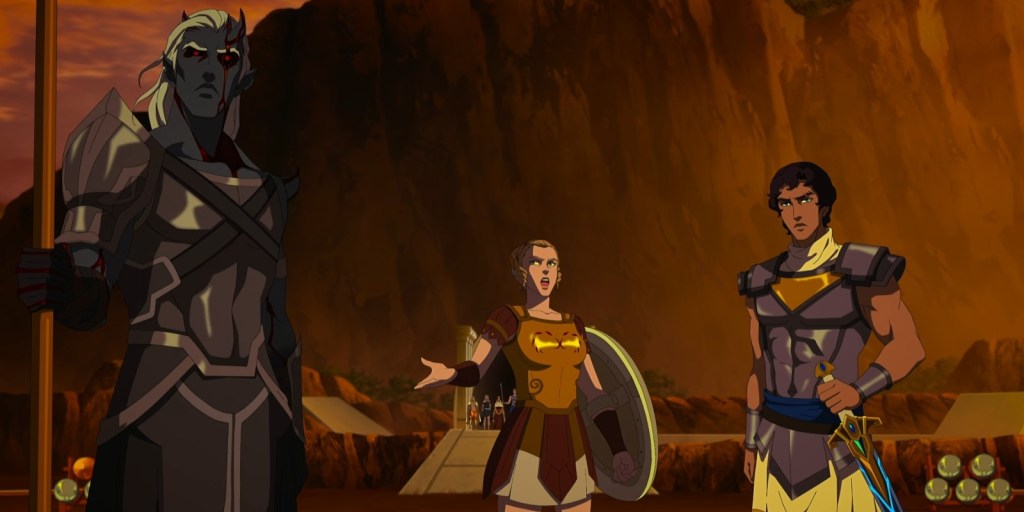
Blood of Zeus has come to an epic conclusion, and series creators Charley and Vlas Parlapanides stand tall with their take on the legendary Gods. Building off the escalation of season 2, Blood of Zeus season 3 pits demigod Heron, his brother Seraphim, and their allies both divine and mortal, against the might of Kronos. Unleashed from Hades alongside Titans like Typhon, the war of the Gods quickly racks up a hefty body count.
It’s pure spectacle at heart, without ever losing that human touch that always gave Blood of Zeus its heart. During an interview with TVBrittanyF, Charley and Vlas Parlapanides discussed the final season of Blood of Zeus, some of the potential directions the show could have taken if it had continued to season 4 and 5, and what they hope audiences take away from their epic riff on Greek Mythology.
TVBrittanyF: Congrats on the third season of Blood of Zeus! You guys nailed a very tricky balance of exploring this massive worldwide war of the Gods, without letting that scope take away from the very human stakes of Heron and Seraphim’s story. What it was like to strike that balancing act?
Charley Parlapanides: It’s interesting. We always had a five-season aspirational goal for the show. Cronos and the Titans were supposed to be a two-season kind of enemy, but when Netflix had told us ‘We’re going to actually wrap things up here,” we pivoted. We could still make it work. IT was cool that they gave us the opportunity to adjust on the fly, so that it could end on a high note. One of the notes our season one executive gave us was, “If you guys are going to end, just go for it. Don’t have some secondary Gods die, or some random character that we saw for a few beats. Have people die that matter to the audience.”
We took that to heart and decided, alright, we’re not going to pull punches. People won’t know what to expect. They won’t know where it goes. To your point, there is no Ragnarok story, no armageddon end times for the Greek Pantheon. We’ve always said [Blood of Zeus] was inspired by Hercules. The idea that there would be a demigod that helped save the Gods from a Titan or Typhon, we just wanted to get that. We thought having all those things coalesce to the ending that we cooked up could send the show off. It all ended up working out well.
Vlas Parlapanides: We always knew season 2 was going to end where it did. That really dark moment, that cliffhanger. Then we knew we were always going to bring the Gods together, that was always going to be a part of it. As Charley mentioned, we had to truncate that… we feel like we actually got lucky. That juxtaposition of where we ended season 2 in comparison to season 1, to see them all come together and end it with a high gave season 3 more weight. It gives it an emotional wall for the end. We’re really happy how that came together.
The show was intended as a large overarching five-season story, but it does reach a satisfying conclusion with season 3. What was that process like designing the ending of Blood of Zeus, and what were some of the challenges of condensing things down to finish out with season 3?
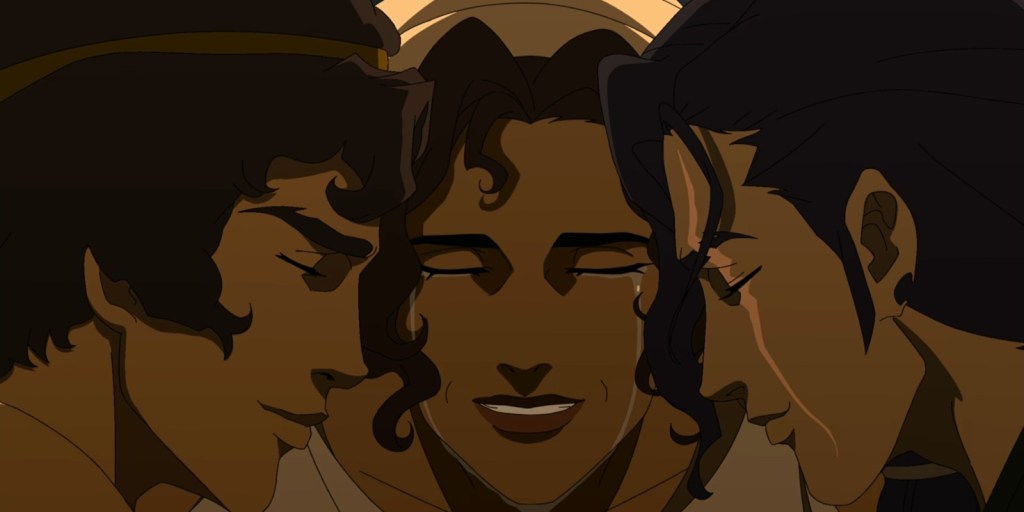
Charley: The first season, no one thought we would ever get a second season before it was initially ordered. We wanted it to feel like it was a complete story, but left a thread you could pull. We always knew we wanted to end things with the two sons and their mother reunited in the Elysian Fields. But we needed to earn that.
That was the hardest part, because that’s the end of the series. We knew that while we were writing season 2. While we were writing season 3, we had that end goal. It was our executive, Brandon Mattingly, who said the show is fundamentally about these two brothers. We kind of have an Oedipus Rex story, but instead of sleeping with his mother, the son kills her. So for him to be reunited, to ask for forgiveness, and to get it, we always knew that was the endpoint. So it became about whether or not we could still earn that ending. We created that Zeus speech where he’s addressing the Gods, which became the bridge to get us to that point.
We postulated that Heron was, for the lack of a better term, the “Chosen One.” And no, it’s actually going to be his brother, that’s always interesting. We were really going to spend time with Seraphim, really see that transformation happen. That was something that always excited us. It was these characters not trying to be perfect, but to be better. Better people, better psychologically, better overall. But once we were told by Netflix to think of wrapping it up in season 3, it became all about executing it in an organic way.
RELATED: J.P. Karliak Talks X-Men ’97, Smurfs, And The Importance Of Turning Fandom Into Activism

I did love the shout-out to Medusa and the Gorgons in the season! Last year, off the record, you revealed to me that the Gorgons were intended to have a pretty big story. Can you elaborate a bit more about what that would have looked like, now that we’ve seen those seeds planted in season 3?”
Charley: We always try to tee up some things and tease what we’re going to see in the next season. In season 1, we saw the underworld in Hades and got a little feel for that. In season 2, we saw Kronos and we see the story of him eating his children. In season 3, we seeded the Gorgons. Heron wasn’t going to die if the show continued past the end of season 3, but Seraphim was going to be with Gorgo.
We were going to find out she was a Gorgon, and we were going to go into this whole storyline where she was going to be our version of Medusa. We had Medusa and Seraphim on this mission while this all-out war was happening with the Gods and the Titans. She’d have given up her power to be a Medusa, but she was going to get it all back so she could help them win. That’s why the Gorgons are seeded in the season like that.
Were there any other ideas for what that ending could have been?
Charley: [The show was always about] if we could explain what happened to the Gods, where they went, and why we remember them. As a writer, we still have ideas in a drawer that we can pull out. The paradigm of season 5 would have been that when Kronos loses in season 4, he does something that puts the entire world in jeopardy. The Gods have to stop that, and to save the world, they have to sacrifice themselves. But they do it to save mankind. Then, in tribute to them, mankind promises to always share their stories and remember them. And that’s how we end up where we are now, where we remember these stories. We say in the very beginning of the show that it’s an oral tradition, so that was meant to be the full circle moment.
Vlas: One thing that always worried us a little bit about that idea — and now it funny because it was all theoretical and then suddenly became practical — but we really love all these characters. The audience loves these characters. Would the audience want to see all of them die? It kind of sucks! But then at least the show would be over [Laughter].
With the show complete, I’ve got to ask — what do you hope fans take away from this series? Whether they watch it today, next week, next year, or even decades from now, what is the core concept you hope they take from Blood of Zeus?
Vlas: We spoke to a critic after season 1, and she told us she had a lot of anger in her before watching the show. We talked about how anger was a thing we explored in season 1. Heron was able to overcome his anger and, in doing so, was able to overcome the adversity pitted against him. Seraphim was not, and that led to his demise. Hera was dealing with it, and we were showing how she grew from her anger and eventually let it go. But it was a process that was going to take a long time. When the critic stepped away from it, it resonated for her. She realized she had to let go of the anger she had in her own personal life.
She was hurting herself, and she said, “I gotta make a change,” and she [Blood of Zeus] helped her. For us, that was very rewarding. If someone can watch Blood of Zeus and make their life better in some way, that is the most rewarding thing. Season 2 is about forgiveness. We feel like the world needs forgiveness. Season 3, for me, is about unselfish love. It’s what Heron does for the greater good. He gives up his life to save the lives of so many. If audiences can come away with even just one thing that makes their life a little better or inspires them in a positive way, that’s what I’m most proud of.
Charley: I hope they’re entertained. I think our business has to get back to entertaining people. When we used to go watch movies and TV shows, it was just fun. I hope they have some fun with the show. I hope it inspires them to look into Greek mythology. The whole show is meant to be… the one thing I love about Greek mythology is that they created these myths and stories to understand the world and why it is this way.
That’s the point of this show. At the end ,we say, like, why do people have these inherent natures? Why do we do these things to one another and for one another? Our show is basically analogous to what Greek mythology is. It’s an entertaining story to explain the world around this. If that encourages someone to crack open a book — or there might not even be books in 20 years, to put in a mental implant about driving as they sit in the back of their automated car — that’ll make us happy [Laughter].
Blood of Zeus is now streaming on Netflix.



 TVBrittanyF.com