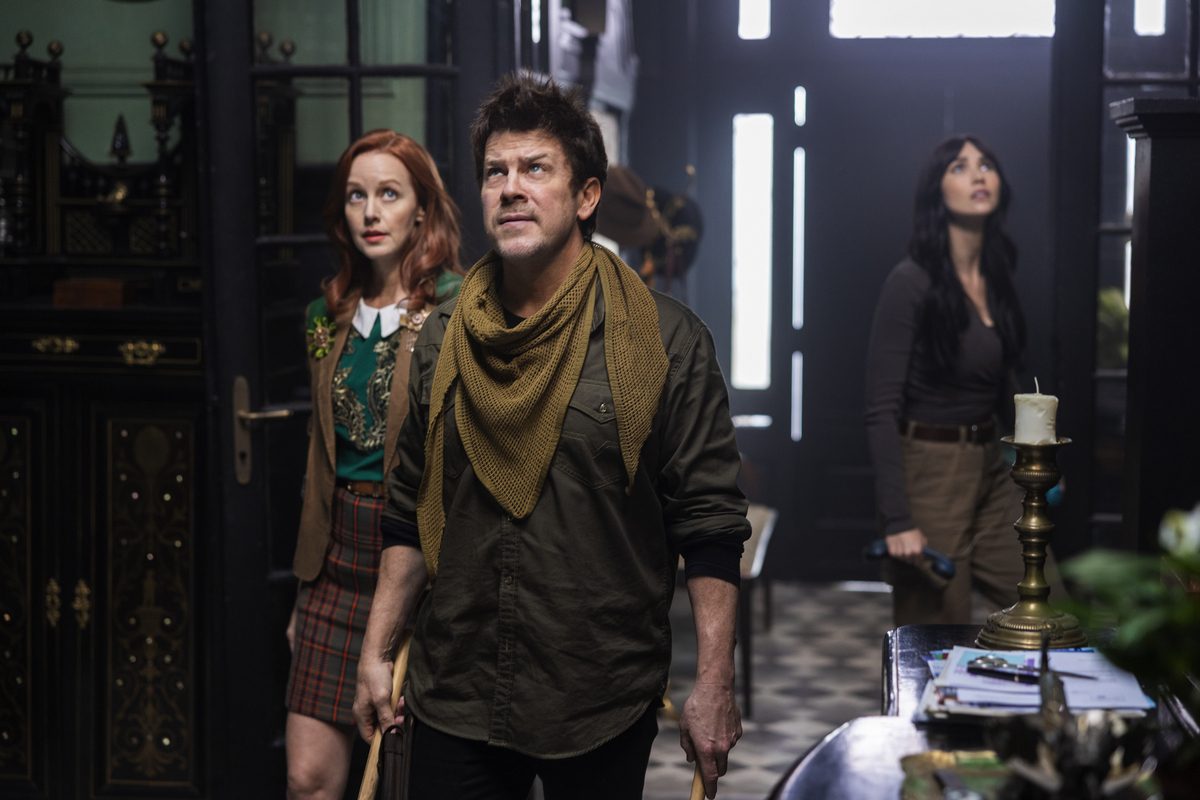
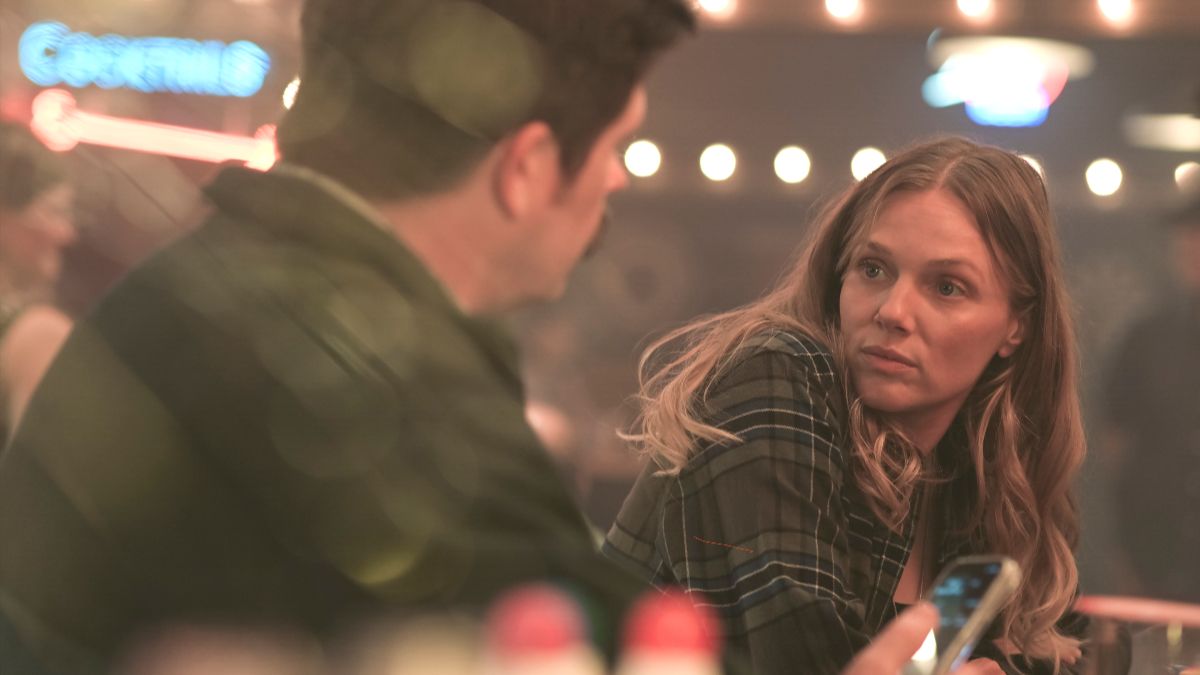
Music can be the key to a larger world, one that award-winning composer Sherri Chung knows all too well. Chung has explored plenty of worlds in her time as a composer for film and television, ranging from the action-packed adventures of Batwoman and Kung-Fu to the more darkly kooky Los Angeles of Based On A True Story.
Some of her most recent work as been in the world of Gremlins, which gave Chung a wider realm of tones and tenors to play with. During an interview with TVBrittanyF, Sherri Chung discussed her approach to scoring for different kinds of projects, the importance of reflecting legacy when working on an established franchise, and the biggest surprise of working with the Gremlins.
RELATED: Suits stars Patrick J. Adams & Sarah Rafferty reflect on Sidebar podcast

BrittanyTVF: You’ve worked on projects like Gremlins, which clearly has this deep history in pop-culture — but you’ve also worked on shows like Based On A True Story that don’t have that franchise history When something like Gremlins: Secrets of the Mogwai, how do you craft an original score while keeping true to the roots of the series and expanding on them?
Sherri Chung: When I first started with Gremlins: Secrets of the Mogwai, I was really quite nervous. I was almost panicked. I was like, ‘Oh, I don’t know if I’m the right person for this.’ Are the fans going to be extra-critical? Which, I think the short answer is yes. But I think that true fans also just want something new as well. I don’t think anybody wants to see the exact same thing again.
I also think that [getting something new] does require a really good showrunner or director or creator. Tze Chun, who was the creator of this prequel series to Gremlins, was very open. He wanted to have not only a Jerry Goldsmith homage, but he also knew we were doing something different. We were doing something new. We were doing something that is predecessor in theory, or at least in design — so it should be unique to these stories and these characters. I was given the permission to do something different and unique and special. There was also a creative conversation.
The first Gremlins movie [and Jerry Goldsmith’s score] had a bit more of an 80s vibe. The question became about ‘Do we want to go that route?’ We all agreed that this probably needed more of an orchestral approach. It was a lot of that. I also kind of just dug into what is Jerry’s overall sound for this was. It is thematic and melodic and lyrical. I feel like a lot of his themes are perfect for the characters themselves. When you have Gizmo’s lullaby, it just kind of just sounds like sweet Gizmo, you know? He even sings it a little bit.
Then you have the “Gremlins Rag.” It sounds like the actual Gremlins. It’s not just a melody that’s attached to them. It actually sounds like, if the Gremlins were gonna sing something, they would sing a song where they would just be little shits like that [Laughter]. They’re joyful little shits. I also thought about the ambient sound. It does have this melody for adventure and sweeping and horror. I almost had to pay attention more to the intention of Jerry Goldsmith’s original score score, and the intent of the sound, while putting a new spin on it that really was going to support this new story.
You can definitely see the inspiration from Goldsmith’s score. Were there any other unlikely inspirations you brought to Gremlins that you think would surprise people?

Panic and fear [Laughter]. I mean, it’s funny, but I do think that there was something like that. I’ve either got nothing to lose or everything to lose. Either way, it’s just time to just throw it all in there and see what really works. The first season takes place only in Shanghai, in the 1920s. In the second season, we move to the Americas, and we go to the Wild West… we’re in San Francisco, and in Chinatown. I think that some of the influences, certainly for the first season, were very much rooted in Chinese music.
I even had to do a little research on Chinese opera, which I say respectfully, is an acquired taste. Chinese opera is not for everyone, and probably not for me either. But it was really eye-opening just to dive into the concept around what Chinese opera is, and how there are certain instruments and certain groups of instrumentation and gestures that belong to certain story lines. It was really interesting.
I didn’t incorporate necessarily every single thing into that. But to research those instruments and those intentions was something that I found kind of influential. It was encouraged by Tze and Brendan Hay, the other showrunner. They encouraged me to lean into and not shy away from Chinese music. Even on Kung Fu, there are times where they said ‘Okay, we really want an Asian influence. We really do want to tap into the cultural specificity, but we don’t want to alienate audiences. We don’t want to make this too much about the Chinese culture.’ That was on Kung Fu. On this one it was like, ‘No! Go in head first!’ Don’t be shy about it. It let us really lean into it. That was a lot of the influence in that as well.
By its very nature, your work on stuff like Kung Fu, Based On A True Story, Batwoman, Gremlins — it all has to be able to shift from funny and uplifting to horrifying in a heartbeat. How do you approach the tonal flexibility through the score?

I mean, I hope I achieved it. I’m not even sure that I did. If I didn’t, then I have no business answering the question. But I guess my intention would be… to lean into the emotion. It’s something that I was encouraged to do in creative talks and to lean into the emotion. That could be the heartfeltness of it, or it could be the horror, or it could be the comedy.
There’s even those middle lines, where there are scenes of Sam wondering what’s the right thing to do. There’s even psychological torture in the first season with Riley Green. I think that I really allowed myself to just dive into those moments, and just say, ‘This is definitely a heartfelt moment’ or ‘This is definitely a confusing moment.’ And then I would lean into that.
Then there were the themes, too. I wanted to use Jerry Goldsmith’s “Gizmo’s Lullaby” to be a sort of emotional home base. The fans hopefully have that nostalgia for that as well. The actors also sing it sometimes on screen. So that was a very good lead into, ‘I should use Jerry’s tunes, the thematic elements of.’ The Gremlins themselves were some of my favorite stuff to score. They have a tritone interval. Using a tritone-based circusy type of thing, it was unsettling but still buoyant and fun. But there’s also mayhem and craziness. I think there’s a lot of hooks in it.
I write music to picture, so when the picture tells me, ‘We’re jumping into horror,’ then we go horror. When the picture says, ‘Hey, we’re going into comedy,’ let’s have some fun. I think a lot about what the story is, leaning into that. I think it’s just all about being able to rely on the themes and rely on good direction and having the permission to just kind of go where your gut is going.
You’ve composed so many very different projects — does the tone and story of the piece you’re working on affect the way you approach composing?

That’s a good question. I’m not sure that my approach is any different. It’s finding the intent and focusing on the function of the score. In something like an animation, the function of scores is sometimes like finishing a sentence. You can have expression or an action or the faces in animation. There’s a lot of time where there’s not as much dialog. There’s a lot that is more action driven. Often times with the music, the function of score is to finish the sentences, to complete the sentences as it were.
I think Based On A True Story was quite dramatic in certain ways, and it was really in your face in certain ways. But a lot of times, I think that maybe does mean that my approach is a little bit different. I think it all stems from the same place, which is, what is the function of score? How much is too much? Sometimes less is more, and sometimes less is less. So I’m not sure that it changes, but I do think that there needs to be an exploration of each of those storylines. Each of those genres needs to be explored… I think that [Based On A True Story] being a comedic thriller, it has to find places and ways to give permission to an audience to when to laugh. We have to sometimes let the audience know we know this is absolutely ridiculous. And then there are other times where it’s like, no, this is actually really bad, and we want an audience member to feel how bad this is.
Then you’ve got something like Kung Fu where it’s actually rooted and a lot more grounded in some ways. There’s obviously a mystical element to it and some supernatural power. Things are going on that are obviously quite unbelievable without the right music or the right VFX. That’s obviously supporting something different. There’s legacy and certain questions about justice and injustice and right and wrong. There are some staples and pillars that always have to be in pretty much any story. It’s just like in any musical. There’s the “I Want song,” that kind of thing. There are all these types of things that have to be apparent and have to be there. I think that those can be connective tissue musically. There’s going to have to be themes that are heroic, that can be fun, that can be romantic, or can be lower intensity, higher intensity. I think that those types of things are true across pretty much any genre and any storyline.
RELATED: Shao Dow Proves The Importance Of Authentic Fandom And Deconstructs What It Means To Be A Nerd
In my time interviewing people across creative industries, I’ve found that almost everyone finds some surprises in every production. With that in mind, what would you say were the biggest surprises you encountered during the scoring for Gremlins: Secrets of the Mogwai?

That is very true, by the way. Everyone who says that is totally right. It’s never what it starts as, it’s never what you think it’s going to be. And that’s probably a good thing, because it’s also a collaborative effort. Sometimes that can be a burden. Sometimes it’s a burden that you kind of have to listen to the people who hired you [Laughing]. Thank goodness that they’re there though, because they’re the ones who created it, whether or not it’s a building of a franchise, or a continuing on a franchise, or building something entirely new. They’re the ones that created it. So you actually want their input, you know?
That was what was great about working with Craig Rosenberg on Based On A True Story. He wrote it, he created it — he didn’t direct it, but he was a showrunner, so there’s no more direct conduit to what it should be and what it needs to be. I really relied on him to let me know, ‘Is this a moment where we’re laughing at the bad things, or is the moment where we’re really scared about the bad things? I really needed him to tell me that sometimes. I needed that input. I think that’s one of the biggest reasons that something doesn’t end the way it started because sometimes there are so many cooks in the kitchen.
Other people have different ideas of what something should be so and sometimes I actually truly believe this. I love a good note. I love when a director or showrunner or executive gives a note that actually opens my eyes about a new way of looking at something that I didn’t know, that I didn’t think about before, and it actually makes it better. Other times I give myself some grace, and I say, ‘There’s no way I could have known that. No way I could have interpreted it that way.” I didn’t have the information that you had. So I do love it when a note or a direction results in a revision, something that actually makes it better and makes more sense or fix it.
I think with Gremlins, I will freely say this — and I hope some other composers maybe admit to these types of things too, maybe this will resonate with other artists — we always want to grow as artists and as craftspeople. I feel like any project that really stretches me and helps me grow in a good way, I appreciate. It’s not just, ‘Shit, I learned that lesson the hard way,’ kind of thing. I mean, those are going to happen too, but I feel like I didn’t realize I was going to grow so much as a composer and as an orchestrator and as a musician and as a storyteller with Gremlins. I think that’s because I spent so long on the project. With the two seasons being produced back to back, it was about a three-year process. It gave me a lot of time to really dive into the characters and really expand on the musical world and tonal world. I really got to have fun with it. A lot of permission was given to go forth and do what I do — I shouldn’t say with minimal direction but with minimal roadblocks.
We nailed the tone, and then it was great. Then we were able to expand and explore from there. I think that was unexpected. I went into this project with a bit of fear and a bit of apprehension. But I was also like, ‘I’m gonna sit up straight and I’m gonna show up and I’m just gonna do my best, and here we go.’ Then I just felt a lot of affirmation, confirmation, a lot of feelings that are really validating as an artist.
Especially as an artist in the service industry. I think that we’re not guaranteed that because it is very much a service industry. It is very much art, creativity, craft, and commerce coming together. So when you get that experience where you can have fun and be really fulfilled creatively, while growing as an artist and knowing that people believe that you’ve really added something to a story, where everybody’s really happy — I didn’t just get approval. Yes, they signed off on them. But they really appreciate how this music is working with their vision. I think that is just an incredibly rewarding part of our industry and our profession. That element does not always happen but did with Gremlins.
Gremlins: The Secets of the Mogwai is now streaming on Max.