
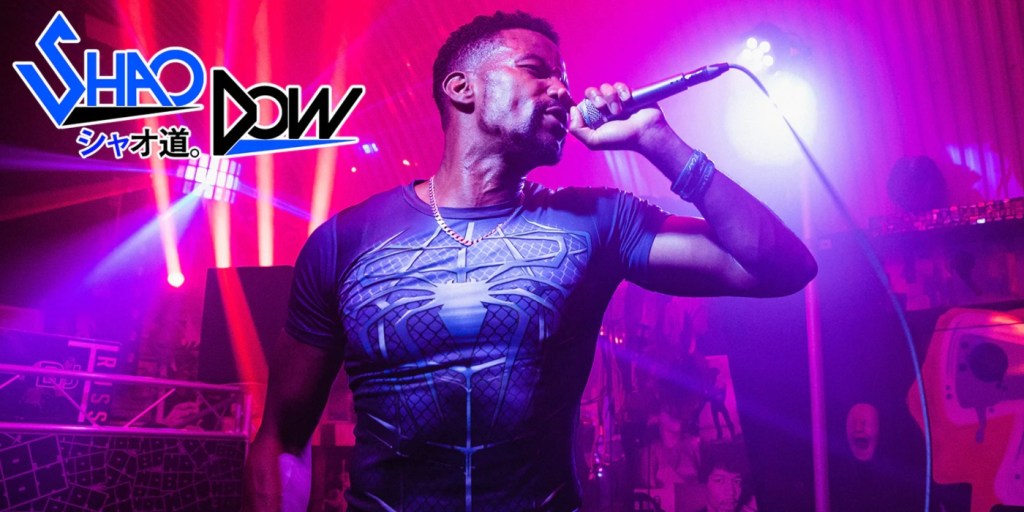
Finding the balance between his love for hip-hop and anime through his music, Shao Dow has been blowing away expectations for years. The London-born rapper grew up a fan of both and has cracked the code on how to fuse those passions into a successful music career. Having already earned AIM Independent Music Award and written a manga based on his life, Shao Dow proves how artists can bring genuine fandom into their music.
During an interview with TVBrittanyF to celebrate the release of his new track “Overtake,” Shao Dow discussed the importance of authenticity in art, the ways nerd-dom has become a more accepted identity, and why independent venues and artists remain a crucial aspect of the music industry.

TVBrittanyF: As a genuine fan of franchises like One Piece, what’s it like to see yourself alongside Luffy and the rest of the crew in “Overtake?”
Shao Dow: It’s a dream come true. I very much do things that I love first , and then I hope other people love them as well. To stand along my favorite characters, who have inspired me basically my entire life? That’s a dream come true. That’s the sort of thing that I’d hoped to be able to do when I started my career in the first place.
Now to be able to realize that, at least in manga form and hopefully one day I can make an animated version where I’m also alongside them all — but might need to make sure the licenses are okay first [Laughing]. It’s very much a tribute. The whole song is a tribute to the show, but also to that feeling of leveling up. To that feeling of realizing that you’re better than you were through the power of your hard work and perseverance.
I love that, because that really does speak to the central themes of stuff like One Piece or Dragon Ball Z or really any anime that comes from the Shonen Jump family. But that’s also a common theme to see in rap, the idea of rising up from the bottom and going all the way to the top. How do you balance those two inspirations in your approach to music?
See, here’s the thing — I’m a child of hip-hop. But I think hip-hop, rap, anime, gaming, it was all very fundamental in my formative years. So to be able to combine them all has been fantastic. When I was growing up, there was more of a common theme involved in rap, which was “gangster this and gangster that.” We all know the stereotypes, and that never really resonated with me. I didn’t feel that it was possible to do this nerdy stuff and to talk about stuff that I was interested in. I didn’t think it was possible to rap about anime and have an audience for it. That in itself is really cool.
I also feel a responsibility to make it dope at the same time. It’s one thing to be like, “Yeah, I’m just singing like Goku” and just have the reference…. I never wanted it to be that. I wanted it to be, regardless of whether you know what I’m rapping about or not, this is just good music, full stop. Then, maybe if you’ve never heard of the show, you might want to check it out. Or, if you have heard of the show, you’re hearing the deep cuts and you’re hearing the subtle references that only the true fans will get there. But on the surface, there’s still a good song. That’s really important for me. I think fundamentally, just making good music, regardless of what the theme is, will put you in a good position.

RELATED: Gastronauts Host Jordan Myrick Dishes On Dropout’s New Cooking Competition
We’re celebrating the anniversary of One Piece this year — was that the big motivation behind putting together a One Piece track?
I’ve done Demon Slayer tracks, Attack on Titan tracks, Jojo’s Bizarre Adventure tracks. But One Piece is my number one. Because of that, the thought of doing a One Piece track always filled me with a bit of trepidation. It was like, well, I need to get this right. I need to do it justice. So it took me a while, firstly, to think of what the concept would be. Then I heard the beat. It was produced by Rifti Beats, and I heard the beat, and I thought, yeah, this is the one. I had written two verses, and I had a strong hook before my tour in Japan. So I actually performed it in Japan and almost market-tested it there before finishing it off. I performed it with the band out there, and it sounded really, really good live.
Actually, in Tokyo, I had an animator who worked on One Piece at the show. We had Gorō Taniguchi, who directed One Piece Film: Red, he came to the show. I performed that song with all of them in the building. And nobody said, “Hey, we’re suing you.” So I was like, ‘I think I’m okay.’ [Laughter] I finished it on the plane on the way to North Carolina for another show. And it just kind of felt right. So when I was done, I thought, ‘Okay, I’m ready. I’ve got this track. But I need to make it make sense.’ It just so happened that they had done the 25th anniversary of the manga earlier in the month when I’d finished it.
So it’s like, okay, well, I can’t do that, but the anime anniversary is coming up, so why not just wait? Why not sit on it for a little bit, make sure the video is top-notch, really put the time and effort into making a video that’s worthy of this song and worthy of the series. It’s almost a thank you to Oda. This is all the inspiration you’ve given me. Let me give it back in some way.
I try and reflect everything I’m passionate about within my artistry. Because of the way that I’ve lived my life and just my general adventure throughout my life, it’s very animated. I always said, if I wrote it down, it would literally be a manga. And I’ve written it down, and it is now literally a manga. Growing up watching anime, going to China, learning Kung Fu, and spending my life pursuing this dream of becoming a full time successful rapper? It’s like a manga. And now I’m semi-successful [Laughing]. I don’t see myself as being where I want to be yet, but certainly a lot further than when I started. To turn that into a manga series just seemed like a no-brainer.
It just gives me plenty of content to turn into videos and things like that. One day, I hope to turn the manga into an anime, but that’s one day a bit further down the line. For now, I just want to continue making awesome stuff that people really enjoy and can really resonate with. To be considered nerdy or geeky, it used to not be cool. It’s becoming cooler, especially with the amount of money being invested in anime. Suddenly people people are coming out the woodwork and be like, “Hey, have you heard of that Naruto thing?” So yeah, it’s become a lot more acceptable, a lot cooler, a lot more mainstream. I just want any of my fellow nerds who are listening to my music, if you pull that earphone out of their ear at any point, you’re like, ‘actually, this is really good.’
As a self-professed nerd, what does it mean to you to see these successes and to see your work recognized by fans all over the world?
I think everybody’s a nerd. I just think it’s the degree to which you recognize it and the degree to which it is acceptable. At one point it wasn’t acceptable to be into Japanese cartoons and video games and card games and things like that. It wasn’t cool and the ladies didn’t like it and blah, blah, blah. If you’re into Pokemon, it’s a red flag. But if you’re into football, to a crazy extent, you’re a nerd. If you are into going to the gym and learning about the different muscle groups and macros and protein intake, you’re a nerd. There are different things you can nerd out on, just some are more acceptable than others. I want to make being an anime nerd and being a general Japan fan cool. I want to make it actually seem like you can do this in your own way. I go to the gym and I wear Dragon Ball Z outfits in the gym, and nobody says anything to me. You know why? Because I have muscles and I’m torn [Laughing].
But as a fan, as a nerd, it is really cool. The fact that God of War used my music to celebrate their game is incredible. I just made the song out of my love for the game, and they saw that love, and they returned that to me. That’s what I do with my shows, with these anime. I don’t want anyone to ever think that, ‘Oh, I’m trying to capitalize off of these popular shows. That’s the only reason I make this music, because there’s a fan base already and I’m trying to piggyback off of that.’ No, it’s because I love this stuff! I want to elevate and amplify it. I’ve had people say, ‘Oh, I’ve never heard of this show that you’re rapping about, but I went and checked it out because of your song, and now I love it.’ That, for me, is huge. That’s a massive reason — that my song is good enough to make you want to check out the source of material. I’ve done my job.
You’ve also proven yourself a big champion of independent music venues and paths outside the music producer system as it’s been established. Why is that important to you?
If you can watch shows like Naruto, Dragon Ball, One Piece, Demon Slayer, and you don’t come away with a sense of following your dream? Of being independent, fighting for the underdog, and never giving up? Then I don’t know what show you’ve watched. The lessons have clearly gone over your head. It’s been baked into me from the beginning to be independent, not just through these shows, but through my parents as well. Being an independent artist, not signing my rights away into a record label, not being controlled by some faceless corporation, that was always number one on my list of how I was going to operate. I am a pirate within this music industry, about as pirate as you can get.
At the same time, these independent music venues are integral to the success of any artist, really. That’s where you find growth, that’s where you cut your teeth, that’s the training grounds for the bigger venues. I’ve been in plenty of independent music venues. I loved performing live during the pandemic, when it turned into online performances. But if that is what the music industry was going to be from now on, if we never get back to being able to stand on the stage and entertain and perform in front of a crowd and feel that energy, that vibe, then I’m out. I make these songs to be able to stand on the stage and go dummy, you know?
These independent music venues are the reason that I can do bigger stages. I had to do those 50 people, 100 people, maybe even one person in small venues in order to then go and sound out in front of 1000s of people. So protecting those venues is incredibly important because otherwise, you lose that natural route to the bigger venues. Tomorrow’s artists don’t get that opportunity to practice and to build and to hone their craft. Some of my favorite performances have been in those intimate venues where you can literally look somebody in the eye and see them converting into a fan right before your eyes. You’ve gotta protect that.

What has surprised you the most about this path so far?
I think that when I first started, my only goal was to travel the world. It became to entertain, inspire, educate, and live my life on my terms. I need to remind myself every day that I am doing that in real time right now. I’m living my dream right now. It’s difficult when you’re so in it, to remember that. To think that something that I envisioned and hoped and willed and dreamed and fought and cried for has become my reality — that’s crazy, because when you first start out, it seems impossible. You can’t see, you can hope, but you can’t fully see the goal. You could dream the goal, but you don’t know how you can exactly get there. It’s like One Piece. We know the One Piece is out there, but we don’t know how Luffy is getting there. But as we get closer we realize it’s possible. When Luffy first started out, we didn’t know how he was going to actually become the Pirate King. It seemed more like a fantastical dream. And now, he is going to be the Pirate King.
That’s kind of a bit of how I feel. When I was starting out, I was on a tiny dingy boat with a general direction, but no clue how I was going to get there. Now, I can almost see what I’m trying to reach, and it feels more realistic. So there’s that. But more than anything, I think it’s that I know I can. I have a career doing exactly what I want to do, on my terms. Because when I started off, I was trying to indirectly emulate what was more popular within the rap scenes. I was rapping about things in my own way, and including the odd reference to anime, but I didn’t go full nerd. I didn’t do a Tropic Thunder. They say never go full nerd. [Laughing]. I went full nerd. And the moment that I did that was when my life really started to change. That’s when the fan base started to build up. And I thought, ‘Well, why didn’t I do this before?’
I really wish I’d thought to do this before, but now I’ve done it. There’s no way I’m going to stop. People like it, I love it, and it makes me happy, and that’s it. Fundamentally, I think that’s what art should be. You shouldn’t be copying what everybody else is doing. You should be forging your own path. You should be unique and inspiring. It should come from the heart and from the passion. I think as we progress more and as anime becomes more popular, we’re going to see far more brands and influencers and people jumping on this bandwagon and being like, ‘Yeah, I’ve been into anime since I was a kid.’ No, you haven’t. You just know there’s money in it, but you sit down for a conversation with me. I will hit you with some deep cuts where you’ll be like, This guy knows his stuff.’
Shao Dow’s music is now available on YouTube, YouTube Music, Spotify, and Apple Music.
 TVBrittanyF.com