
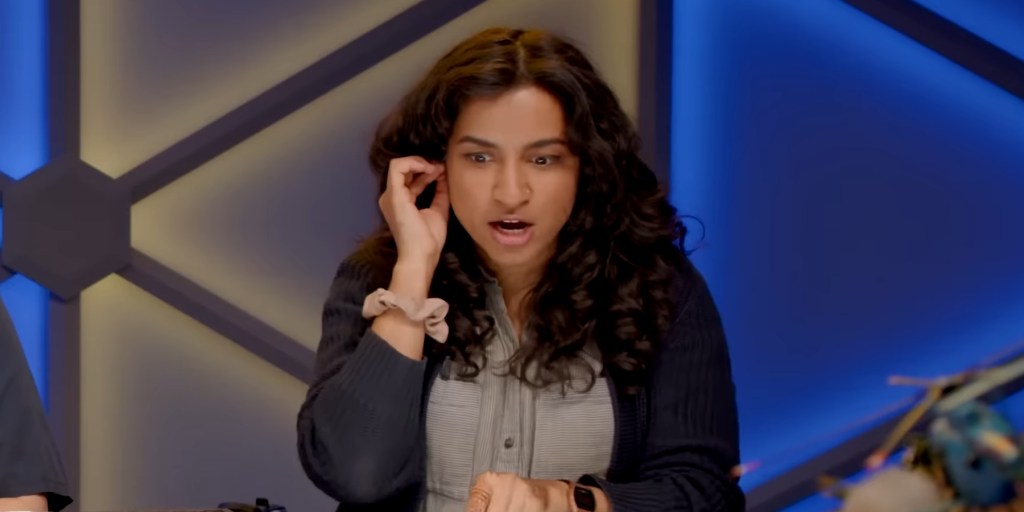
Rekha Shankar’s latest appearance in Dimension 20 is a great showcase of the storytelling power of improv and tabletop RPGs. Never Stop Blowing Up is a wild season for a show that’s always pushed the lines of absurdity, focusing on a group of six video store employees who end up dragged into the most ridiculous action movie ever conceived. Taking cues and archetypes from properties like Die Hard and the James Bond franchise, the season ended up being one of the wackiest entries in the series.
However, a focus on character-driven growth was key to the season’s success, as seen with Usha. Played by Rekha Shankar, the comically old bookkeeper ended up finding her own internal strength and ability to change amidst a series of absurd swings and unexpected gags. During an interview with TVBrittanyF, Shankar delved into the biggest surprises she discovered with Usha, the other directions her season arc could have gone, and discussed the key ingrediant to succesful presentations on her other Dropout series, Smartypants.

BrittanyTVF: It’s been a while since you’ve appeared in Dimension 20, and it’s great to see you back in the Dome. What lessons did you want to bring from your previous experience on Dimension 20 to Never Stop Blowing Up?
Rekha Shankar: I love being in the Dome. I love being on Dimension 20. It is always one of the more fun weeks I have in my year when I get to do it… I wanted to be better about the mechanics of the system. It was really great [using the Kids on Brooms game system] because it is so much simpler for me than [Dungeons & Dragons 5th Edition]. It’s funny, I wanted to make sure I was taking a lot of notes. But I think, in retrospect, taking notes made me not listen as much. I also wanted to make sure I was sharing space because this was specifically the all goofball season. And I’m like, ‘We’re all going to be nuts. We have to all be able to share focus pretty well.’
Usha is a really fun character because you get to play her to these two different performance extremes. She’s sometimes this silly old person who was there when they invented the pencil, but sometimes you’re exploring this old woman rediscovering that she doesn’t have to be done living. How did you approach that balance?
I love playing a very weird character, that’s very sidelined. Very batty, that has an emotional, relatable center. With Usha — I was half-raised by my grandparents. I know a lot of elderly Indian people. I know that world, so I had a lot of fun coming up with the specific types of things older people do. Not just around technology, but around young kids. ‘Everybody’s a whippersnapper’ kind of thing, where [other people] maybe are relating to you, or they’re starting to be like, ‘You’re getting old…’ I really love diving into that.
In terms of finding those more sentimental arcs, I originally imagined that she would have an arc that’s like, ‘I don’t like technology. Oh, maybe I’ll give it a try.’ But maybe it’s also okay that I don’t know it. That’s the kind of what I thought. But with Brennan, the real improv moment, he gave me a speech that really pushed Usha to change. That made Usha realize change has to happen. You can’t just be stuck in time. The growth Usha had had from being hacked by a guy that has nobody in his life had to — both those things kind of forced my hand. Usha has to move in with her granddaughter.
Because it’s not because [Usha] is weak and she can’t live by herself… it’s not because she’s not able to live by herself, but it’s because she wants to be around Lisa. She now knows what it’s like to be in the body of someone who eventually becomes disconnected from people, that craves people — either to take advantage of or to connect to. So I think some of that journey was improvised. It wasn’t entirely like what the plan was.
RELATED: Michael Hirsh Reflects On An Animated Life In Book Animation Nation
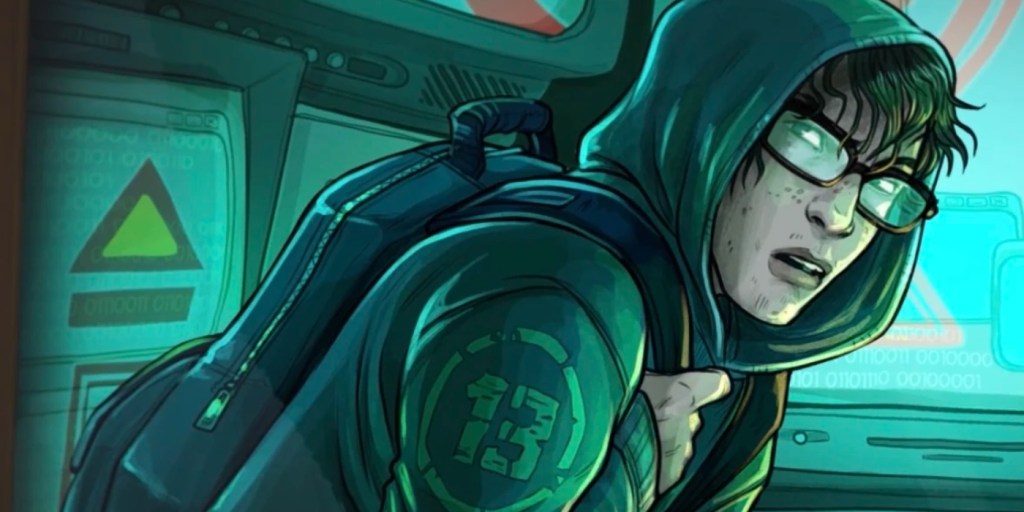
You had the unique chance this season to actually be directly antagonistic to your Never Stop Blowing Up counterpart. G13 trying to hack Usha was a wild turn, how did that come into play and what was that like to explore?
I just noticed that my stats were really high in areas I don’t think Usha would be good at. So tech made sense because she’s in the body of a hacker. Totally makes sense. But I had three other D 20s on my board, and I was like, ‘I can’t square this.’ I ran into a role-playing issue. I didn’t know how to play Usha good at all these things. Like, I think [Beardlesy] makes the joke, ‘The only stunt Usha has done before is putting a DIVA Cup in.’ Usha is not flexible. The only thing that would make her flexible is if she fell from something and maybe she would accidentally land on her feet. It wouldn’t be that she does that one little backflip.
So I was trying to square away, how does someone that should have low stats have high stats? And I was like, ‘Oh! Well, my alter ego has a ton of high stats, and he probably doesn’t like her, so he hacked into her.’ That came out organically with Brennan and I improvising in that moment. I don’t recall having outlined that any more than you see in that episode. I had written down the thought, but I didn’t know if it made sense yet. And then, in terms of G13’s arc, what I had thought was, if I had gotten to hack Usha’s body longer, I really did want to have a takeover. Whether that means he tries to get out of the tape and go into the real world to see people now, because he, himself is ones and zeros. He lives in a tape and that’s all he deals with. He also doesn’t have friends, even in his movie world.
I thought it could be cool if he just took over and tried to PvP, a thing I’ve never done. In his body, but with half the brain of an old lady. There’s just something that also felt a little right about a young, rude hacker trying to hack an old lady. So I don’t know why, but it just kind of had to happen. No matter what comes of this, it kind of just has to happen. We fixed it so G13 was not really in the picture [by the end of the season]. But I had imagined that, if he had gotten out of the tape, one of two things would have happened. The schmaltzy thing would be, he learns people are beautiful. But I think what I would morally end toward with, what I set up for him, is that he can’t be taught. He’s been too disconnected from the world for too long. He is just ones and zeros.
RELATED: John David Bethel discusses his journey as a writer: ‘Take that idea and run with it’
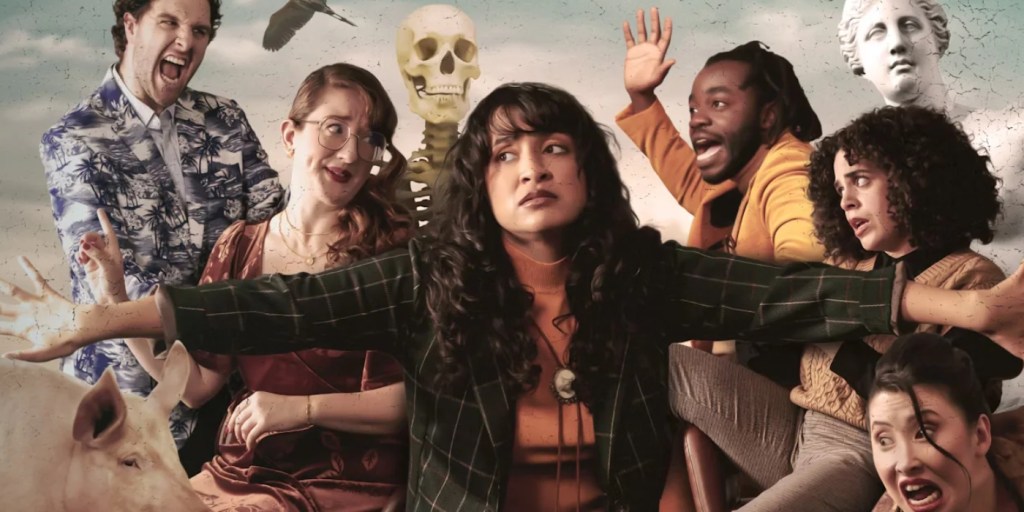
What would you say surprised you the most this season with Usha?
I did not know Usha would turn to living with her granddaughter. That really did surprise me. I didn’t know that — I thought her being resistant to change was kind of good. It’s shows that she’s confident in herself, and she doesn’t need to to impress other people to be confident. But what I learned about [Usha] is, like, I think she’s resistant to change because she’s comfortable.
Being comfortable is totally fine. It’s good to be comfortable. But if you’re comfortable for too long, you don’t grow. I don’t know if Usha knew she could grow more. I think that’s interesting, always realizing that phases in life don’t come at certain ages. She’s so many years old and is now in my phase of life where, ‘I live with my granddaughter, and we gal pal it up. ‘ That’s incredible. That’s so nice. I like where she ended up
I’ve also got to say, I’m also a huge fan of your other Dropout show Smartypants. There’s been so many approaches to the presentations so far, in terms of approach and topic. What would you say has been the key element that all these different approaches share?
Passion. So you can do a presentation that is pure information, with no comedic take whatsoever… If you are passionate, the specificity of your take will read funny and be very funny. It’s like Grant. Grant did a big treatise on roller coasters. It was really interesting. It was really funny, because it’s genuine. He genuinely has that passion. In Grant O’Brien’s free time, he watches YouTube videos of roller coasters. I’ve seen it.
A stupid thesis that could be meaningless to you, and you say it as if it’s the most important thing in the world. The passion needs to come from one of the directions. Ideally, it comes from both. You know, I do believe as stupid as Paul Robolino’s presentation on human body modifications was, there’s a core element he probably believes — and then there’s this stupid thesis. It was double passion, you know, for this dumb topic.
Dimension 20 and Smartypants are both now streaming on Dropout
 TVBrittanyF.com