

Dimension 20‘s latest season, Never Stop Blowing Up, is one of the most ridiculous yet from the TTRPG series — and that’s saying something. Trapping six people inside the personas of action movie archetypes, Never Stop Blowing Up quickly escalates the action further than almost anything seen in the series previously. However, thanks to a committed cast and the inventive world-building of Brennan Lee Mulligan, the show never loses that human (and hilarious) touch that makes Dimension 20 storylines so special.
Having reached 250 episodes with Never Stop Blowing Up, Dimension 20 decided to celebrate the occasion the only way they knew how: by taking things to the most absurd heights they could think of. Speaking with BrittanyTVF about the latest season of the Dropout series, Never Stop Blowing Up GM Brennan Lee Mulligan reflected on the evolving tonal elements of the series, embracing the season’s sheer escalation, and reflected on which settings he’d be most excited to return to.
RELATED: Michael Hirsh reflects on an animated life in book Animation Nation

What’s great about Never Stop Blowing Up is that, even when compared to other seasons of Dimension 20, it really felt like things went off the rails this season.
Brennan Lee Mulligan: Well, that was the amazing thing. The slow realization that, because of the reality of this VHS tape, because of the reality of the Never Stop Blowing Up, this surreal world is a kind of alternate reality. There’s this realization that as things start to go off the rails, it’s actually on another set of rails. When you’ve projected into an alternate reality that is ruled by these genre rules, [the world] starts to tear at the seams because of the choices the players are making.
You realize, ‘Oh, this is actually a very concrete threat. The VHS is unspooling, the magical processes by which this is happening are overheating.’ You are still in very real danger, even as we’ve got t-rexes and people being stabbed with national monuments. The absurdity is concrete and a threat unto itself, which was a nice way of kind of balancing the fun of the absurdity. As this gets more cartoonish, that in and of itself is a new practical threat.
I love that, because it keeps the stakes high even as the reality becomes so elevated.
It gets that world where you’re in this cartoon logic, and hey, you can do the cartoon logic. But remember, you’re real people. So whatever happens, you got to get out of this VHS tape somehow. You have to have some kind of process by which you do that. I think that’s really delightful and fun to find that out. It was nice to have a clear sandbox. You’re in a magical VHS tape. So do all the goofy, big, cartoony stuff you want to do, and we will still be anchored in a grounded person’s point of view. This world accommodates that outlandishness.
That was even the case outside of the actual game, with players getting to actually sit in the GM chair at certain points. Especially after the whole K2 situation in Fantasy High: Junior Year, that’s a wild turn of events.
[Laughter]. Blimey. Truly unbelievable. Yeah, we had Zac Oyama jump in for Fantasy High: Junior Year. We had Iffy, Reika, and Izzy do it [this season]. Proud to say, my at the time unborn child has also been in the GM seat throughout Never Stop Blowing Up. Wild, really wild.
RELATED: John David Bethel discusses his journey as a writer: ‘Take that idea and run with it’
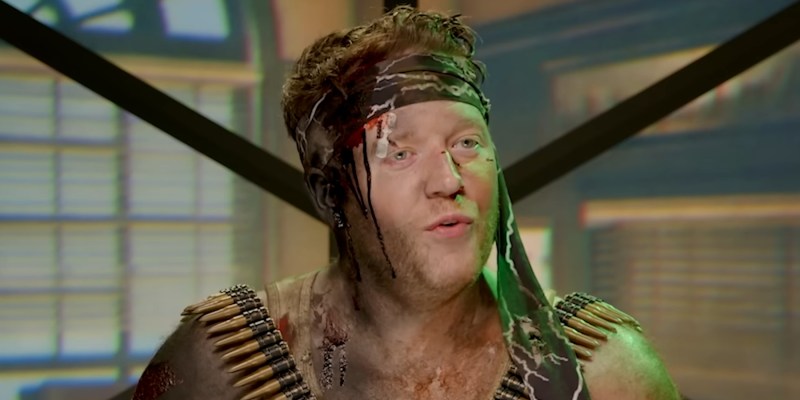
One of my favorite things about Dimension 20 is the way it hops between genre and style so often. Never Stop Blowing Up gets to escalate the tone in a way that even shows like Mentopolis or A Crown of Candy don’t quite reach. From your perspective, how did the tone of Never Stop Blowing Up differ from previous seasons?
That’s a great question. To me, there are a couple things about tone. Number one, I think my favorite part of working with tone is understanding that genre is a little bit separate from tone. Genre is sort of about these larger categories of storytelling tropes and themes. Tone actually can be exhibited in a bunch of different ways. I talk about Casablanca as a North Star for me, of a story that’s within a genre but occupies so many different tones. There’s romance, there’s intrigue, there’s screwball comedy, there’s moments of horror, suspense, tension. It’s political, but it’s human. There’s heartbreak and betrayal and sorrow.
It’s got it all, and it feels human. I think we can point to a lot of movies that occupy a single tone throughout, and there’s a word for that: Monotone. And it’s not a positive word, right? I think that the idea in the stories I tell, moving from tone to tone, is a way to make something more grounded, not less grounded. That’s human life. Some storytellers would anchor firmly in a tone.
My real life experience tells me that tone is fluid. I have been in rooms where we are losing a family member, and there is weeping and sorrow, and then someone will say something, and everyone will laugh. Tone in real life is very malleable, and people move through emotions from context to context, sometimes quite quickly. Groundedness, to me, is also a measure not of boring, logistical rules. Goundedness is not a measure of what is and is not possible, or what is and is not surreal. As someone who went to film school, I watched short films in which all of the things that happened were plausible — and the movie did not feel real. It did not feel true.
Some of those movies were about things the filmmaker had actually lived through, and there was something fake about it. You go, ‘this is not rendered in a grounded way.’ I’ve seen other stories that were total flights of fancy, phantasmagoria, supernatural, fantastical. Characters are talking pieces of furniture, or they’re magical creatures, and their emotional relationship to the events of their life is so centered and truthful to their point of view. That’s groundedness to me. Groundedness is the character being centered in an emotional worldview that remains consistent. They have a true north star, even as their circumstances are fanciful and surreal. That’s groundedness to me.
We’ve seen so many settings in Dimension 20 — what setting would you be most excited to return to?
Oh my gosh, what would I love to return to? I think honestly, the answer is so many of them. There are so many wonderful things I’d love to go back to. I would love for the show and for myself as a player, selfishly, to go back to Aabria’s A Court of Fey and Flowers world. I would love as a player to go back to her Misfits & Magic world.
I’d love for a chance to go back Starstruck Odyssey and the AnarchEra or Calorum. I think I’ve always had a place in my heart for Spire. For the side-quests, going back to the world of Mice and Murder at some point… so the answer is all of them. I’m greedy. I want to go back to all of them as much as I can.
Which player would you say surprised you the most this season?
I think going around the table, every single person had a moment of catching me truly by surprise. I think Iffy is one of the best tabletop storytellers of all time. His decision fundamentally built a world-building plank of the world, and it let Vic and Wendell have this relationship. That’s a gift, not only to me as a GM, but to all his fellow players. You can see it in Reika’s moment of having G 13 take over Usha, right?
Because you can see that play between the players, and that’s real collaborative world-building. Beardsley’s embrace of being that plot-hound character was so delightful to watch. That big swing Jacob took with a deep, emotional scene with Wolfman Ann, digging into that. I think Alex having Kingskin and Liv rebel against the other players at a certain point was so wonderful.
Honestly, this season is in so many ways a love letter to Izzy, whose favorite genre is action comedy. For me, watching them stabbing people with the Washington Monument, watching my incredible partner get to go so unhinged and find the absolute apex of reality, to the point where both of us are just dying with laughter — everyone had moments this season that just surprised me. That took me off my feet. It was wonderful.
All ten episodes of Dimension 20: Never Stop Blowing Up (as well as all other previous seasons) are now streaming on Dropout.
 TVBrittanyF.com